The Tabernacle and Temple
The Story of God Dwelling among Humanity
For every brother and sister asking why God needs a house. He does not. But he longs so deeply to draw near to us.
1. Why Does God Want a Dwelling?
One sentence in Exodus unlocks the meaning of both tabernacle and temple:
“Let them make me a sanctuary, that I may dwell among them.” (Exodus 25:8)
Notice the direction: God does not ask that they come to him, but that he dwell among them. From heaven to earth, from God to humanity: this is Scripture's heartbeat. God keeps moving towards us.
Eden was the beginning of God dwelling with humanity. After Adam and Eve sinned, humanity was expelled and a fracture opened between heaven and earth. The tabernacle and temple were God's bridge across that fracture. Through an arrangement he established, a sinful people could still live in the presence of the holy God.
Hebrew gives the tabernacle two names. מִשְׁכָּן (mishkan) means dwelling, emphasising that God has settled among his people. אֹהֶל מוֹעֵד (ohel mo'ed) means tent of meeting, emphasising the place where God and humanity meet. Presence and fellowship together form a miniature picture of the gospel.
2. The Tabernacle's Layout
The tabernacle was a portable sanctuary that could be dismantled and carried through Israel's forty wilderness years. From outside to inside, it had three levels. Each brought a person nearer God's presence, but imposed stricter conditions of entry.
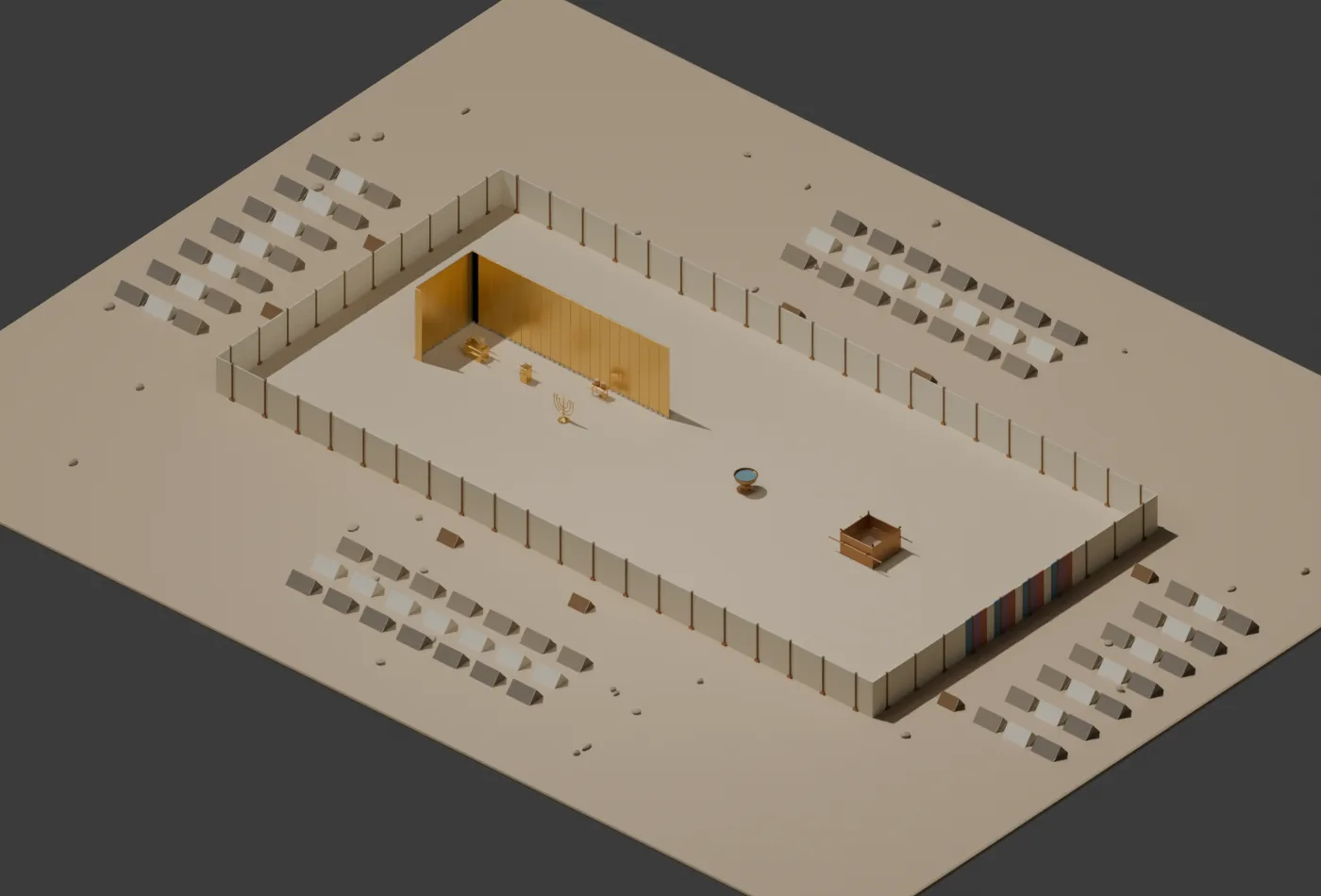
The 3D tabernacle in Scripture Trove's Bible Geography, shown with outer walls cut away. Rotate and zoom to inspect each furnishing, or walk in first person from the courtyard through the Holy Place into the Most Holy Place. Open the 3D tabernacle →
The Courtyard
The courtyard was a rectangle approximately 45 metres long and 22 metres wide, enclosed by fine linen curtains, with a single east-facing entrance. Any Israelite could enter to offer sacrifice. It contained two furnishings:
- The altar of burnt offering: the first object encountered was a large bronze-covered altar. All sacrifices took place here. Without blood atonement, humanity could go no further. The tabernacle's first lesson was that drawing near to God costs a life.
- The bronze basin: priests had to wash their hands and feet in this large water basin before entering the Holy Place (Exodus 30:18–21). Cleansing was a prerequisite, not an option.
The Holy Place
The Holy Place formed the tent's front section, entered only by priests. It held three furnishings:
- The gold lampstand, or menorah: made of pure gold, its seven lamps provided the only light. They had to be tended continually from evening to morning (Leviticus 24:2–4). Without windows, the sanctuary would otherwise be completely dark.
- The table of showbread: twelve loaves represented the twelve tribes, replaced each Sabbath (Leviticus 24:5–9). God's table always held a place for his people.
- The gold incense altar: immediately beside the veil into the Most Holy Place, it received incense morning and evening (Exodus 30:7–8). Rising smoke symbolised prayers ascending before God (Psalm 141:2; Revelation 5:8).
The Most Holy Place
The Most Holy Place, Hebrew קֹדֶשׁ הַקֳּדָשִׁים (qodesh haqqodashim), literally holy of holies, was the innermost square space, separated by a thick veil. This was the heart of God's presence, the holiest few cubic metres on earth. On ordinary days, nobody could enter. Only the high priest entered on the annual Day of Atonement, carrying blood as prescribed.
It held one furnishing: the ark of the covenant. This acacia-wood chest, covered in gold inside and out, contained the two tablets of the Ten Commandments, a jar of manna and Aaron's budding staff (Hebrews 9:4). Its cover was the כַּפֹּרֶת (kapporet), called the mercy seat in the Chinese Union Version, more precisely the atonement cover. The high priest sprinkled sacrificial blood upon it. Two gold cherubim stood at its ends with touching wings. God said, “There I will meet with you” (Exodus 25:22).
The journey from courtyard to Most Holy Place portrays sinners approaching the holy God step by step: blood atonement, cleansing water, walking in light, a place at God's table, prayer before the veil and, finally, the heart of his presence.
Another detail is often overlooked. God's instructions for building the tabernacle form seven speeches, each introduced by his speaking to Moses (Exodus 25:1; 30:11, 17, 22, 34; 31:1, 12), corresponding to creation's seven days. The tabernacle is more than an ordinary tent: it is a miniature Eden. The lampstand resembles the tree of life; cherubim guard the Most Holy Place as they guarded the way to that tree; cherubim are woven into the veil (Exodus 26:31). At Sinai's foot, God rebuilt an Eden. Although sin lost humanity paradise, he recreated among his people a space joining heaven and earth.
3. The Day of Atonement: The Year's Most Solemn Day
Leviticus 16 describes the Day of Atonement, Hebrew יוֹם כִּפּוּר (Yom Kippur). This ceremony gives the Old Testament's most concentrated picture of dealing with sin.
The high priest removed his splendid garments and wore plain white linen, entering the Most Holy Place alone. First he offered a bull as a sin offering for himself and his household. Then came two male goats. One was killed; its blood was carried inside and sprinkled on the mercy seat to atone for the people. The other was the goat for Azazel, עֲזָאזֵל (azazel). The high priest laid his hands on its head, confessed Israel's sins and transgressions, then sent it into the wilderness (Leviticus 16:20–22). One goat's blood covered sin; the other carried sin away.
The ceremony's tension was real. According to later Jewish tradition, a rope was tied to the high priest's foot as he entered, so that if he collapsed inside, those outside could pull him out without anyone daring to enter.
Looking back, Hebrews makes an astonishing declaration about Christ: “…nor yet through the blood of goats and calves, but through his own blood, entered in once for all into the Holy Place, having obtained eternal redemption” (Hebrews 9:12). The Day of Atonement repeated annually because animal blood could not truly remove sin. Christ offered himself once and accomplished it completely.
4. Solomon's Temple: The First Temple
After entering Canaan, Israel set up the tabernacle at Shiloh, then moved it through various places. After uniting the kingdom and establishing Jerusalem as its capital, David wanted to build God a permanent house. God's surprising answer assigned this task to David's descendant: “He will build a house for my name” (2 Samuel 7:12–13). God refused David's proposal but gave a greater promise: his descendant would occupy an everlasting throne. That promise ultimately points to Jesus Christ.
Solomon, David's son, built the temple over seven years, approximately 966–959 BC. Its layout followed the tabernacle—courtyard, Holy Place and Most Holy Place—but on a far greater scale. The Holy Place was about 18 metres long. The Most Holy Place was a cube about 9 metres per side, its inner walls entirely covered in gold (1 Kings 6:20–22). It housed the ark beneath two enormous olive-wood cherubim whose wings stretched from wall to wall.
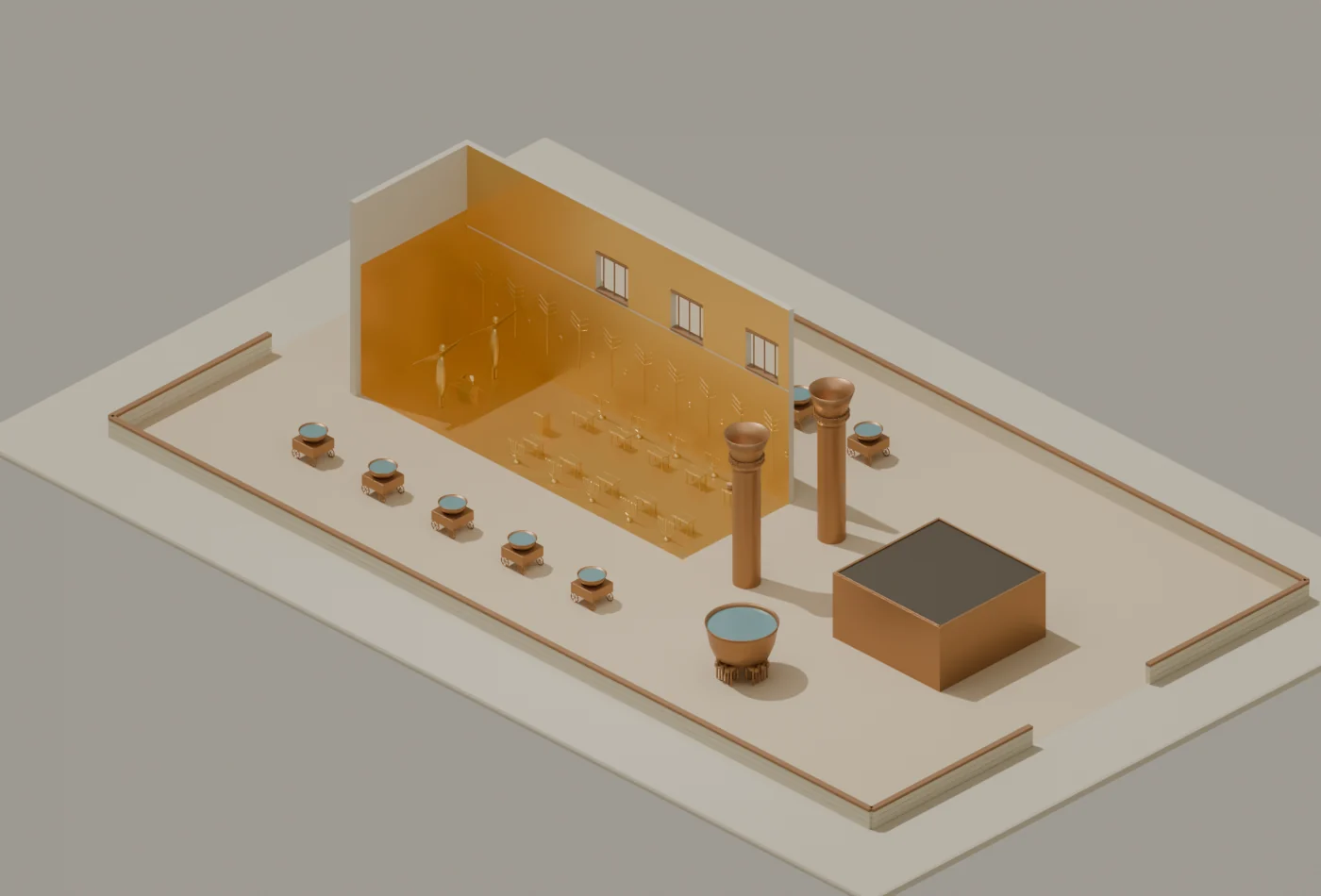
Solomon's temple in Scripture Trove's Bible Geography, shown with walls cut away: the bronze pillars Jachin and Boaz stand before the house, while the courtyard holds the bronze altar, bronze sea and ten bronze basins. Rotate to inspect it or walk inside. Open the 3D temple →
On dedication day, as the priests came out, God's glory filled the house, so that they “could not stand to minister” (1 Kings 8:10–11). Heaven and earth's sovereign descended into a building made by human hands: one of Israel's most glorious moments.
Solomon's prayer is deeply moving. Knowing that “heaven and the heaven of heavens can’t contain you; how much less this house that I have built!” (1 Kings 8:27), he nonetheless asked God to hear every prayer there: confession, disputes, defeat, drought, plague and even foreigners' prayers (1 Kings 8:41–43). From the beginning, this temple was more than Israel's alone. Its doors opened towards all nations.
Yet its splendour did not last. Solomon followed his foreign wives' idols in old age. The kingdom divided, and Judah's kings alternated between faithfulness and betrayal. In 586 BC, Nebuchadnezzar of Babylon captured Jerusalem and burned the temple. The ark's whereabouts became unknown. God's glory had already departed before destruction: Ezekiel saw it rise from the cherubim, move from the threshold to the east gate, and finally leave (Ezekiel 10:18–19; 11:23).
5. The Second Temple: From Ruins to Splendour
Zerubbabel's Rebuilding
After Cyrus of Persia permitted Jewish exiles to return, Zerubbabel led the first returnees in rebuilding the temple, completed around 516 BC. When its foundations were laid, younger people cheered, but older people wept loudly. They remembered the first temple's splendour; this seemed painfully modest (Ezra 3:12–13). Sadder still, the Most Holy Place stood empty. The ark never returned.
Jewish tradition, in the Babylonian Talmud, Yoma 21b, lists five things absent from the second temple: the ark and mercy seat; heavenly fire; God's visible glorious presence, שְׁכִינָה (Shekinah); the Holy Spirit's inspiration; and the Urim and Thummim, by which the high priest sought God's will. The building's shell had returned, but the central signs of direct communion with God were missing. In a sense, that empty inner sanctuary pictured God's silence throughout the intertestamental period.
Yet through Haggai, God gave an exciting promise: “The latter glory of this house will be greater than the former” (Haggai 2:9). Nobody could then understand it, until a Nazarene entered that temple more than five hundred years later. All five absences found their answer in him: he was the new ark, God's Word made flesh; heavenly fire, with the Spirit descending upon him; God's visible glory, for “We saw his glory” (John 1:14); the Spirit's fullness; and the ultimate revelation of God's will.
Herod's Magnificent Expansion
Herod the Great began expanding the second temple in 20 BC. A political project and architectural wonder, it nearly doubled the Temple Mount's area and created an immense platform. Some foundation stones survive as today's Western or Wailing Wall. The outer court accommodated tens of thousands. The disciples marvelled, “Teacher, see what kind of stones and what kind of buildings!” (Mark 13:1). Josephus describes its golden brilliance in sunlight and its resemblance from a distance to a snow-covered mountain.
The entire project was not finished until AD 64, just six years before destruction.
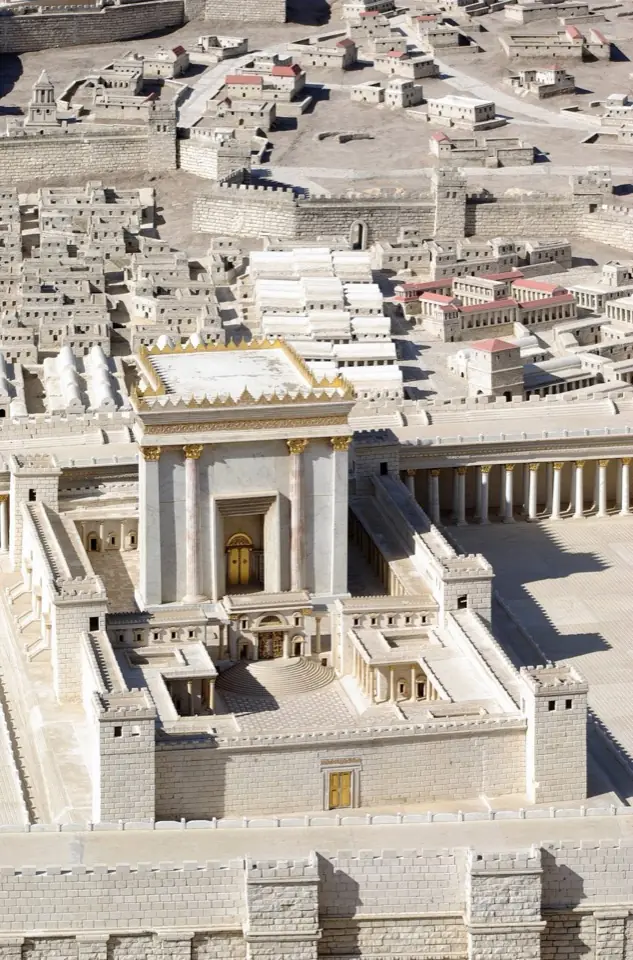
The Israel Museum's 1:50 model reconstructs Jerusalem as it appeared in AD 66. Herod's expanded temple stands at its centre. This was the building about which the disciples marvelled at the stones and buildings (Mark 13:1). Source: Jerusalem Modell BW 3.JPG, Berthold Werner, public domain. View this exhibit in the Bible Museum

Jesus and the Temple
Jesus' relationship with the temple is full of meaning. Forty days after birth he was brought there (Luke 2:22). At twelve, among its teachers, he asked, “Didn’t you know that I must be in my Father’s house?” (Luke 2:49). During his public ministry, he cleansed it twice (John 2:13–17; Matthew 21:12–13), overturning money-changers' tables and saying, “My house shall be called a house of prayer,” but “you have made it a den of robbers!”
The most startling moment comes in John 2:19. Challenged about his authority, Jesus answers, “Destroy this temple, and in three days I will raise it up.” His questioners think he means Herod's temple: “It took forty-six years to build this temple! Will you raise it up in three days?” John explains: “But he spoke of the temple of his body” (John 2:21).
Jesus is more than someone worshipping God in the temple. He is the temple itself, the ultimate fulfilment of God dwelling with humanity.
6. The Torn Veil: The End of the Old Arrangement
Matthew, Mark and Luke all record the temple veil tearing during Jesus' passion:
“…the veil of the temple was torn in two from the top to the bottom.” (Matthew 27:51)
This was no ordinary cloth. According to Jewish tradition, it was a handbreadth thick, about 10 centimetres, and needed three hundred priests to move it. It separated the Most Holy Place from the outside world, the impassable barrier between God's holiness and human sin.
It tore from top to bottom: the movement began from God's side. Humanity did not break through. God himself tore open the curtain.
Hebrews explains the meaning: “Having therefore, brothers, boldness to enter into the holy place by the blood of Jesus, by the way which he dedicated for us, a new and living way, through the veil, that is to say, his flesh” (Hebrews 10:19–20). Christ's body was torn, and so was the veil. Every person trusting him may now approach God directly, confidently and at any time. No priestly intermediary, annual wait for Atonement Day or animal blood is needed.
In AD 70, the Roman general Titus captured Jerusalem and the second temple burned to ashes. Since then, Jewish people have had no temple and cannot offer sacrifices. For Christians, however, its mission has been fulfilled: the true temple has come.
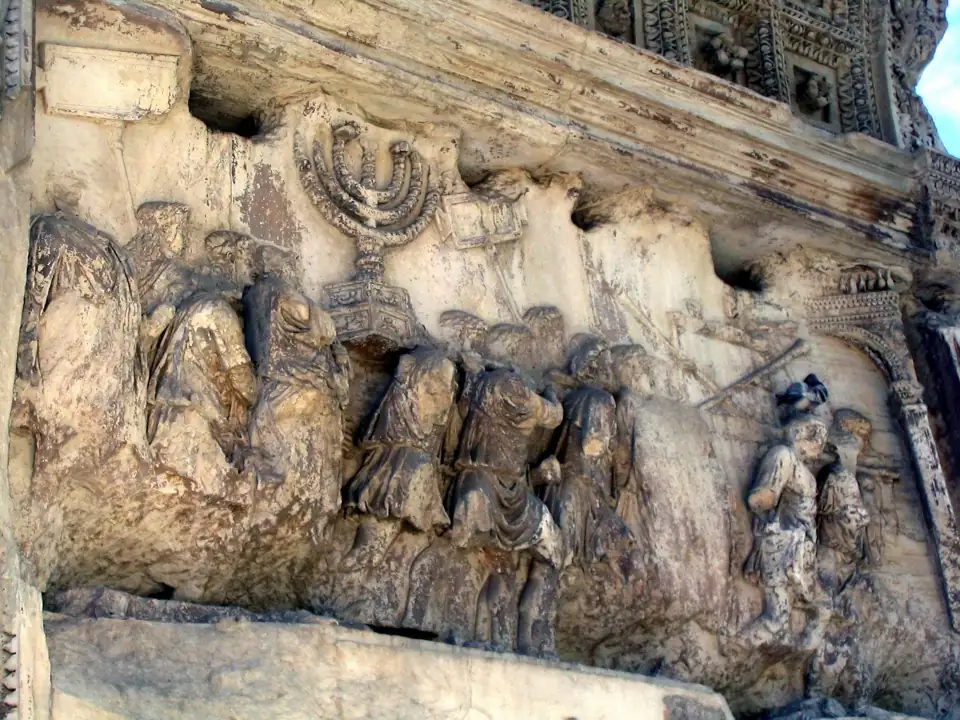
The relief inside Rome's Arch of Titus shows soldiers parading the temple's captured gold lampstand in triumph. The arch was completed after Titus died in AD 81, commemorating his capture of Jerusalem. Source: Arch of titus relief 2.jpg, Anthony M., CC BY 2.0. View this exhibit in the Bible Museum

7. From Tent to Eternity: God Dwelling with Humanity
John opens his Gospel by saying, “The Word became flesh and lived among us” (John 1:14). The Greek behind lived, σκηνόω (skēnoō), literally means pitching a tent. John is saying Jesus is the new tabernacle. God has again pitched his tent among humanity, this time through flesh and blood rather than acacia wood and gold.
This thread runs throughout Scripture:
- Eden: God walks face to face with humanity (Genesis 3:8).
- The tabernacle: he dwells among Israel, but behind a veil (Exodus 25:8).
- The temple: his glory fills a permanent building (1 Kings 8:11).
- The incarnation: he personally becomes human and lives among us (John 1:14).
- Believers' bodies: “your body is a temple of the Holy Spirit” (1 Corinthians 6:19).
- The church: “in whom you also are built together for a habitation of God in the Spirit” (Ephesians 2:22).
- The new heaven and earth: “Behold, God’s dwelling is with people; and he will dwell with them” (Revelation 21:3).
In Revelation's final vision, John sees the new Jerusalem descending from heaven and writes something astonishing: “I saw no temple in it, for the Lord God the Almighty and the Lamb are its temple” (Revelation 21:22).
A temple is no longer needed. God has not departed; quite the opposite. No barrier remains between him and humanity. No veil will hang again and no separation return. God and humanity finally dwell face to face, as in Eden, yet more beautifully, deeply and eternally.
Conclusion: You Are God's Temple
If you trust Christ, Paul tells you something awe-inspiring: your body is the Holy Spirit's temple (1 Corinthians 6:19).
Only the high priest could enter the ancient Most Holy Place, once a year. Now the God who dwelt there lives within you.
You need no special location to meet God, no special day to draw near, and no human intermediary to relay your prayers. From tabernacle to temple, temple to Christ, and Christ to you, God has continually moved towards you.
The ultimate hope still lies ahead. One day, in the new heaven and earth, we will see him face to face (Revelation 22:4). The story begun in Eden will reach its perfect conclusion: God and humanity dwelling together for ever.