Daily Life in Jesus' Era
— Homes, Food, Clothing, and Work in First-Century Palestine
Written for every brother and sister who reads the Gospels and wonders, "What was it actually like back then?" Jesus' parables are not fables: they were drawn from the real life unfolding all around him.
I. Why Does Everyday Life Matter?
Jesus never taught in abstractions. Every parable he told was drawn from things his listeners could see and touch every single day: seeds, yeast, fishing nets, flocks of sheep, oil lamps, silver coins, vineyards.
The problem is, we no longer live in that world.
When Jesus says, "Whoever strikes you on your right cheek" (Matt. 5:39), modern readers simply move on. But first-century listeners would have reacted immediately: to strike someone's right cheek with the right hand requires a backhand slap. In Jewish law, striking someone with the back of the hand carried double the fine of an open-handed blow, because it was a slap of contempt. Jesus was not talking about what to do when someone beats you up — he was talking about how to respond when someone humiliates you.
When Mark records that they “removed the roof” and “let down the mat that the paralytic was lying on” (Mark 2:4), modern readers find this hard to picture. But if you know that first-century Palestinian rooftops were flat surfaces made of wooden beams, branches, and packed mud, and that families used their rooftops as terraces and workspaces, then "breaking through the roof" doesn't mean demolishing reinforced concrete — it means pulling apart a layer of mud and branches. Bold? Yes. Technically impossible? Not at all.
Understanding everyday life transforms you from someone who reads the story to someone who enters it.
II. Houses — What Was a Home Like in Jesus' Time?
The Ordinary Person's House
A typical village house in first-century Galilee or Judea looked something like this:
- Materials: locally quarried stone (roughly cut and stacked) for the walls; wooden beams laid across the walls, topped with branches, reeds, and compacted mud to form the roof
- Size: very small — typically a single main room (roughly 20–40 square metres) where the whole family ate, lived, and slept
- Floor: packed earth; wealthier households might lay stone slabs
- Light: no windows, or only very small ones (for warmth and security), making the interior quite dark; oil lamps provided the light
- Animals: many homes had a sunken area at one end, lower than the main floor, where livestock (a donkey, sheep) were brought in at night — humans and animals sharing the same space was completely normal
- Roof: flat, with an external stairway leading up. The roof was used for drying grain, taking the air, prayer, and even sleeping
With this picture in mind, several passages come suddenly alive:
Breaking through the roof to lower the paralyzed man (Mark 2:4): Four friends climbed the external stairway, pulled apart the mud-and-branch roof, and lowered the man down to Jesus. Outrageous? Certainly. But not technically difficult.
Putting a lamp under a basket (Matt. 5:15): In a single-room house with hardly any windows, one oil lamp could light the entire space. When Jesus says "put it on the lampstand, and it gives light to everyone in the house" — one lamp for the whole household — that is no exaggeration.
Don't come down from the housetop (Mark 13:15): When Jesus foretells the destruction of Jerusalem, he warns that those on the rooftop should not come down to take anything. Because the roof had its own external stairway, you could run straight from the rooftop without ever going through the house.
The friend who knocks at midnight for bread (Luke 11:5–8): In the parable, "Friend, lend me three loaves," the man who has already gone to bed says, "The door is now shut, and my children are in bed with me." One room, the whole family squeezed in together — opening the door would indeed disturb everyone.
The Wealthy Person's House
Better-off households and upper-class urban homes were far larger, typically built around a central courtyard:
- The courtyard was the hub of daily life: cooking, washing, receiving guests all happened there
- There would be a dedicated guest room (kataluma — the "inn" in Luke 2:7 may actually refer to a guest room in a relative's home)
- There would be an upper room (hyperōon — the "upper room" in Acts 1:13 where the disciples gathered)
- A banquet hall could accommodate many guests reclining to eat
In Luke 7:36–50, when Jesus dines at the home of Simon the Pharisee, a "woman who was a sinner" is able to walk in and wash his feet with her tears — this was not breaking and entering. At a first-century dinner party, the door was left open: the poor and passersby could stand at the entrance watching the feast, or even step to the edge of the courtyard to pick up leftover scraps. That woman walked in through an open door.
III. Food — What Did People Eat in Jesus' Time?
Staple Foods
The diet of first-century Palestinians was built on three foundational crops: grain, olives, and grapes — what Scripture calls "grain, new wine, and oil" (Deut. 7:13):
- Bread: the absolute daily staple. A homemaker would rise early every morning to grind grain on a stone mill, knead the dough, and bake. Loaves were typically flat rounds — unleavened or lightly leavened — torn apart rather than sliced (the origin of "breaking bread")
- Olive oil: used for cooking, lamp fuel, skin care, and medicine — almost universally useful. The Good Samaritan treated the wounded man's injuries with oil and wine (Luke 10:34)
- Grapes and wine: fresh grapes, raisins, grape cakes (pressed and dried for storage), and wine were all everyday foods. Wine was normally diluted with water before drinking
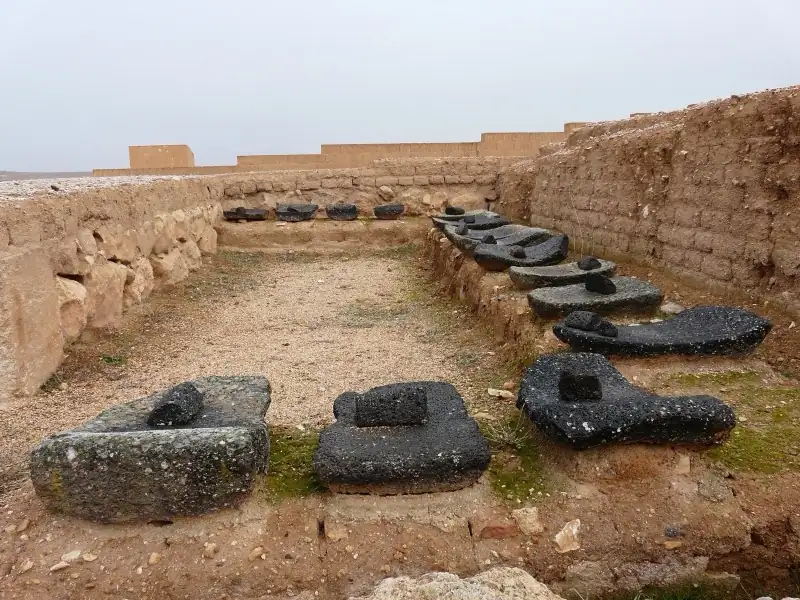
A saddle quern preserved in place at Ebla in Syria. A person knelt in front of the stone and pushed a smaller grinding stone back and forth over the grain. This method of grinding flour was used in the Near East for thousands of years. Source: Ancient Saddle Querns and Grinding Stones in situ at Ebla…, Ywpark2003, CC0. See this exhibit in the Bible Museum

Secondary Foods
- Legumes: lentils, chickpeas — the working poor's main source of protein. Esau sold his birthright for a bowl of red lentil stew (Gen. 25:34)
- Vegetables: cucumbers, leeks, onions, garlic — the very things the Israelites in the wilderness longed for from Egypt (Num. 11:5)
- Fruit: figs, pomegranates, dates — the fig tree appears repeatedly in Scripture as a symbol of peace and security (Mic. 4:4)
- Fish: a crucial source of protein for communities around the Sea of Galilee. The "two fish" in the feeding of the five thousand (John 6:9) were salted or dried small fish
- Meat: ordinary people rarely ate meat — it was food for festivals and celebrations. The father in the parable of the prodigal son kills the "fattened calf" (Luke 15:23), signalling that this was a truly extraordinary occasion
- Honey: the natural sweetener. John the Baptist in the wilderness ate "locusts and wild honey" (Matt. 3:4)
- Dairy: goat's milk, cheese
Dietary Rules
Jewish people observed the dietary purity laws from the Law of Moses (Leviticus 11):
- Land animals: only those that have split hooves and chew the cud (cattle and sheep — yes; pigs and camels — no)
- Water creatures: only those with fins and scales (most fish — yes; shrimp, crabs, shellfish — no)
- Birds: birds of prey and carrion birds are forbidden
The Pharisees added a large body of oral tradition on top of these rules — for instance, the requirement to wash hands before eating in a specific ceremonial way (not for hygiene, but for ritual purity). Mark 7:1–5 records the Pharisees challenging Jesus' disciples for eating with "unwashed hands." Jesus' response cut straight to the heart of the matter:
"There is nothing from outside of the man that going into him can defile him; but the things which proceed out of the man are those that defile the man." (Mark 7:15)
Table Manners
Ordinary people ate two main meals a day: a light morning meal (bread dipped in olive oil, or bread with olives), and a more substantial evening meal.
At formal dinner parties, the posture for eating was not sitting upright on chairs as we do today, but reclining on cushions: leaning on the left elbow, eating with the right hand. This is why John 13:23 describes John as reclining next to Jesus — they were side by side, and John only had to lean back to be close to Jesus.
In Luke 7:38, the sinful woman could stand "behind" Jesus and weep at his feet: because Jesus was reclining, his feet extended toward the back, and the woman did not need to go around to the other side of the table.
IV. Clothing — What Did People Wear in Jesus' Time?
Basic Dress
First-century Jewish dress consisted of several layers:
- The inner garment (χιτών, chitōn; Hebrew כְּתֹנֶת, kethoneth): a full-length tunic worn next to the skin, usually woven from linen or wool, reaching to the knees or ankles. This was the most basic piece of clothing. Working at home wearing only the tunic was perfectly normal, but going out in only a tunic was considered the same as going about "naked"
- The outer garment (ἱμάτιον, himation; Hebrew שִׂמְלָה, simlah): a large square of fabric draped over the tunic, serving as a coat by day and a blanket by night. The Law of Moses required that if someone's outer garment was taken as a pledge, it must be returned before sunset (Exod. 22:26–27), because it might be the only "blanket" that person had
- The belt: worn around the tunic to gather it up, enabling work and free movement. "Girding up one's loins" meant getting ready for action: 1 Pet. 1:13 — "gird up the loins of your mind" — draws on exactly this image
- Sandals: simple leather sandals tied to the feet with straps. John the Baptist said he was not worthy to "stoop down and loosen" Jesus' sandal straps (Mark 1:7) — untying sandals was a slave's task, and John was saying he was not even fit to be Jesus' slave
The Tassels
Devout Jewish men attached tassels (צִיצִית, tzitzit) to the four corners of their outer garments — a requirement of the Law (Num. 15:38–39) meant to remind them to keep God's commandments.
In Matthew 9:20, the woman who had suffered from hemorrhaging for twelve years reached through the crowd to touch the fringe of Jesus' outer garment. She was not randomly grabbing at the hem of his robe — she was touching the fringe that symbolized the Law and authority of God.
Jesus criticized the Pharisees for "making their phylacteries wide and enlarging the fringes of their garments" (Matt. 23:5): they had turned signs of faith that were meant to remind themselves into decorative displays of outward piety.
Foot Washing
A day of walking on dusty stone paths in open sandals left feet dirty and sore. Washing a guest's feet when they entered your home was a basic act of hospitality — normally performed by a servant or the lowest-ranking member of the household.
This is why it was so staggering when Jesus personally washed his disciples' feet at the Last Supper (John 13:1–17). He was the rabbi, the Lord — yet he performed the most menial act of the most lowly servant. Peter's reaction is entirely understandable: "You will never wash my feet!" (John 13:8)
V. Work — How Did People Make a Living in Jesus' Time?
1. Farming — The Livelihood of Most People
Roughly 90% of the population in first-century Palestine depended on agriculture. Jesus drew more material from farming than from any other occupation:
Sowing seed (Matt. 13:3–9): A farmer would scatter seed across the ground by hand (not plant it one grain at a time), then turn the soil with a plough to cover it. Seed fell on the path, on rocky ground, among thorns, and on good soil — this was not because the farmer scattered carelessly, but because Palestinian fields simply looked like this: footpaths ran through the fields, rocks broke the surface, thorns grew at the edges.
Harvest (Matt. 13:24–30): At harvest time, grain stalks were cut with a sickle, bundled into sheaves, and hauled to the threshing floor. Threshing floors were usually on high, open ground near the village (to catch the wind), where oxen dragged a threshing sledge over the grain. The crushed grain was then winnowed: tossed into the air so that the wind blew away the light chaff while the heavier kernels fell back to the ground. When John the Baptist said that the Messiah holds a "winnowing fork" to "thoroughly cleanse his threshing floor" (Matt. 3:12), his listeners understood in an instant.
The vineyard (Matt. 20:1–16): Grape cultivation required enormous labour: pruning, training on trellises, guarding (against foxes and thieves), harvesting, and treading to press the juice. Jesus' parables about vineyards reflect the common day-labour system of the time: the landowner went to the marketplace — the open square by the city gate — at dawn to hire workers, who were paid at the end of the day.
Yeast (Matt. 13:33): "The Kingdom of Heaven is like yeast, which a woman took and hid in three measures of meal, until it was all leavened." Three measures of meal is roughly twenty-two litres — a considerable quantity, enough to feed a large family for several days. A woman kneading dough and baking bread at home every day was the most ordinary thing imaginable. Jesus tucked the kingdom of heaven into the kitchen bread bowl.
2. Fishing — The Backbone of the Galilean Economy
The fishing industry on the Sea of Galilee was a major part of the local economy. Several of Jesus' core disciples were fishermen: Peter, Andrew, James, and John.
First-century fishermen used three main methods:
- The cast net (Matt. 4:18): a circular hand-thrown net with lead weights around its edge; when cast, it spread across the water in a circle, sank, and trapped fish underneath
- The dragnet (Matt. 13:47–48): a large net operated by several men or two boats working together, dragging it through the water — "the Kingdom of Heaven is like a net cast into the sea, gathering all kinds of fish"
- Hook and line: Matt. 17:27 — Jesus tells Peter to cast a hook, and the first fish he catches has a coin in its mouth to pay the temple tax
Fishing was typically done at night (fish are more active after dark and more easily caught in nets), while daytime was spent on shore mending nets, cleaning them, and setting them out to dry. This is why, in Luke 5:5, Peter says "Master, we worked all night and caught nothing" — fishing through the night was their regular routine.
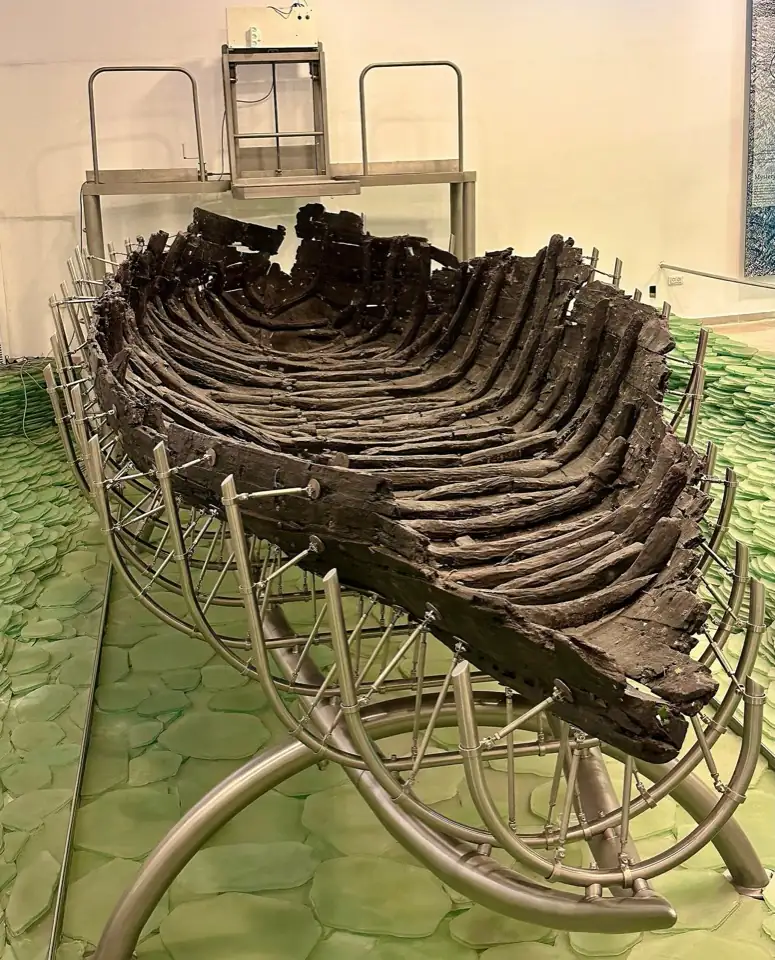
This wooden boat was discovered in the lakebed mud when the Sea of Galilee's water level fell sharply in 1986. It dates to around the first century BC to the first century AD, is about eight metres long, and is now housed at the Yigal Allon Centre beside the lake. The fishing boats used by Jesus and his disciples probably looked something like this. Source: Ancient Boat of Sea of Galilee.jpg, Warfieldian, CC BY-SA 4.0. See this exhibit in the Bible Museum

3. Crafts and Trades
Jesus himself is called tekton (τέκτων, Mark 6:3), translated in many Bibles as "carpenter," but the word more precisely means a craftsman in construction — working with both wood and stone. In Galilee, where stone was the primary building material, Jesus very likely worked in stone-cutting and masonry as well.
Near Nazareth lay the Greek-style city of Sepphoris, then under active construction — just six kilometres away. Many scholars suggest that Jesus and Joseph may well have worked there as builders.
Other common trades included:
- Potters (Jer. 18:1–6): God shapes his people as a potter shapes clay
- Tanners (Acts 9:43): Peter stayed with Simon the tanner in Joppa. Tanning (curing leather) involved handling animal carcasses and was considered an unclean occupation; tanneries had to be located outside the city
- Weavers and dyers: Lydia was a dealer in purple cloth (Acts 16:14)
- Stonemasons: the Temple and the growing cities required vast numbers of skilled stone workers
4. Shepherding
Shepherding had been part of Palestinian life for thousands of years. Jesus used the image of the Good Shepherd to describe himself (John 10:11–18), and for his listeners this was a vivid, concrete picture.
Several features defined shepherding in first-century Palestine:
- A shepherd walked ahead of the flock to lead them (John 10:4) — not driving them from behind as on a Western ranch
- Shepherd and sheep had a personal relationship: the shepherd knew each sheep individually, gave them names, and the sheep recognized the shepherd's voice (John 10:3)
- At night, the shepherd herded the sheep into a sheepfold (an open-air enclosure of stacked stones) and slept across the entrance, serving as the "door" — "I am the door" (John 10:9) was a literal, living reality
- If a single sheep went missing, the shepherd would leave the ninety-nine in the open country and go searching for the one (Luke 15:4) — not because the ninety-nine didn't matter, but because in open pastureland other shepherds could keep watch over them temporarily, while the lost sheep had to be found immediately or it would die
VI. The Synagogue — The Heart of the Village
By the time of Jesus, almost every village with ten or more Jewish families had a synagogue (συναγωγή, synagōgē).
The synagogue was not the Temple: there was only one Temple, in Jerusalem, and sacrifice could only be offered there. The synagogue was a local gathering place, with these main functions:
- Sabbath worship: reading from the Torah and the Prophets, expounding the text, prayer
- Education: boys from the age of five or six began learning to read the Hebrew Scriptures at the synagogue
- Community affairs: settling disputes, making announcements, hosting travellers
The order of a Sabbath service ran roughly as follows:
- Recitation of the Shema (שְׁמַע — "Hear"): "Hear, Israel: Yahweh is our God. Yahweh is one." (Deut. 6:4)
- Prayers (including the Eighteen Benedictions)
- Reading from the Torah (the Five Books of Moses were read through on a three-year or one-year cycle)
- Reading from the Prophets (a passage chosen to correspond to the Torah portion)
- A sermon/exposition: any adult male could be invited to come forward and explain the passage
Luke 4:16–21 records exactly this order during Jesus' visit to the Nazareth synagogue: he was handed the scroll of the prophet Isaiah, stood to read a passage, and then sat down to teach. Note: he was sitting — in the synagogue, standing was the posture for reading Scripture aloud, while sitting was the teacher's posture for preaching. When he sat down, "the eyes of all in the synagogue were fastened on him" — because everyone present knew: he was about to expound what he had read.
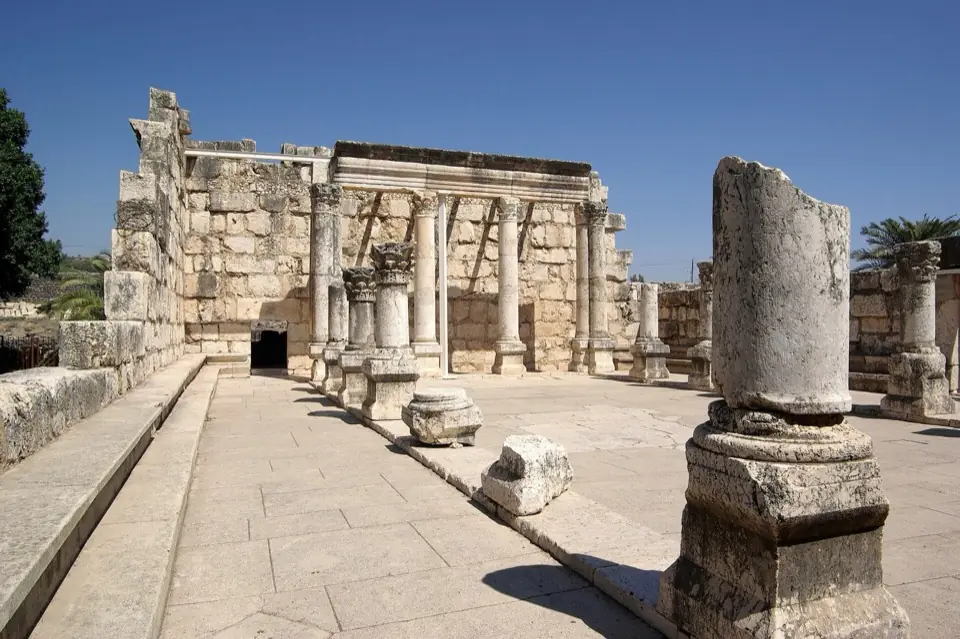
The white limestone synagogue at Capernaum was built around the fourth or fifth century. Archaeologists found earlier black basalt foundations beneath it; some scholars suggest these belonged to the synagogue of Jesus' time (Mark 1:21). The photograph mainly shows the upper, white synagogue. Source: Kafarnaum BW 20.jpg, Berthold Werner, public domain. See this exhibit in the Bible Museum

VII. The Sabbath — The Rhythm of the Week
The Sabbath (שַׁבָּת, Shabbat) begins at sundown on Friday and ends at sundown on Saturday.
The heart of the Sabbath is ceasing from work and worshipping God. In practice, this meant:
- On Friday afternoon, the whole household bustled to prepare the Sabbath food (no cooking was done on the Sabbath itself)
- Sabbath candles were lit before sunset
- The family ate the Sabbath evening meal together (usually more generous than a weekday meal)
- On Saturday morning, everyone went to the synagogue for worship
- Throughout the day, no activities classified as "work" were performed
The Pharisees enumerated 39 categories of forbidden activities (later codified in the Mishnah tractate Shabbat), including ploughing, reaping, threshing, sifting, kneading, baking, writing, building, and carrying. This is why Jesus' healings on the Sabbath repeatedly caused conflict: the Pharisees held that healing (unless there was immediate danger to life) constituted "work."
Jesus' response still echoes down through the centuries:
"The Sabbath was made for man, not man for the Sabbath." (Mark 2:27)
VIII. Clean and Unclean — A Classification System That Touched Everything
For first-century Jewish people, "clean" and "unclean" were not concepts of physical hygiene but ritual and religious categories — concerning whether a person was in a state that allowed them to draw near to God.
Common situations that rendered a person "ritually unclean" included:
- Touching a corpse (Num. 19:11): unclean for seven days
- Skin disease / leprosy (Lev. 13): until healed and examined by a priest
- A woman during menstruation and in the postpartum period (Lev. 12, 15)
- Contact with unclean animals
- Seminal discharge (Lev. 15:16)
Being unclean was not the same as sinning: most states of uncleanness were a normal part of life (burying a relative, giving birth). But a person in an unclean state could not enter the Temple or take part in certain religious rites; they had to undergo a prescribed waiting period and purification ritual (usually involving immersion and/or sacrifice) before being restored to a clean state.
Every village had an immersion pool (מִקְוֶה, mikveh): a stone-lined basin that collected living water (rainwater or spring water) for full-body ritual immersion. Archaeologists have uncovered large numbers of first-century mikveh remains across Israel.
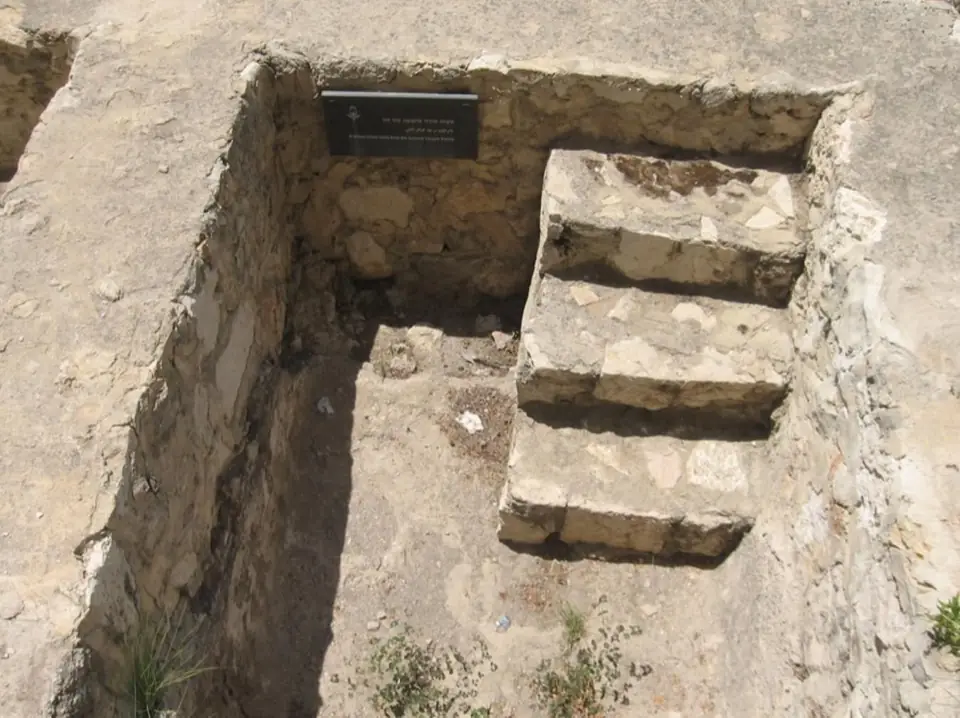
A stepped ritual immersion pool excavated south of Jerusalem's Temple Mount. People walked down the steps and immersed their whole bodies in the water to become ritually clean. Source: Mikvew near the temple mount in Jerusalem.jpg, Rdusatko, CC BY-SA 3.0. See this exhibit in the Bible Museum

With this system in mind, you can see how radically Jesus crossed the lines:
- He touched a leper (Mark 1:41): according to the Law, this would have made Jesus himself unclean
- He was touched by the woman with hemorrhaging (Mark 5:25–34): her chronic bleeding kept her in a permanent state of uncleanness
- He touched the dead (the widow of Nain's son, Luke 7:14)
- He ate with sinners and tax collectors
In every one of these encounters, the direction that the purity system prescribed was that uncleanness should pass from the unclean person to the clean. But Jesus reversed the flow: his cleanness passed to the unclean. The leper was cleansed. The hemorrhaging woman's bleeding stopped. The dead rose.
This was not Jesus disregarding the Law — it was him being the reality that the Law had always pointed toward: when the very source of cleanness came in person, impurity before him did not infect him — it was abolished by him.
IX. Silver Coins and Oil Lamps — The Background Behind Two Small Parables
The Parable of the Lost Coin (Luke 15:8–10)
"Or what woman, if she had ten drachma coins, if she lost one drachma coin, wouldn't she light a lamp, sweep the house, and seek diligently until she found it?"
These ten silver coins (drachmē) were almost certainly her dowry coins or the coins of a headdress: in first-century Palestine, married women often wore a headband strung with silver coins — the one piece of property that was entirely hers (not her husband's). Losing one was not merely a financial loss; it was losing part of her identity and honour.
She had to "light a lamp" to search because the house had no windows, or only tiny ones — even in daytime the interior was dim. She had to "sweep the house" because a packed-earth floor was full of cracks and hollows where a coin could easily disappear.
When she finds it, she calls her friends and neighbours: "Rejoice with me!" In a tight-knit village community, one family's joy belonged to the whole village.
Jesus is saying: God searches for you the way this woman searches for that one coin — lighting the lamp, sweeping every corner, not stopping until she finds it.
The Parable of the Ten Virgins (Matt. 25:1–13)
Ten young women with lamps go out to meet the bridegroom — this reflects the reality of a first-century Jewish wedding:
- The bridegroom set out from his own home on the wedding night to fetch the bride from her home
- The exact time of his arrival was unpredictable: he still had to complete final negotiations and rituals with the bride's father
- The bride's companions ("virgins") waited along the road holding their lamps; when the bridegroom arrived they would light them, join the procession, and escort the couple back to the groom's home for the wedding banquet
Their lamps were not the large lanterns we might picture — they were small clay oil lamps that fit in the palm of the hand: the wick lay in olive oil, and a single filling burned for only a few hours. If the bridegroom was delayed (in the parable he is "a long time in coming"), a lamp without reserve oil would simply go out.
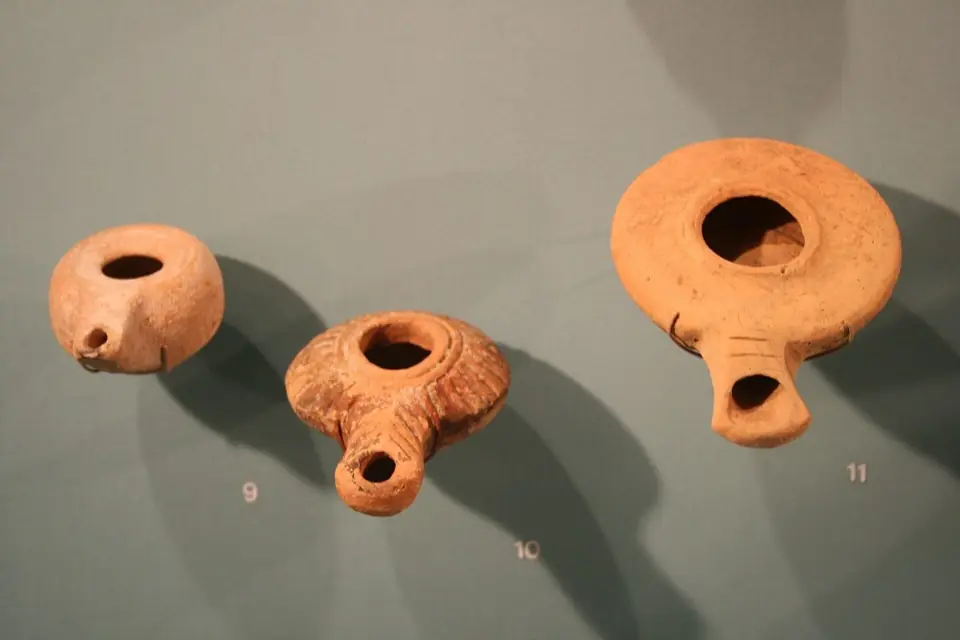
Three ancient clay oil lamps: number 11 on the right is a “Herodian lamp” of the kind common in Jesus' time, small enough to fit in the palm of a hand. The two on the left are earlier Hellenistic lamps. Source: Oil Lamps, -9-10 Hellenistic; -11 “Herodian”…, Gary Todd, CC0. See this exhibit in the Bible Museum

X. Theological Reflection: God Speaks in the Midst of Ordinary Life
Looking back over the daily life of Jesus' era, a profound truth comes into view: God has never spoken from outside ordinary life — he speaks right in the middle of it.
- Jesus did not explain the kingdom of heaven in philosophical terms — he used seeds and yeast
- He did not describe God's love in abstract language — he used a woman in a darkened house turning every corner inside out looking for a coin
- He did not explain his mission in theological concepts — he used a shepherd who walks ahead of the flock and sleeps across the sheepfold entrance at night
- He did not train his disciples in a school — he taught them on a fishing boat, on a hillside, along paths through the fields
This tells us two things:
First, God takes ordinary people's ordinary lives seriously. Jesus was not born in the Imperial Palace in Rome but in an animal shelter in Bethlehem. His first thirty years were the daily life of a craftsman — cutting timber, laying stone, grinding grain, eating bread. The Son of God spent thirty years living an "ordinary life" and only three years in public ministry. This in itself is a statement: ordinary days are not wasted in God's eyes.
Second, faith is not an add-on that exists somewhere outside ordinary life. Not one of Jesus' teachings floats free from real life. He invited his disciples to “See the birds of the sky” (Matt. 6:26) and consider how the lilies of the field grow (Matt. 6:28): looking up at the sky and down at the ground, they could see their heavenly Father’s provision.
"Therefore don't be anxious, saying, 'What will we eat?', 'What will we drink?' or, 'With what will we be clothed?' … your heavenly Father knows that you need all these things. But seek first God's Kingdom and his righteousness; and all these things will be given to you as well." (Matt. 6:31–33)
These words are not about spiritual principles in the abstract: they are about tomorrow's bread, the clothes on your back, and the sandals on your feet. Jesus placed the kingdom of heaven in the kitchen, the field, and the wardrobe.
XI. A Few Verses Worth Memorising
"See the birds of the sky, that they don't sow, neither do they reap, nor gather into barns. Your heavenly Father feeds them. Aren't you of much more value than they?" (Matt. 6:26)
"The Sabbath was made for man, not man for the Sabbath." (Mark 2:27)
"I am the good shepherd. The good shepherd lays down his life for the sheep." (John 10:11)
"There is nothing from outside of the man that going into him can defile him; but the things which proceed out of the man are those that defile the man." (Mark 7:15)
Further Reading:
- Jeremias, Joachim, Jerusalem in the Time of Jesus — the socioeconomic structure of first-century Palestine
- Bailey, Kenneth E., Jesus Through Middle Eastern Eyes — reading the Gospels from a Middle Eastern cultural perspective
- Vamosh, Miriam Feinberg, Daily Life at the Time of Jesus — combining archaeology and documentary sources
- Rousseau, John J. & Arav, Rami, Jesus and His World — an archaeological perspective
💬 After reading this article, if you have any thoughts or questions, feel free to ask Pastor Bond:
- "Does understanding the everyday life of that time make Jesus' parables easier to grasp?"
- "What exactly did 'turn the other cheek' mean in its original context?"
- "Can teaching from two thousand years ago still be lived out today?"