The Roman Empire and the New Testament
— The Empire That Crucified Jesus, Heard Paul's Appeal, and Carried the Gospel Across the Mediterranean
Written for every brother and sister who wants to understand the political background of the New Testament. Once you grasp the vast stage that was the Roman Empire, you will discover: God was not quietly working in the cracks of history — he turned the entire empire into a runway for the gospel.
I. Why Must You Understand Rome to Read the New Testament?
Open the first page of the New Testament, and the Roman Empire is already present:
"Now in those days, a decree went out from Caesar Augustus that all the world should be enrolled." (Luke 2:1)
The birth of Jesus, his trial, his crucifixion; Paul's missionary journeys, his arrest, his appeal; the expansion of the early church and the persecutions it faced — behind every one of these major events stands the towering presence of the Roman Empire.
Without understanding Rome, you cannot grasp:
- Why Joseph and Mary had to travel all the way from Nazareth to Bethlehem (Luke 2:4)
- Why the Jews themselves could not carry out the death penalty and had to hand Jesus over to Pilate (John 18:31)
- Why a single sentence — "I appeal to Caesar" — was enough to rescue Paul from a Jewish assassination plot (Acts 25:11)
- Why the gospel could spread from Jerusalem to Rome in just thirty years (Acts 28:14)
- Why Revelation devotes so much space to describing the fall of "Babylon the Great" (Revelation 17–18)
The Roman Empire was simultaneously the greatest obstacle to the gospel and its greatest enabler. It killed Jesus, yet it also paved the roads along which Jesus' message traveled to the ends of the earth.
This is not a historical coincidence — it is God's perfect timing.
"But when the fullness of the time came, God sent out his Son, born to a woman, born under the law." (Galatians 4:4)
Behind those words — "the fullness of the time" — lies everything the Roman Empire had prepared for the gospel.
II. How Did Rome Come to Be? — From City-State to Empire
A Brief History
- 753 BC (legendary): Romulus founds the city of Rome
- 509–27 BC: The Roman Republic — jointly governed by the Senate and consuls
- 3rd–2nd centuries BC: Rome conquers the Italian peninsula, Carthage, Greece, and Asia Minor
- 63 BC: The Roman general Pompey conquers Jerusalem; Judea comes under Roman influence
- 44 BC: Julius Caesar is assassinated; the Republic descends into civil war
- 27 BC: Octavian becomes the first Roman emperor, taking the title Augustus (meaning "the Revered One"); the imperial era officially begins
By the time Jesus was born, the Roman Empire had become one of the largest political entities in human history:
- Its territory ringed the entire Mediterranean, from Britain to Egypt, from Spain to Syria
- Its population is estimated at 50 to 70 million
- It had unified law, currency, a road system, and administrative structures
- Latin was the official language, but Greek was the common language of the eastern regions — the language in which the New Testament was written
How Did Rome Rule Judea?
Rome used flexible methods to govern conquered territories, broadly falling into three patterns:
- Provincial rule: Governed directly by a Roman-appointed governor — as Judea was after AD 6
- Client kingdoms: Local dynasties allowed to self-govern under Roman supervision — like the Herodian family
- Free cities: Cities granted a degree of self-governance — like Thessalonica
Judea underwent a transition from client kingdom to province:
- 37–4 BC: Herod the Great ruled as Rome's appointed "King of the Jews" over all Judea
- After Herod died in 4 BC: his territory was divided among three sons
- AD 6: Judea and Samaria were reorganized as a Roman province under direct Roman governors — Pilate was the fifth
This means Jesus' life spanned two systems of rule: at his birth Judea was a client kingdom, but by the time he was grown it had become a Roman province.
III. The Roman Emperors of the New Testament
The New Testament era spans roughly seven Roman emperors. While most are mentioned only indirectly, knowing them helps anchor the New Testament timeline.
1. Augustus (27 BC – AD 14)
"Now in those days, a decree went out from Caesar Augustus that all the world should be enrolled." (Luke 2:1)
Augustus is the first emperor named in the New Testament. He ended the century of civil wars that had torn apart the Roman Republic and ushered in an era later historians would call the Pax Romana ("Roman Peace").
Under his rule:
- The empire's borders were relatively stable, with no large-scale wars in the Mediterranean
- Roads, harbors, and aqueducts were built on a massive scale
- Provincial administration was reformed, with censuses and tax systems reorganized
It was his census decree that brought Joseph and Mary from Nazareth to Bethlehem, fulfilling the prophecy of Micah 5:2: the Messiah would be born in Bethlehem.
An administrative order from an empire became the instrument through which God fulfilled his ancient promise.
Augustus was venerated in Rome as "Son of God" (divi filius), "Savior" (σωτήρ, soter), and "bringer of peace" — yet it was under his reign that the true Son of God, the true Savior, the true Prince of Peace, was born in a manger in Bethlehem.
2. Tiberius (AD 14–37)
"Now in the fifteenth year of the reign of Tiberius Caesar, Pontius Pilate was governor of Judea..." (Luke 3:1)
Jesus' entire public ministry (approximately AD 27–30) and his death and resurrection all took place during the reign of Tiberius.
Tiberius was suspicious and brooding by temperament. In his later years he withdrew to the island of Capri and ruled at a distance, delegating enormous power to the Praetorian prefect Sejanus — who was notorious for his anti-Jewish sentiments. This may explain why Pilate walked a tightrope in his dealings with the Jews: he needed to assert Roman authority without giving anyone grounds to report him to the emperor.
When Jesus said in the Gospels, "Render to Caesar the things that are Caesar's, and to God the things that are God's" (Mark 12:17), the "Caesar" he referred to was Tiberius — more precisely, it was the portrait of Tiberius stamped on the coin.
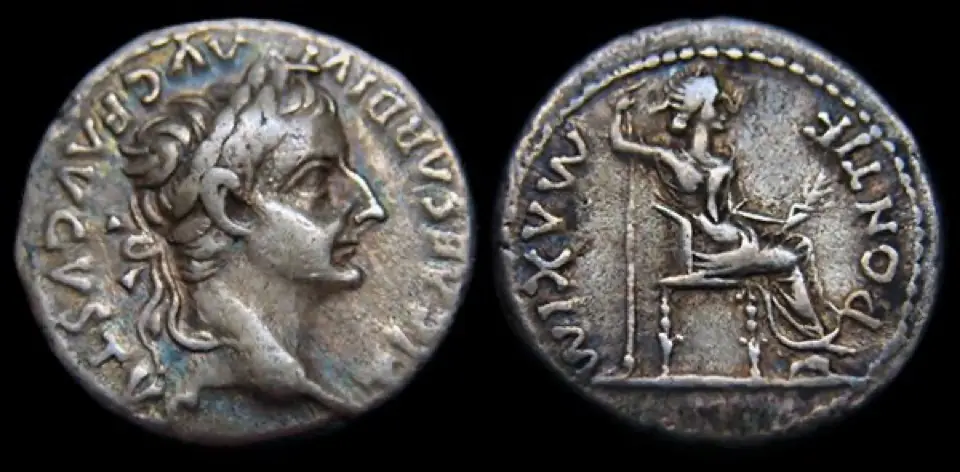
A silver denarius minted during Tiberius’s reign (AD 14–37). The obverse bears the emperor’s portrait, with an inscription calling him “son of the divine Augustus”. When Jesus asked, “Whose is this image and inscription?” (Mark 12:16), the coin shown to him was very likely of this kind. Source: Emperor Tiberius Denarius - Tribute Penny.jpg, DrusMAX, CC BY-SA 3.0. See this exhibit in the Bible Museum

3. Caligula (AD 37–41)
The New Testament does not mention him directly, but during his reign he did something that came close to igniting a full-scale Jewish revolt: he ordered his own statue to be erected inside the Jerusalem Temple.
The governor of Syria, Petronius, received the order but stalled its execution, knowing it would provoke the Jews to die in protest. Caligula was assassinated before the statue arrived, and the Temple was spared for the moment.
This episode caused Jewish hostility toward Rome to surge, sowing seeds that would bear fruit three decades later in the Jewish War.
4. Claudius (AD 41–54)
"because Claudius had commanded all the Jews to depart from Rome." (Acts 18:2)
The book of Acts records that Claudius ordered the expulsion of Jews from Rome. The Roman historian Suetonius adds a telling detail: he says the Jews were expelled because they "were constantly making disturbances at the instigation of Chrestus."
Most scholars believe "Chrestus" is a garbled spelling of "Christus" (Christ) — meaning that the Jewish community in Rome had been so convulsed by debates over whether Jesus was the Messiah that the Roman authorities felt compelled to intervene.
Because of this expulsion decree, the Jewish believers Priscilla and Aquila relocated from Rome to Corinth, where they met Paul (Acts 18:1–3). This couple became some of Paul's most important co-workers.
Once again, God turned an imperial political decision into an opportunity for the gospel.
5. Nero (AD 54–68)
When Paul said "I appeal to Caesar" (Acts 25:11), it was Nero to whom he appealed.
Nero was the first Roman emperor to persecute Christians on a large scale. After the great fire of Rome in AD 64, Nero needed a scapegoat and blamed the Christians. The Roman historian Tacitus records that Christians were "sewn into the hides of wild beasts and torn apart by dogs" and "tied to stakes and set alight to illuminate Nero's gardens."
Church tradition holds that the apostles Peter and Paul both died as martyrs under Nero's persecution: Peter was crucified upside down (tradition says he considered himself unworthy to die in the same manner as the Lord), while Paul, as a Roman citizen, was beheaded.
Nero ultimately died by suicide during a military revolt, at the age of just thirty.
6. Vespasian and Titus (Vespasian, AD 69–79; Titus, AD 79–81)
This father-and-son pair is linked to the greatest catastrophe in Jewish history.
After the Jewish revolt of AD 66, Vespasian led the Roman forces to suppress it. When he was proclaimed emperor in AD 69, he returned to Rome and handed the campaign to his son Titus. In AD 70, Titus stormed Jerusalem and completely destroyed the Second Temple, leaving only one wall standing — what Jews today call the Western Wall.
The historian Josephus, who witnessed the war firsthand, records that during the siege of Jerusalem, the famine inside the city was so severe that mothers resorted to eating their own infants.
Jesus had prophesied all of this more than thirty years earlier:
"Do you see these great buildings? There will not be left here one stone on another, which will not be thrown down." (Mark 13:2)
"For the days will come on you, when your enemies will throw up a barricade against you, surround you, and hem you in on every side, and will dash you and your children within you to the ground. They will not leave in you one stone on another, because you didn't know the time of your visitation." (Luke 19:43–44)
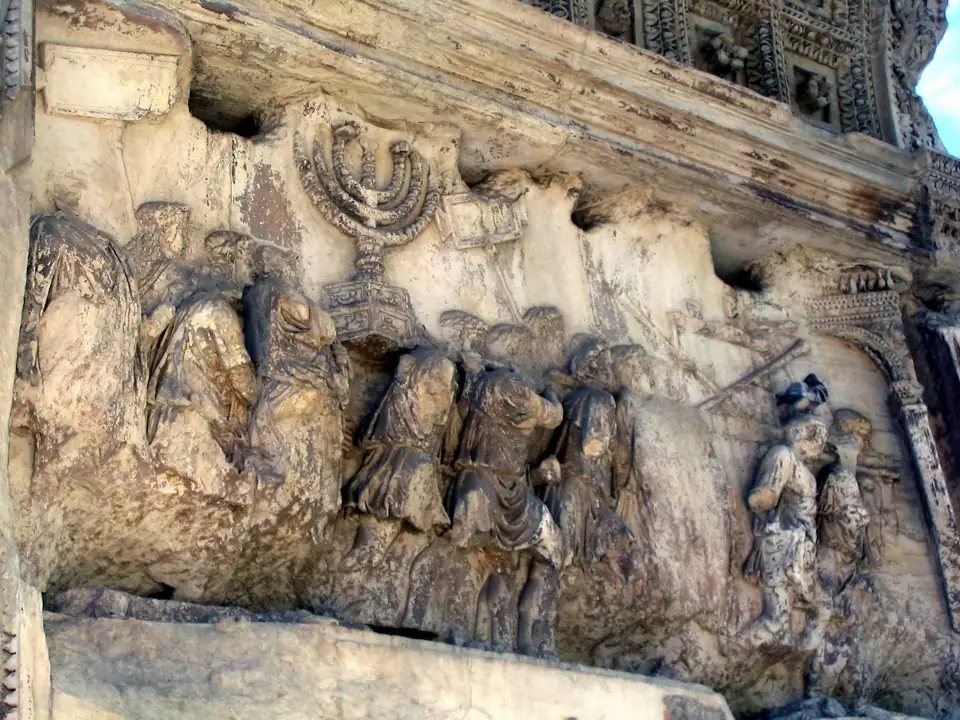
A relief inside Rome’s Arch of Titus shows Roman soldiers parading in triumph with the golden menorah taken from Jerusalem’s Temple. The arch was completed after Titus’s death in AD 81 to commemorate his capture of Jerusalem. Source: Arch of titus relief 2.jpg, Anthony M., CC BY 2.0. See this exhibit in the Bible Museum

7. Domitian (AD 81–96)
Many scholars believe Revelation was written near the end of Domitian's reign. Domitian demanded that his subjects address him as "Lord and God" (Dominus et Deus), and he persecuted Christians who refused to participate in the imperial cult.
The apostle John was exiled to the island of Patmos (Revelation 1:9) during this very persecution. On that barren island, he received the visions of Revelation — and what he saw was this: the one enthroned was not Domitian, but the Lamb who was slain.
IV. Roman Governors and Judea
In the New Testament, the figures who directly encountered Jesus and the apostles were not the emperors far away in Rome, but the governors (praefectus, later procurator) Rome stationed in Judea.
Pontius Pilate (approximately AD 26–36)
He is the most important Roman official in the New Testament. Every time Christians recite the Apostles' Creed, his name appears: "suffered under Pontius Pilate."
In 1961, an inscription was discovered at Caesarea Maritima bearing the words "Pontius Pilate, Prefect of Judea" — the first archaeological evidence confirming his existence.
Josephus and Philo both describe Pilate as an arrogant, cruel governor with complete disregard for Jewish religious sensibilities. Early in his tenure he brought military standards bearing the emperor's image into Jerusalem (his predecessors had always removed such images to avoid offending the Jews), triggering mass protests. He also diverted Temple funds to build an aqueduct and sent soldiers to suppress the demonstrators.
Yet at Jesus' trial, this normally high-handed governor hesitated repeatedly:
"I find no basis for a charge against him." (John 18:38; 19:4, 6)
He declared Jesus innocent three times, tried to release him, and even publicly washed his hands saying, "I am innocent of the blood of this righteous person. You see to it" (Matthew 27:24) — but in the end he caved to the political threat from the Jewish leaders: "If you release this man, you aren't Caesar's friend!" (John 19:12).
Pilate knew Jesus was innocent, yet out of fear of losing his position he handed him over to be crucified: this was the most unjust verdict in human history, and the most critical step in God's plan of salvation.
Jesus said to Pilate words that reveal the truth about all earthly power:
"You would have no power at all against me, unless it were given to you from above." (John 19:11)
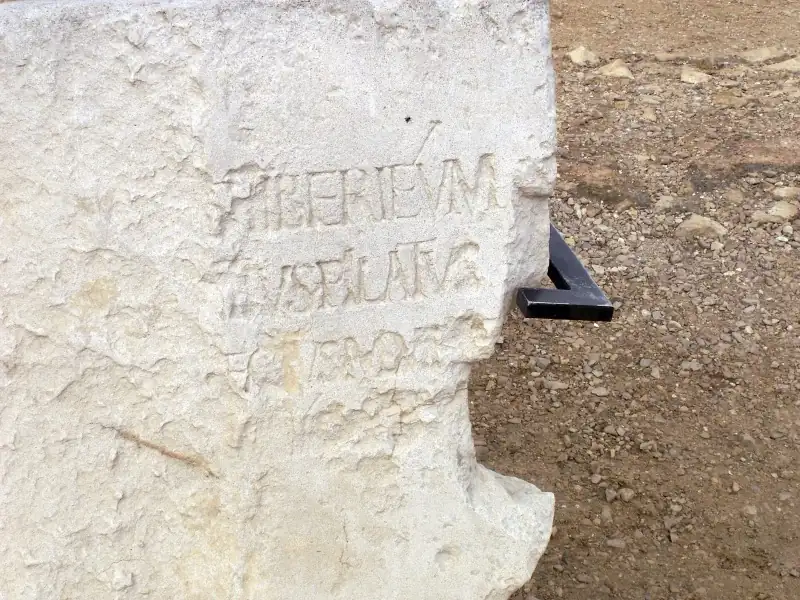
A replica of the Pilate Stone displayed at Caesarea; the original is in the Israel Museum. The Latin inscription includes “Pontius Pilate” and “prefect of Judea”. Source: Pilate Inscription.JPG, Marion Doss, CC BY-SA 2.0. See this exhibit in the Bible Museum

Felix and Festus
After Paul's arrest, he was tried successively by two Roman governors of Judea:
- Felix (approximately AD 52–59): while listening to Paul speak about "righteousness, self-control, and the judgment to come," he "was terrified" — yet he kept Paul in prison for two years, hoping for a bribe (Acts 24:25–27)
- Festus (approximately AD 59–62): barely into his term, he faced Paul's case; wanting to do the Jews a favor he proposed sending Paul to Jerusalem for trial. Paul responded by invoking his Roman citizenship: "I appeal to Caesar!" (Acts 25:11)
Paul's appeal changed everything. He was sent to Rome, preaching along the way, and for two years he lived at the heart of the Roman Empire, "proclaiming God's Kingdom... with all boldness, without hindrance" (Acts 28:31). The book of Acts closes with this image: the gospel had traveled from Jerusalem to the center of the world.
V. The Roman Roads — Gospel Highways
One of the most enduring legacies of the Roman Empire was its road network.
The Romans built more than 400,000 kilometers of roads, of which roughly 80,000 kilometers were paved stone trunk roads. These roads connected every corner of the empire, from Britain to Syria, from North Africa to the Danube.
Features of the Roman roads:
- Durable construction: Multilayer structure (rubble base, gravel fill, stone-slab surface) — many sections survive to this day
- Straight and wide: Main roads were approximately 4–6 meters wide, able to carry legions and merchant caravans
- Infrastructure along the way: Milestones, relay stations, and inns at regular intervals
- Security: Roman troops patrolled the roads, greatly reducing banditry
This road system was originally built to move armies quickly — but God turned it into a highway for the gospel.
Trace Paul's missionary journeys on a map and you will find he traveled almost exclusively on Roman trunk roads:
- Via Egnatia: Crossing Macedonia from Philippi through Thessalonica to the Adriatic. Paul traveled this road on his second missionary journey
- Via Appia: Running south from Rome to Brindisi, the oldest main road in Italy. Acts 28:15 records that before Paul arrived in Rome, the brothers came to meet him at the "Market of Appius" and "Three Taverns" — both places located along the Appian Way
- The Roman road network in Asia Minor: Connecting Ephesus, Colossae, Laodicea, and other cities
Without the Roman roads, Paul could not have traversed Asia Minor, Macedonia, and Achaia within a decade and ultimately reached Rome.
The words of the prophet Isaiah found an unexpected fulfillment in the Roman Empire: "Prepare the way of Yahweh in the wilderness! Make a level highway in the desert for our God." (Isaiah 40:3) Of course, Isaiah was speaking of spiritual preparation — but God also paved the road on a physical level.
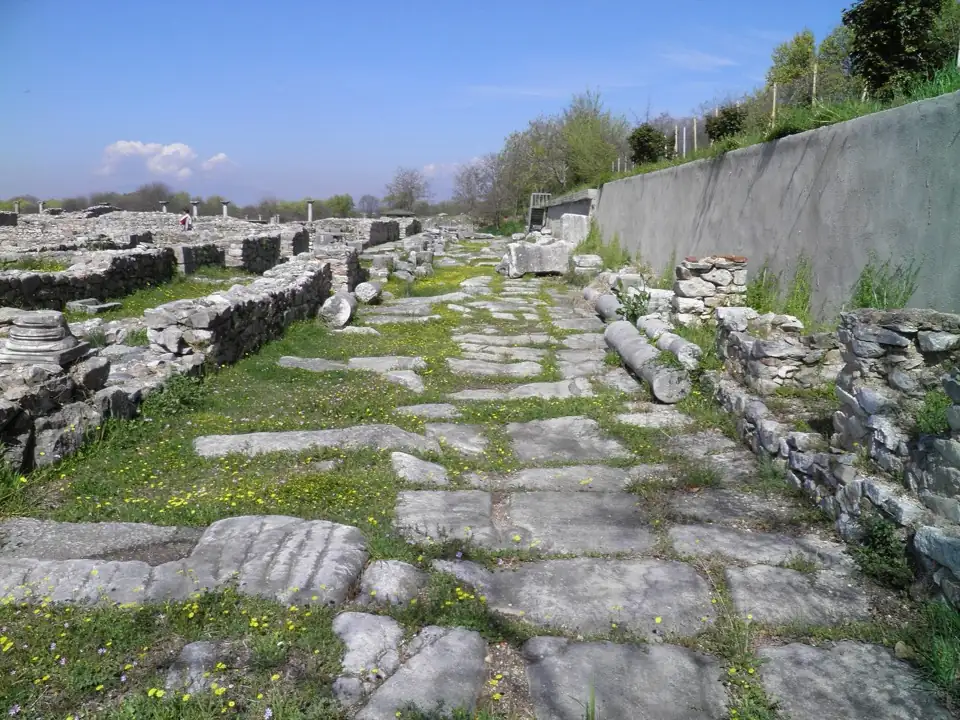
A surviving stretch of the Via Egnatia at Philippi. When Paul left Philippi and “passed through Amphipolis and Apollonia” to Thessalonica (Acts 17:1), he travelled along this road. Source: The Via Egnatia, Philippi, Carole Raddato, CC BY-SA 2.0. See this site in the Bible Museum

VI. The Pax Romana — A Window for the Gospel
From Augustus to Marcus Aurelius (27 BC – AD 180), the Roman Empire enjoyed roughly two hundred years of relative peace and stability — a period historians call the "Pax Romana," or Roman Peace.
The characteristics of this era were critical for the spread of the gospel:
1. No Large-Scale Wars
The Mediterranean world was broadly unified under a single government, with no wars between nations to block travel. A person could walk from Jerusalem to Rome without crossing a single national border.
2. Greek as the Common Language
Alexander the Great's conquests two centuries earlier had spread the Greek language throughout the entire eastern Mediterranean world. By the New Testament era, Koine Greek (common Greek) was the shared language of merchants, scholars, and officials — and it was in this language that the New Testament was written.
Paul wrote to the church in Rome in Greek, to the church in Corinth in Greek, to the church in Ephesus in Greek, because he knew that whatever their native language, they could all read it.
The Old Testament had also been translated into Greek as early as the 3rd century BC (the Septuagint), making it accessible to diaspora Jews scattered across the empire and to Gentiles who were drawn to Judaism.
3. Synagogues Throughout the Empire
As a result of successive dispersions (the fall of the northern kingdom in 722 BC and the Babylonian exile in 586 BC), Jews had scattered to virtually every major city in the Mediterranean world. They established synagogues wherever they settled, which became the centers of faith and community identity.
Wherever Paul went, he always entered the synagogue first (Acts 13:5, 14; 14:1; 17:1–2, 10, 17; 18:4, 19; 19:8). The synagogues were attended not only by Jews but also by a group of Gentiles known as "God-fearers" — people who worshipped the one God of Judaism but had not fully converted (they were uncircumcised). These God-fearing Gentiles became Paul's most receptive audience: already grounded in the Old Testament, they needed only to hear that Christ had fulfilled everything.
Cornelius (Acts 10) and Lydia of Philippi (Acts 16:14) are classic examples of "God-fearers."
4. Relative Religious Tolerance
The Roman Empire generally practiced a policy of religious tolerance toward the peoples it conquered: you could worship your own gods, as long as you also participated in the Imperial Cult. Judaism was even granted special exemptions from certain obligations (such as the imperial cult), holding the status of a religio licita (permitted religion).
Early Christianity was initially viewed by Roman authorities as a branch of Judaism, and therefore enjoyed the same protection. This gave the church a relatively safe period of growth in its first decades. Systematic persecution did not begin until Roman authorities recognized Christianity as an independent and rapidly expanding movement.
All of this together — unified government, open roads, a common language, synagogues throughout the empire, relative peace — constituted a unique window in history. God's choice to send his Son into the world at this particular window was no accident.
VII. Roman Citizenship — Paul's Passport
In the Roman Empire, citizenship was an extraordinarily precious legal status.
The vast majority of the empire's inhabitants were "non-citizens" — they lived under Roman rule but enjoyed none of the legal protections of citizens. Roman citizens, by contrast, held a series of privileges:
- Could not be flogged without a trial (Acts 22:25)
- Had the right to appeal directly to Caesar (Acts 25:11)
- Could not be crucified: even if sentenced to death, only beheading was permitted (this is the traditional reason Paul died by beheading rather than crucifixion)
- Enjoyed legal protection anywhere in the empire
Paul was born a Roman citizen (Acts 22:28 — "I was born one"). He was born in Tarsus of Cilicia (in present-day southern Turkey), which suggests his father or grandfather had obtained citizenship through some means — perhaps through military service, a special contribution, or purchase.
Paul invoked his citizenship on at least three critical occasions:
1. Philippi: Stopping an Illegal Flogging
Paul and Silas had been illegally beaten and imprisoned in Philippi by the city magistrates. The next day, when the magistrates sent word to release them quietly, Paul refused:
"They have beaten us publicly, without a trial, men who are Romans, and have cast us into prison. And now do they release us secretly? No, most certainly, but let them come themselves and bring us out!" (Acts 16:37)
"The sergeants reported these words to the magistrates, and they were afraid when they heard that they were Romans." (Acts 16:38)
Paul was not defending his personal honor. He was protecting the newly founded church in Philippi: by forcing the magistrates to publicly acknowledge their wrongdoing, he made it much harder for them to harass the church in future.
2. Jerusalem: Stopping a Coercive Interrogation
After Paul was beaten by a mob in Jerusalem, the Roman tribune rescued him — but prepared to examine him by flogging. Paul calmly asked:
"Is it lawful for you to scourge a man who is a Roman, and without a trial?" (Acts 22:25)
The tribune was immediately alarmed, because illegally binding a Roman citizen was itself a serious crime. The tribune had paid a large sum of money for his citizenship (Acts 22:28); Paul had been born with his.
3. Caesarea: Appealing to Caesar
When the new governor Festus proposed sending Paul back to Jerusalem for trial (where an ambush awaited him), Paul exercised the most powerful right available to a Roman citizen:
"I appeal to Caesar!" (Acts 25:11)
Festus had no choice: "You have appealed to Caesar. To Caesar you shall go." (Acts 25:12)
That appeal rescued Paul from a Jewish murder plot and set him on a journey to Rome — exactly as the Lord had already promised: "As you have testified about me at Jerusalem, so you must testify also at Rome." (Acts 23:11)
Paul's story of citizenship reminds us: God uses not only spiritual means to accomplish his purposes, but also secular laws and institutions. The Roman citizenship document Paul held was a passport God had prepared for him before his birth, ensuring that he would one day stand at the center of the empire to proclaim the message of the cross.
VIII. The Cross — Rome's Most Brutal Punishment
Today the cross is Christianity's most sacred symbol. But in the New Testament era, it was the cruelest and most degrading method of execution humanity had devised.
What Was Crucifixion Like?
Crucifixion was not a Jewish punishment (Jewish law prescribed death by stoning) — it was a form of execution Rome reserved specifically for slaves, rebels, and the lowest classes of criminals. Roman citizens could not be crucified, which itself indicates the depth of its humiliation.
The process:
- The condemned was first flogged: the Roman flagrum (scourge) had metal and bone fragments embedded in its tips, capable of tearing a person's back to shreds. Jesus underwent this (John 19:1)
- The condemned carried the crossbeam (patibulum) to the execution site; when Jesus could no longer carry it, the Roman soldiers compelled a passerby — Simon of Cyrene — to carry it for him (Mark 15:21)
- The hands were nailed to the crossbeam, which was then raised and fixed to the upright post
- Death usually came not from blood loss but from asphyxiation: the hanging position made breathing extremely difficult; the condemned had to push up on their nailed feet to breathe, and eventually exhaustion made it impossible
- The process could take hours to days
- The body was typically left on the cross to be consumed by birds and animals, as a public warning
The Roman statesman Cicero called crucifixion "the most cruel and terrible punishment," and said even the word itself should never come near the ears of a Roman citizen.
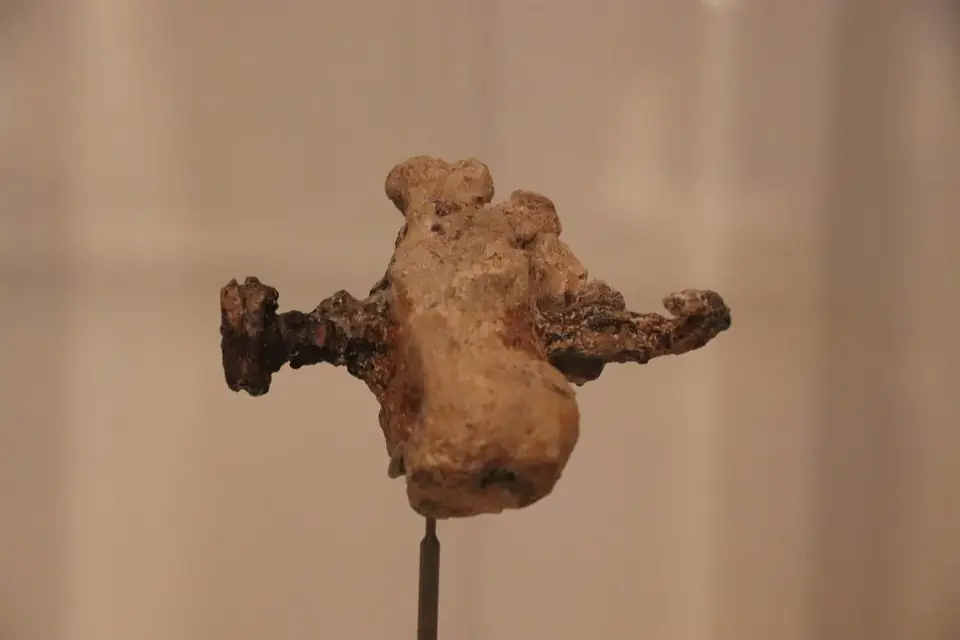
A heel bone excavated in 1968 from a first-century AD tomb in Jerusalem, with an iron nail still piercing the bone. The photograph shows a replica displayed in the Israel Museum. This is the best-known archaeological evidence of crucifixion, showing that the victim’s feet were indeed nailed. Source: Nail & Heel Bone, Jerusalem, 1st C. AD, Gary Todd, CC0. See this exhibit in the Bible Museum

Why Did Rome Use the Cross?
Crucifixion was not merely an execution — it was a public political statement.
The Romans erected crosses outside city gates and along roadsides so that all who passed could see: this is what happens to those who challenge the authority of Rome.
After Spartacus' slave revolt was crushed in 71 BC, Rome lined the Appian Way from Capua to Rome with 6,000 crosses, stretching for 200 kilometers, each bearing the body of a slave.
Jesus' cross carried an equally strong political message. Pilate had the inscription written: "JESUS OF NAZARETH, THE KING OF THE JEWS" (John 19:19), in Hebrew, Latin, and Greek — so that everyone could read it.
The chief priests protested: "Don't write, 'The King of the Jews,' but, 'he said, "I am King of the Jews."'" Pilate answered: "What I have written, I have written." (John 19:21–22)
This was Pilate's final retaliation against the Jewish leaders: he used Jesus' death to humiliate the entire Jewish nation. But what he did not know was that the sign in three languages nailed above Jesus' head was declaring to the whole world a truth he could not comprehend.
God's Reversal of the Cross
Paul grasped this paradox with profound clarity:
"For the word of the cross is foolishness to those who are dying, but to us who are being saved it is the power of God." (1 Corinthians 1:18)
"For Jews ask for signs, Greeks seek after wisdom, but we preach Christ crucified — a stumbling block to Jews, and foolishness to Greeks — but to those who are called, both Jews and Greeks, Christ is the power of God and the wisdom of God." (1 Corinthians 1:22–24)
Rome invented the cross to display the empire's power to crush all opposition. But God sent his Son to die on that cross, transforming history's most shameful instrument of torture into the most glorious sign of salvation.
Rome thought the cross was the end of the story. God said: this is only the beginning.
IX. Imperial Persecution and the Expansion of the Church
The relationship between Christianity and the Roman Empire moved through stages: from tolerance, to conflict, to full-scale persecution.
The Root of Conflict: Worship — Nothing Else
The Roman Empire was generally tolerant of most religions: you could worship your own gods, as long as you also participated in the Imperial Cult.
The Imperial Cult did not necessarily require genuine belief that the emperor was the supreme deity — it functioned more like a political loyalty ritual: burn a pinch of incense before the emperor's image, say the words "Caesar is Lord" (Kaiser kurios), and you demonstrated your allegiance to the empire. Most people did it without a second thought.
But Christians could not.
Because they had already confessed a different creed: "Jesus is Lord" (Iesous kurios, Romans 10:9; 1 Corinthians 12:3).
For Christians, the word "Lord" (κύριος, kurios) could not be applied simultaneously to Caesar and to Jesus — there is only one Lord. This was not a political stance; it was a confession of faith. But Rome interpreted it as political treason.
Stages of Persecution
- Nero (AD 64): The first large-scale persecution, confined to the city of Rome, using the great fire as a pretext
- Domitian (c. AD 90s): Demanded that subjects address him as "Lord and God"; those who refused faced punishment — Revelation was likely written during this period
- Trajan (c. AD 112): Pliny the Younger's letters to the emperor survive and describe in detail how Christians were interrogated: asked three times whether they were Christians — if they refused to deny it, they were executed
- AD 250–311: Systematic empire-wide persecution under Decius, Valerian, and Diocletian
The Church's Response
Faced with persecution, the early church did not take up weapons (they were not Zealots), did not flee into the wilderness (they were not Essenes), did not compromise with Rome (they were not Sadducees) — they chose martyrdom.
The Greek word for "martyr" is μάρτυς (martys), which simply means "witness." Martyrdom was not passive submission to death; it was bearing the final witness with one's life.
The 2nd-century church father Tertullian wrote a phrase that has echoed ever since: "The blood of the martyrs is the seed of the church."
The more Rome persecuted the church, the more the church grew. By the time Constantine issued the Edict of Milan in AD 313 declaring Christianity legal, Christians made up approximately one-tenth of the empire's population. Less than a hundred years later, in AD 380, Christianity became the official religion of the Roman Empire.
The empire that had crucified Jesus ultimately knelt before the cross.
X. Paul's Theology of the Roman Empire
There is a passage in Paul's letters that has generated much discussion:
"Let every soul be in subjection to the higher authorities, for there is no authority except from God, and those who exist are ordained by God." (Romans 13:1)
This was written during the early years of Nero's reign (approximately AD 57), before Nero had begun persecuting Christians.
Paul was not saying "government is always right" — he himself had been illegally flogged and imprisoned by the government multiple times. He was stating a deeper theological principle: the structures of order and authority within human society are themselves established by God, and government serves the function of upholding justice and restraining evil (Romans 13:3–4).
But Paul also knew clearly that when earthly authority comes into conflict with God's authority, the choice for Christians is plain — the same principle the apostles had already declared: "We must obey God rather than men" (Acts 5:29).
As Paul proclaimed the gospel within the context of the Roman Empire, he made deliberate use of language that subverted imperial claims:
| Imperial Claim | Paul's Gospel Proclamation |
|---|---|
| Caesar is "Lord" (kurios) | Jesus is Lord (Philippians 2:11) |
| Caesar is "Son of God" | Jesus is the Son of God (Romans 1:4) |
| Caesar brings "peace" (pax) | Christ is our peace (Ephesians 2:14) |
| Caesar is "Savior" (soter) | God our Savior (Titus 1:3) |
| The empire spreads "good news" (euangelion — the public announcement of an emperor's accession or military victory) | The gospel of Christ (Romans 1:16) |
This was no coincidence. Paul deliberately took every title the empire used to deify Caesar and assigned it to Christ instead. His message was: You say Caesar is Lord, Son of God, Savior, bringer of peace? No — that one is Jesus Christ. And his kingdom will not decay the way Rome will.
XI. AD 70: Judgment Falls
The Jewish-Roman War of AD 66–70 is one of the most significant historical events in the background of the New Testament.
The immediate trigger was the Roman governor Florus seizing Temple funds, sparking a Jewish uprising. But its roots lay in decades of accumulated grievance: from Pompey's entry into the Holy of Holies, to the tyranny of the Herodian family, to the corruption of one Roman governor after another — the Jewish people had finally reached their breaking point.
The Zealots and the Sicarii (the "dagger men") led the revolt. Initially the Jews won stunning victories, even annihilating a Roman legion. But the empire marshaled massive forces in response, and the army commanded by Vespasian and Titus systematically crushed Jewish resistance over four years.
In AD 70, Jerusalem fell. Josephus records that even though Titus had ordered the Temple to be preserved, Roman soldiers set it ablaze anyway — the Second Temple, approximately 500 years after its completion, was reduced to ashes.
Jesus' prophecy on the Mount of Olives was fulfilled word for word:
"Do you see these great buildings? There will not be left here one stone on another, which will not be thrown down." (Mark 13:2)
Christian tradition records that the Jerusalem church had fled the city before the siege, following the Lord's warning, and settled in Pella across the Jordan River (likely acting on Jesus' prophecy in Luke 21:20–21: "But when you see Jerusalem surrounded by armies, then know that its desolation is at hand. Then let those who are in Judea flee to the mountains").
The destruction of the Temple meant:
- The sacrificial system permanently ceased: there would never again be burnt offerings or sin offerings
- The Sadducees disappeared: their power base was gone
- Judaism was transformed: from a Temple-centered faith to a synagogue- and rabbi-centered faith (the Pharisaic tradition prevailed)
- Christianity and Judaism formally parted ways: the church no longer depended on the Temple
The author of Hebrews (writing perhaps shortly before the Temple's destruction) had already seen the theological significance of this trajectory:
"In that he says, 'A new covenant,' he has made the first old. But that which is becoming old and grows aged is near to vanishing away." (Hebrews 8:13)
XII. Theological Reflection: Empire and Kingdom
Looking back over the full interweaving of the Roman Empire with the New Testament, a clear theme emerges: God was using the empire, but God did not belong to the empire.
- God used Augustus' census to bring Mary to Bethlehem, but the true King was not Caesar
- God used the Roman roads to carry the gospel across the Mediterranean, but those roads led not to Rome's glory but to Christ's kingdom
- God used Rome's cross to accomplish humanity's greatest redemption, but the cross went from a mark of shame to a mark of glory
- God used Paul's Roman citizenship to carry the gospel to the empire's heart, but when Paul arrived in Rome he came not as a citizen but as a prisoner — a man in chains who was freer than the emperor
Revelation captures the conclusion of this story in its most sweeping strokes:
"The seventh angel sounded, and great voices in heaven followed, saying, 'The kingdom of the world has become the kingdom of our Lord, and of his Christ. He will reign forever and ever!'" (Revelation 11:15)
The Roman Empire fell — the Western Empire in AD 476, the Eastern Empire (Byzantium) in AD 1453.
Caesar's name today lives only in history books.
But the faith that began in a remote province of the Roman Empire — in the body of a carpenter whom that empire nailed to a cross — today is followed by more than two billion people.
God never needed the empire's permission to do his work. He used the empire, transcended the empire, and will ultimately judge the empire.
All earthly power, no matter how mighty or how long-lasting, has an expiration date. Only one kingdom has none:
"His kingdom is an everlasting kingdom, and his dominion is from generation to generation." (Daniel 4:3)
XIII. Verses Worth Memorizing
"Render to Caesar the things that are Caesar's, and to God the things that are God's." (Mark 12:17)
"You would have no power at all against me, unless it were given to you from above." (John 19:11)
"But when the fullness of the time came, God sent out his Son." (Galatians 4:4)
"The kingdom of the world has become the kingdom of our Lord, and of his Christ. He will reign forever and ever!" (Revelation 11:15)
Further Reading:
- Josephus, The Jewish War: A firsthand account of the Jewish-Roman War of AD 66–70
- Bruce, F. F., New Testament History
- Wright, N. T., Paul and Caesar: The Imperial Context of Paul's Letters
- Witherington, Ben III, New Testament History: A Narrative Account
- Tacitus, Annals 15:44: The earliest secular record of Nero's persecution of Christians
💬 After reading this article, if you have any thoughts or questions, you are welcome to ask Pastor Bond:
- "Rome persecuted the church — so how did it end up paving the way for the gospel?"
- "A carpenter who was crucified — how did he end up defeating an entire empire?"
- "The early believers stood firm under persecution. What can I learn from them?"