How the Bible Came to Us
— From Papyrus to Your Phone
Written for every brother and sister who has opened a Bible without ever stopping to ask, "Where did this book come from?" The very existence of the book in your hands is itself a miracle.
I. How Was the Bible Written?
The Bible did not fall from heaven one day as a finished book. It was written by approximately forty authors across roughly fifteen hundred years — from Moses to the Apostle John — in three languages: the Old Testament mainly in Hebrew, with small portions in Aramaic (such as sections of Daniel), and the New Testament in Greek (the common language of the Mediterranean world at the time, called κοινή, koinē, "common Greek").
These authors came from every walk of life: a king (David), a shepherd (Amos), fishermen (Peter), a physician (Luke), a Pharisee (Paul), a tax collector (Matthew). They wrote from the wilderness of Sinai to the rivers of Babylon, from the royal palace in Jerusalem to a Roman prison. Yet these works, spanning centuries and vastly different backgrounds, form one coherent story: from creation to new creation, from the garden of Eden to the New Jerusalem.
2 Peter 1:21 says, "For no prophecy ever came by the will of man, but holy men of God spoke, being moved by the Holy Spirit." The Bible was written by human hands, but its content was breathed out by God's Spirit. The authors were not passive typewriters — each writer's personality, style, and circumstances are preserved in the text — yet God ensured that what He intended to say was recorded accurately and completely.
II. What Was It Written On?
The earliest biblical texts were not written on paper — paper would not be invented for another thousand years or more. Ancient writing materials came in three main forms:
Papyrus
Papyrus: made by cutting the stems of the papyrus plant that grew along the Nile, layering the strips crosswise, pressing them flat, and drying them. This was the most common writing material in the ancient Mediterranean world — relatively affordable, but vulnerable to moisture. The letters of the New Testament were most likely first written on papyrus. Multiple sheets glued together and rolled up formed a scroll, the "scroll" frequently mentioned in Scripture (e.g., Jer. 36:2).
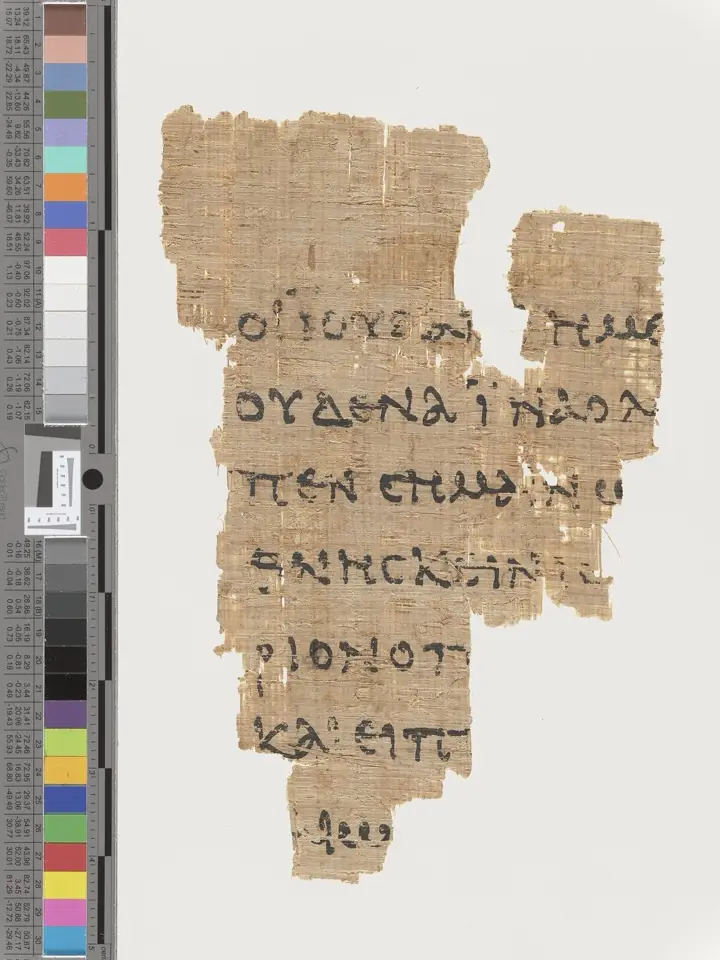
A papyrus fragment of John’s Gospel (P52), c. AD 125–175, in the John Rylands Library in Manchester. Only the size of a business card, its front preserves a few lines from Pilate’s questioning of Jesus in John 18. It is one of the earliest surviving New Testament manuscript fragments. Source: JRL19071950.jpg, RylandsImaging, CC BY-SA 4.0. See this exhibit in the Bible Museum

Parchment
Parchment: made from the processed skins of sheep or goats — far more durable than papyrus, but also far more expensive. When Paul asks Timothy in 2 Timothy 4:13 to "bring... the parchments," he is referring to documents written on this material. Over time, parchment gradually replaced papyrus as the primary material for copying the Scriptures.
Codex
Codex: Around the first and second centuries AD, Christians began cutting papyrus or parchment into individual pages and binding them together — the codex, the direct ancestor of the modern book. While Jews continued using scrolls, Christians adopted the codex form much earlier, likely because turning pages was far more practical than unrolling a scroll, making it much easier to locate passages quickly during gatherings.
III. The Formation of the Old Testament Canon
The word "canon" (from the Greek κανών, kanōn, meaning "rule" or "standard") refers to the collection of books recognized as divinely inspired and carrying supreme authority.
The formation of the Old Testament canon was a gradual process. After Moses wrote the Law, he commanded the Levites to place it beside the ark of the covenant (Deut. 31:24–26) — the earliest expression of what we might call "canon consciousness." From there, the writings of the prophets and the wisdom literature were progressively recognized by Israel as the word of God. By the time of Jesus, the Jewish Scriptures had an established and recognized scope. Jesus himself spoke of “the law of Moses, the Prophets, and the Psalms” (Luke 24:44) — the traditional three-part division of the Hebrew Bible:
- The Law (תּוֹרָה, Torah): Genesis through Deuteronomy, five books
- The Prophets (נְבִיאִים, Nevi'im): the Former Prophets (Joshua through Kings) and the Latter Prophets (Isaiah through Malachi)
- The Writings (כְּתוּבִים, Ketuvim): Psalms, Proverbs, Job, Ruth, Esther, Daniel, and more
Together, these three sections form the תַּנַ"ךְ (Tanakh) — the name Jews use for their own Scriptures. The content is identical to the Christian Old Testament's thirty-nine books; only the arrangement and division of books differs.
Jewish tradition and multiple early documents indicate that Jews widely believed the voice of prophecy had ceased after Haggai, Zechariah, and Malachi. The Jewish historian Josephus (first century AD) explicitly recorded that the Jews recognized only those books written during the period of prophetic succession as Scripture, and that no one after that period had the standing to add new books. In other words, by approximately the third century BC, the core scope of the Old Testament canon had effectively been settled.
IV. The Formation of the New Testament Canon
The canonization of the New Testament's twenty-seven books unfolded over roughly three hundred years. The earliest New Testament documents were Paul's letters (written approximately AD 49–67), followed by the four Gospels. After the apostles and their close associates wrote these books, the various churches shared and copied them among themselves.
Three Criteria for Recognition
The early church used three primary standards to discern whether a book belonged in the canon:
- Apostolicity: Was it written by an apostle or a close associate of an apostle? (For example, Mark was Peter's associate; Luke was Paul's associate.)
- Orthodoxy: Did its content align with the known teaching of the apostles? Was it consistent with the Old Testament Scriptures and other accepted writings?
- Universality: Was it widely accepted and used by churches across regions?
Most New Testament books gained recognized status very early. A smaller number — Hebrews, James, Jude, and Revelation — were discussed for a longer period. In AD 367, Bishop Athanasius of Alexandria listed in his Festal Letter the exact twenty-seven books of the New Testament we have today. The Council of Carthage in AD 397 formally confirmed this list.
It is important to be clear: the church did not decide which books were Scripture — it recognized which books already carried the authority of God's Word. As one theologian put it: the church did not give authority to Scripture; Scripture itself has authority, and the church simply acknowledged that fact.
Why Do Protestant Bibles Have Sixty-Six Books?
You may have heard that Catholic Bibles contain more books than Protestant ones. The additional books are called the Apocrypha (also known as the "deuterocanonical" books), and include Tobit, Judith, 1 and 2 Maccabees, and others — seven books in total. How did this come about?
In brief: these books were written during the "four hundred years of silence" between the Old and New Testaments. They were included in the Greek translation of the Old Testament (the Septuagint), but they are not in the Hebrew Bible. Jesus and the apostles never cited any of them as authoritative Scripture with the formula "it is written." Jerome, who translated the Vulgate from the original languages, knew Hebrew well and clearly stated that these books did not belong to the Hebrew canon and should not be treated as equal to canonical Scripture. Nevertheless, largely through the influence of Augustine and others, they were included in the Vulgate and became widely used in the Western church.
When the Reformation came in the sixteenth century, the Reformers returned to the scope of the Hebrew Bible — the canon Jesus and His disciples used. In 1546, at the Council of Trent, the Roman Catholic Church formally elevated these deuterocanonical books to full canonical status, in part as a response to the Reformation. The Protestant churches held firm: the Old Testament canon must match the Hebrew Bible that Jesus and the apostles recognized — thirty-nine books, no more and no less. Add the twenty-seven New Testament books, and you have the sixty-six books in our hands.
The Apocrypha is not without value: it is an important historical source for the period between the two Testaments, and Maccabees records the stirring and inspiring story of Jewish resistance. But the Protestant tradition holds that these books do not carry the same authority as canonical Scripture.
V. The Scribal Tradition — The Piety of the Copyists
Before the invention of printing, every copy of the Bible had to be written out by hand. This work was carried out primarily by professionally trained scribes (Hebrew: סוֹפֵר, sofer).
The Strict Rules of Jewish Scribes
Jewish scribes who copied the Torah followed an extraordinarily rigorous set of regulations, later codified into a formal body of rules. The earliest group of professional Scripture copyists were known as the Soperim (approximately 500 BC to AD 100): the very name comes from the Hebrew word for "to count," because they counted every single letter in the Torah to ensure that copies were letter-perfect. The subsequent Tannaim period (approximately AD 100–300) brought even more detailed requirements:
- The number of lines per column was fixed; the number of letters per line was capped
- The scribe must bathe before beginning; the pen must be re-dipped in ink before writing any name of God
- Not a single word could be written from memory: the scribe had to look at the source while copying every word
- After copying a scroll, it had to be checked word by word. One method was counting letters: if the middle letter was in the wrong position, the entire scroll was discarded and rewritten
- If a letter was written incorrectly, it could not be erased or corrected — the page was destroyed; more than three errors on a single page, and the entire page was destroyed
The Monastic Scriptorium
In the medieval period, Christian monasteries took on the work of copying the New Testament and the Greek translations of the Old Testament. Monks labored day after day in dedicated copying rooms called the scriptorium (Latin for "place of writing"). Some manuscripts were exquisitely beautiful, decorated with colored illustrations and gold leaf.
Over three thousand years of scribal transmission, some variation was naturally inevitable. But when modern scholars compare thousands of manuscripts, they find a remarkable fact: the vast majority of differences are minor matters of spelling or word order, and not a single variation affects any core doctrine of the Christian faith.
The two most significant textual debates in scholarship concern Mark 16:9–20 (the record of Jesus's post-resurrection appearances) and John 7:53–8:11 (the woman caught in adultery): both passages are absent from the oldest and most reliable manuscripts. Modern Bible translations typically include a note at these passages. It is worth noting, however, that even without these two sections, the reality of Jesus's resurrection and His grace toward sinners are amply and consistently attested throughout the rest of Scripture. The differences between manuscripts are real, but the core message of the Bible stands unchanged — a fact that itself invites reflection.
One more remarkable piece of evidence: the Church Fathers of the early centuries — Irenaeus, Origen, Augustine, and others — quoted extensively from New Testament texts in their sermons, commentaries, and debates. To date, scholars have catalogued more than one million patristic citations. Even if every New Testament manuscript were to disappear, we could reconstruct nearly the entire New Testament from these citations alone. The transmission of Scripture does not hang by a single thread — it is a net spread across the entire ancient world.
VI. Key Manuscripts and Archaeological Discoveries
Several important biblical manuscripts and archaeological finds provide powerful evidence for the reliability of the biblical text:
The Dead Sea Scrolls
The Dead Sea Scrolls (discovered 1947): A Bedouin shepherd boy stumbled upon a cache of ancient scrolls in the caves at Qumran, on the northwestern shore of the Dead Sea. These documents date from the third century BC to the first century AD and contain fragments of every Old Testament book except Esther. The most celebrated find is a complete scroll of Isaiah — approximately one thousand years older than the previously known earliest Hebrew manuscript of Isaiah — yet the two are almost entirely identical. One thousand years of hand-copying, and the text of Isaiah had not drifted.
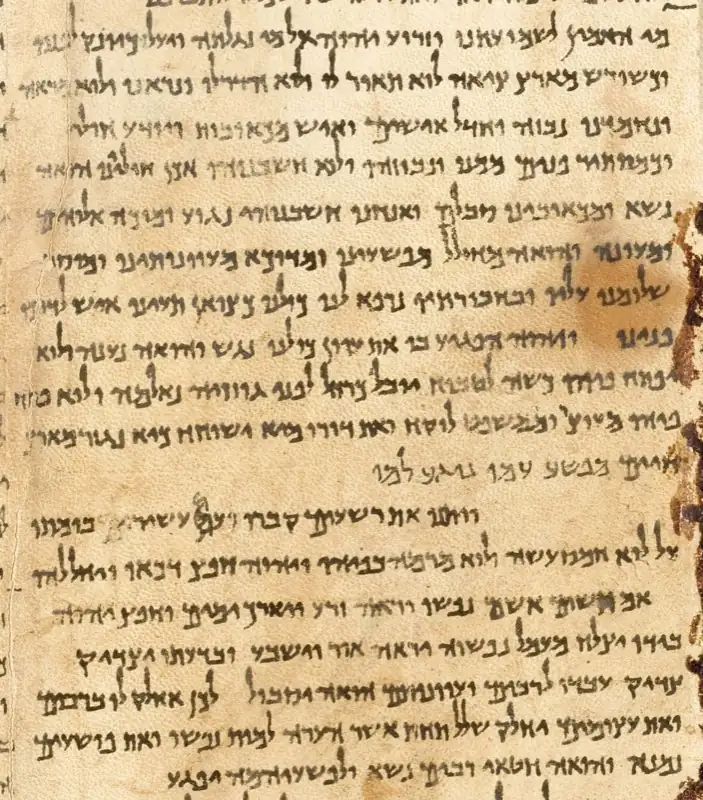
The Great Isaiah Scroll, one of the Dead Sea Scrolls, showing part of Isaiah 53. Dating to c. 125 BC and held in the Israel Museum, it is about a thousand years older than the earliest Hebrew manuscript of Isaiah known before its discovery. Source: Great Isaiah Scroll Ch53.jpg, Ardon Bar Hama (photographer), public domain. See this exhibit in the Bible Museum

Three Great Codices
Codex Sinaiticus (approximately AD 350): discovered in the nineteenth century at St. Catherine's Monastery on Mount Sinai; one of the oldest complete Greek New Testament manuscripts in existence, also containing most of the Old Testament in Greek.
Codex Vaticanus (approximately AD 325–350): housed in the Vatican Library; another supremely important early complete Bible manuscript.
Codex Alexandrinus (approximately AD 400–440): now in the British Library; contains nearly the complete Old and New Testaments.
The known Greek New Testament manuscripts (including fragments) number more than 5,700; Latin manuscripts exceed 10,000; counting ancient translations in other languages, the total surpasses 24,000 copies. No other work from the ancient world comes close to this manuscript density. By comparison: Thucydides survives in about 20 copies, Livy in about 27, and Tacitus in only 3. If we have good reason to trust the texts of those classical works, our grounds for trusting the New Testament text are a thousand times stronger.
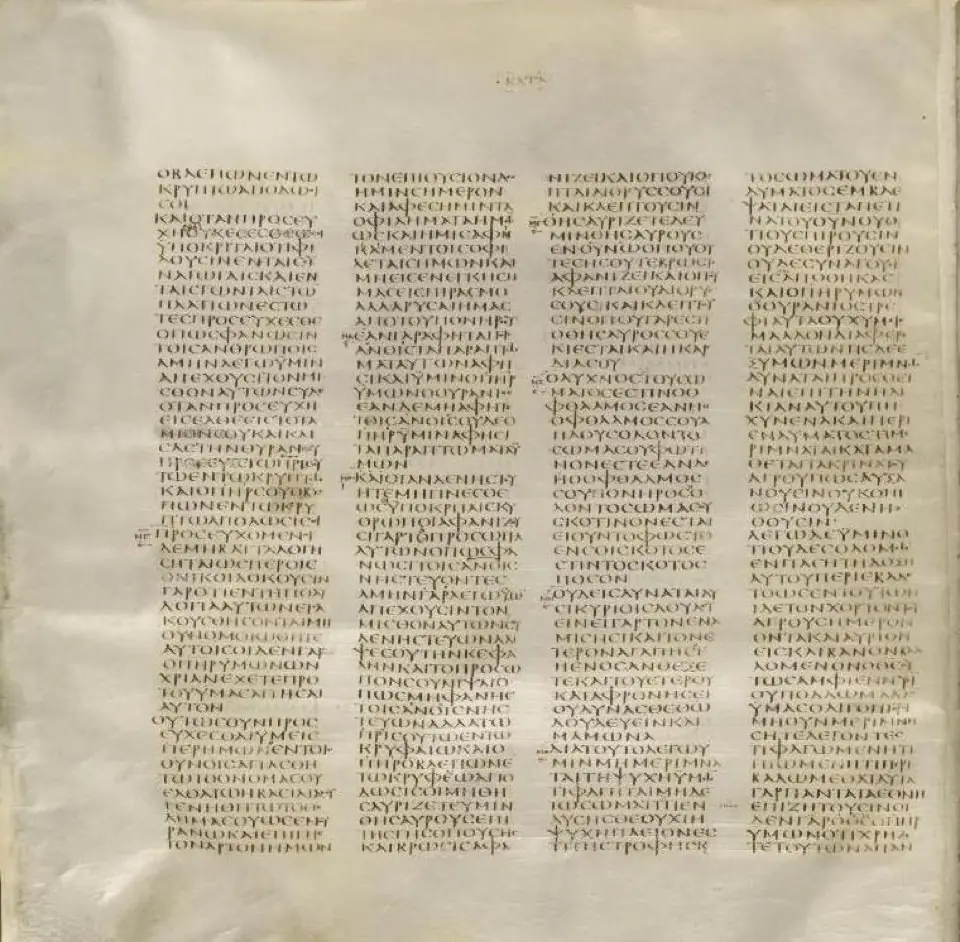
A page of Matthew 6 in Codex Sinaiticus, including the Lord’s Prayer. The manuscript dates to around the mid-fourth century AD, and most of it is now in the British Library. Source: Codex Sinaiticus Matthew 6,4-32.JPG, public domain. See this exhibit in the Bible Museum

Archaeological Confirmation
Beyond manuscript evidence, modern archaeological excavations have confirmed the biblical record from a completely different angle:
The Gospel of John records that Jesus healed a paralyzed man at the Pool of Bethesda in Jerusalem (John 5:2): archaeologists have excavated this double-pool site in the north of Jerusalem's Old City, and its structure matches John's description precisely. In 2005, the Pool of Siloam mentioned in John 9:7 was also discovered archaeologically. The remains of the synagogue in Capernaum (Mark 1:21) have been found beneath later structures. The name of Pontius Pilate, who ordered Jesus's execution, appears on an inscription unearthed at Caesarea Maritima — independent archaeological confirmation of Pilate's existence outside of Scripture.
The author of Acts, Luke, used place names and official titles with stunning precision. He refers to Gallio as the "proconsul" of Achaia (Acts 18:12), to officials in Ephesus as "Asiarchs" (Acts 19:31), and to the civic magistrates of Thessalonica as "city rulers" (πολιτάρχης, politarchēs, Acts 17:6) — highly obscure titles in ancient literature, every one of which has been confirmed as the accurate local designation for that time and place by recovered inscriptions. Almost every city Luke mentions has been archaeologically identified and excavated. A first-century recorder achieving this level of precision is itself a powerful testimony to credibility.
VII. The History of Translation
The earliest translation of Scripture dates to the third century BC:
The Septuagint
The Septuagint (commonly abbreviated LXX): In the fourth century BC, Alexander the Great's conquests swept across the entire Near East, making Greek the common language of the Mediterranean world. Large numbers of Jews relocated to Greek-speaking cities like Alexandria in Egypt, and younger generations gradually lost fluency in Hebrew. To allow Jews scattered throughout the diaspora to still read their own Scriptures, Jewish scholars in Alexandria translated the Hebrew Bible into Greek sometime between the third and first centuries BC. Tradition holds that seventy-two scholars participated, hence the name "Septuagint" (Latin for "seventy"). This translation carried enormous significance: when New Testament authors quote the Old Testament, they most often use the wording of the Septuagint. Looking back, the Greek conquest was political expansion — but in God's hands, it prepared a common language that allowed the Old Testament to travel beyond Palestine and pave the way for the gospel.
The Vulgate
The Vulgate: In the late fourth century AD, the scholar Jerome was commissioned by the Pope to translate the Bible into Latin — then the common language of the day. This translation dominated the Western church for more than a thousand years. But as Latin gradually became a language only clergy and intellectuals could read, ordinary believers had no direct access to Scripture.
The Reformation and the Explosion of Bible Translation
The Reformation and the explosion of Bible translation: One of the core convictions of the sixteenth-century Reformation was that "every believer ought to be able to read Scripture in their own mother tongue." Martin Luther translated the Bible into German (the complete Bible finished in 1534). William Tyndale risked his life to translate the New Testament into English; he was eventually executed for heresy in 1536. His reported dying prayer was, "Lord, open the King of England's eyes." Barely three years later, Henry VIII commanded that an English Bible be placed in every church.
The King James Version (1611): completed by fifty-four scholars over seven years, it profoundly shaped the English language itself and remains to this day one of the most widely used English Bibles in the world.
VIII. The Chinese Union Version — How the Bible Came to China
For Chinese Christians, the most significant Chinese Bible translation is the Chinese Union Version (published 1919).
After Protestant Christianity entered China, various mission societies each produced their own translations in different dialects and forms of classical Chinese, with no unified standard. At the 1890 General Conference of Protestant Missionaries in Shanghai, a decision was made to produce a single, unified Chinese Bible translation collaboratively. This is the origin of the name "Union" (和合, héhé): it signified the cooperation of the missions and the unification of existing versions.
The translation committee consisted of Western missionaries and Chinese co-workers and labored for nearly thirty years. Chauncey Goodrich, the chair of the New Testament translation committee, died before the work was complete. In 1919, the complete Union Version Bible was finally published, and it became the most widely used Chinese Bible translation in the world.
The Union Version was rendered in a style of Chinese that stood between classical and vernacular — literary and polished, yet accessible. More than a century later, it still reads with elegance, a testament to the quality of the translation. Verses like "For God so loved the world, that he gave his one and only Son" (John 3:16) and "Your word is a lamp to my feet, and a light for my path" (Ps. 119:105) have been woven so deeply into the devotional language of Chinese Christians that they are inseparable from the community's faith.
Since 1919, several newer Chinese translations have appeared — the Revised Union Version (2010), the New Chinese Version (1992), the Contemporary Chinese Version, and others. But the Union Version remains the primary Bible used in the great majority of Chinese-speaking churches.
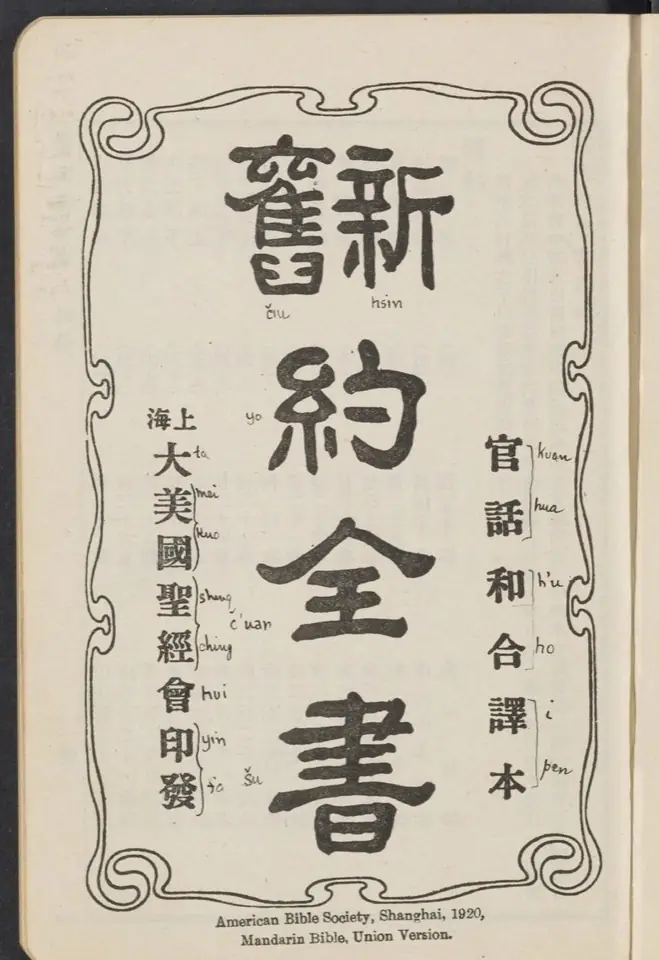
The title page of the Old and New Testaments in the Mandarin Union Version, printed by the American Bible Society in Shanghai in 1920. The Union Version first appeared in 1919; this copy was printed the following year. Source: Internet Archive, scan of a copy held by the Harvard-Yenching Library, public domain. See this exhibit in the Bible Museum
IX. The Printing Press — God's Prepared Accelerator
There is one pivotal turning point in the history of Bible transmission: the Gutenberg printing press.
Around 1455, the German goldsmith Johannes Gutenberg used his newly invented movable-type printing press to print the first book — and what he chose to print was the Bible (the Latin Vulgate). This was no coincidence: in Gutenberg's view, nothing was more worthy of being mass-produced and widely spread than the Word of God.
The change printing brought was revolutionary. Before it, producing a hand-copied Bible required approximately one full year of a monk's devoted labor, at a cost equivalent to several years of an ordinary family's income. After the press, costs plummeted and output soared. Within just a few decades, tens of thousands of Bibles were printed across Europe. When the Reformation erupted in 1517, the printing press was already in place: Luther's German Bible and the pamphlets of reform spread across Europe at a speed previously unimaginable.
Technology is not neutrally accidental. God prepared the printing press sixty years before the Reformation — just as He had prepared the Roman roads and the Greek common language before the birth of Christ. Before every major advance of the gospel, the infrastructure was already in position.
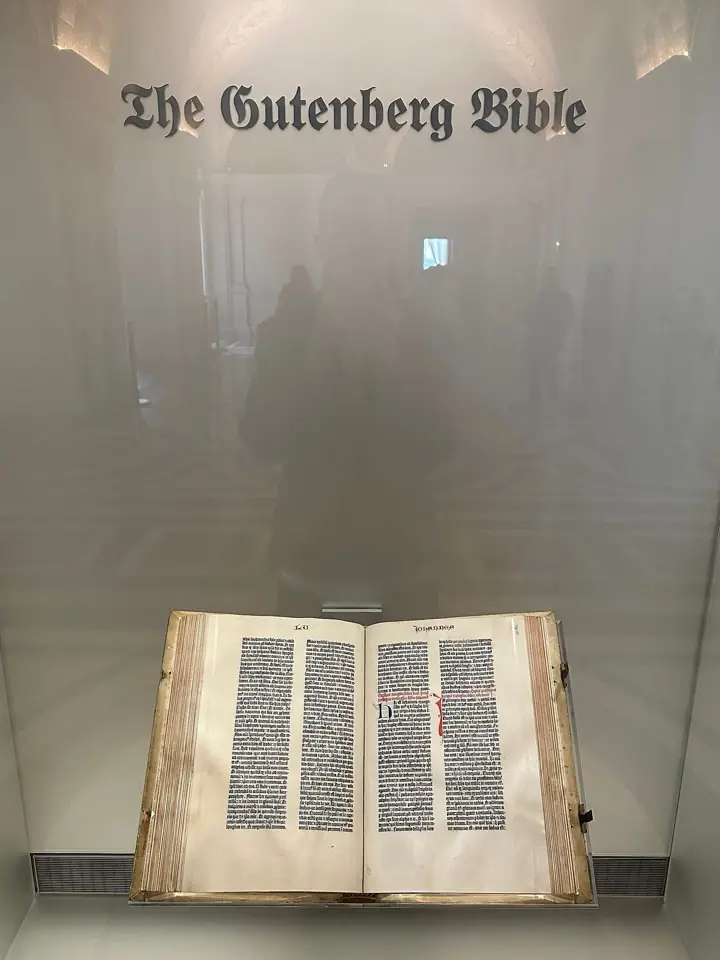
The Gutenberg Bible, printed with movable type in Mainz, Germany, around 1455, held in the Library of Congress. Source: Gutenberg Bible - Library of Congress.jpg, APK, CC BY 4.0. See this exhibit in the Bible Museum

X. Why Has the Bible Survived?
The prophet Isaiah wrote these words twenty-seven hundred years ago: "The grass withers, the flower fades; but the word of our God stands forever." (Isa. 40:8)
A Book That Could Not Be Burned
History has tested that claim. Throughout the long centuries, countless forces tried to destroy this book:
- In 167 BC, Antiochus IV Epiphanes ordered all Torah scrolls burned; possession meant death
- In AD 303, Emperor Diocletian's Great Persecution decreed that all copies of Scripture be burned
- In the medieval period, owning a Bible in one's native language could be prosecuted as heresy in some regions
- In the modern era, totalitarian regimes repeatedly banned the printing and distribution of Scripture
Yet every time, the Bible survived. Burn one batch of manuscripts — more lay hidden in caves. Ban the translation in one language — another translation is already underway. Kill one translator — ten others take up his work.
Today, the Bible has been fully translated into more than 700 languages, with portions translated into more than 3,500 languages. It is the most translated, most printed, and most read book in human history.
This did not happen through the promotional power of any institution or the political backing of any empire. In fact, the Bible often flourished most fiercely precisely when it was most severely persecuted. The only adequate explanation is this: behind this book stands an Author who promised that His Word would stand forever — and He kept His word.
Conclusion: From His Mouth to Your Hands
Now you know the journey this Bible has made to reach you.
It began with God's inspiration, passed through the pens of prophets and apostles, and was set down on papyrus and parchment scrolls. Scribes copied it letter by letter for over a thousand years; monks guarded it century after century by candlelight. Translators gave their lifetimes — and sometimes their lives — so that it could speak in your language. The printing press carried it from monastery shelves to the table of every home. And today, it is in your phone.
From papyrus to phone screen, the medium has changed countless times. But the words themselves have not changed by a single letter. Because the One who spoke them is still alive, and still speaking.
The prayer of the poet David three thousand years ago is still our prayer today: "Forever, LORD, your word is settled in heaven." (Ps. 119:89)
So open it.
💬 After reading this article, if you have any thoughts or questions, you are welcome to ask Pastor Bond:
- "After all this copying and translating, is today's Bible still accurate?"
- "The Bible has been banned and burned over and over — and never disappeared. What does that tell us?"
- "Some people say the Bible has been changed many times. How should I respond?"