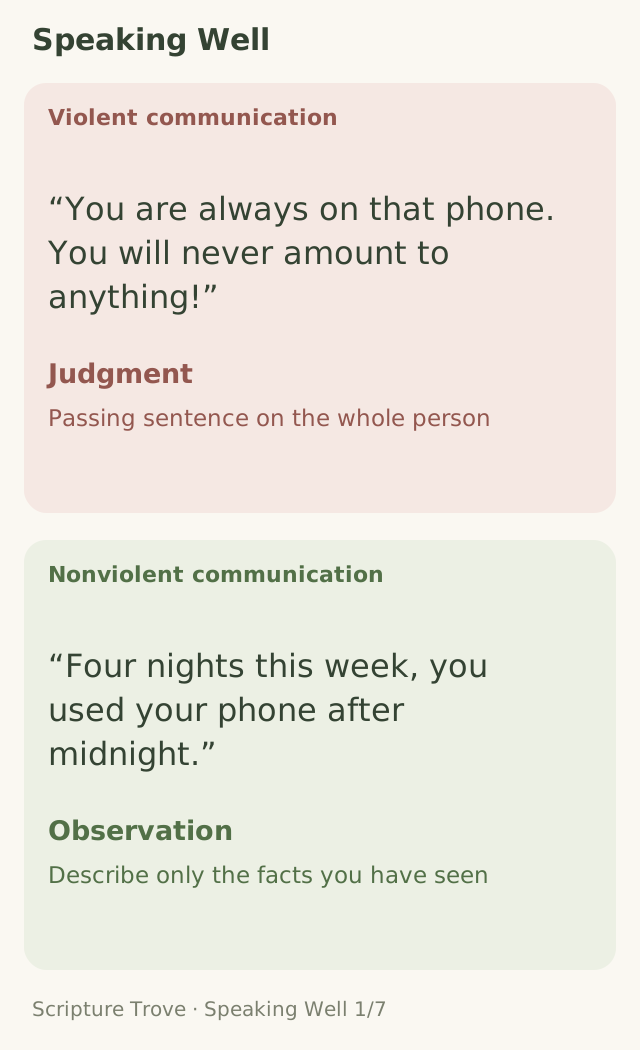
At half past ten, a mother opens her child's bedroom door and finds him scrolling on his phone. “You are always on that phone. You will never amount to anything!”
He hides it under the pillow and turns his back. Neither speaks at breakfast.
Her concern is justified: he is staying up too late. But declaring him hopeless passes judgment on his whole person. Before concern is expressed, the door closes.
Proverbs says, “There is one who speaks rashly like the piercing of a sword, but the tongue of the wise heals” (Proverbs 12:18).
American clinical psychologist Marshall B. Rosenberg spent years mediating conflict. Seeing labels, comparisons, accusations and demands alienate and wound, he developed Nonviolent Communication, emphasising honest expression and empathetic listening. His book is widely read in Chinese. Though originating in psychology, many of its insights agree with Scripture.
1. Four Elements: Observation, Feeling, Need and Request
Observation: Describe What You See without Passing Sentence
“You are always on that phone. You will never amount to anything!” contains two judgments: exaggeration and a verdict on the person. The child immediately defends himself: “Not always!”
Try observation: “Four nights this week, you used your phone after midnight.” Visible facts invite less immediate defensiveness and leave room for conversation.
Jesus says, “Don’t judge, so that you won’t be judged” (Matthew 7:1). He does not prohibit moral discernment: he next tells us to remove our own beam, “and then you can see clearly to remove the speck out of your brother’s eye” (Matthew 7:5). A specific wrong may be addressed without taking the judge's seat and condemning the whole person.
Feeling: Own Your Feelings without Charging Them to Someone Else
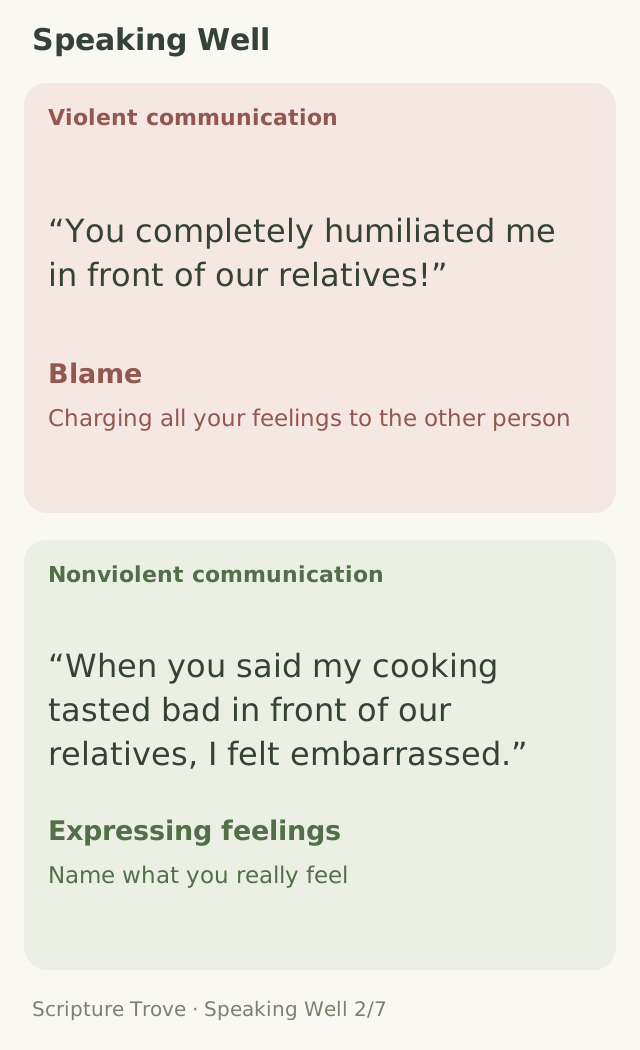
“You completely humiliated me in front of our relatives!” charges the whole emotional bill to the other person, rather than responsibly owning your emotions. Try: “When you said my cooking tasted bad in front of our relatives, I felt embarrassed.”
“I feel you do not care about me” sounds like feeling, yet judges another person's heart. Sadness, disappointment, fear, hurt and exhaustion are feelings.
Scripture does not demand emotional suppression. The psalm invites, “Trust in him at all times, you people. Pour out your heart before him” (Psalm 62:8); Paul says, “Be angry, and don’t sin” (Ephesians 4:26).
Expressing feelings does not excuse someone's harm. They remain responsible for their actions. James reminds us of our side: “the anger of man doesn’t produce the righteousness of God” (James 1:20). We must bring our handling of anger before God.
Need: Say What You Actually Want
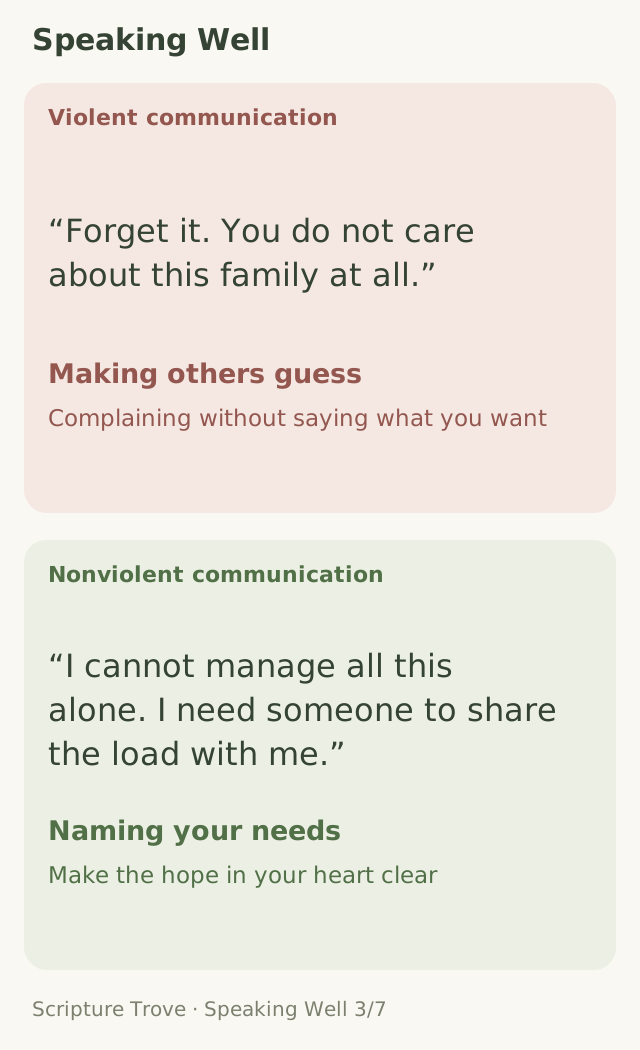
“Forget it. You do not care about this family at all.” conceals an unspoken need: I cannot carry everything alone. The listener hears accusation instead.
Say directly, “I cannot manage all this alone. I need someone to share the load with me.” Clear needs prepare the way for specific requests.
Jesus asks the roadside blind beggar, “What do you want me to do for you?” (Mark 10:51). Though knowing, he lets the man say it. Paul urges believers, “let your requests be made known to God” (Philippians 4:6). Clear expression between people is likewise honest.
Request: Leave Freedom to Refuse
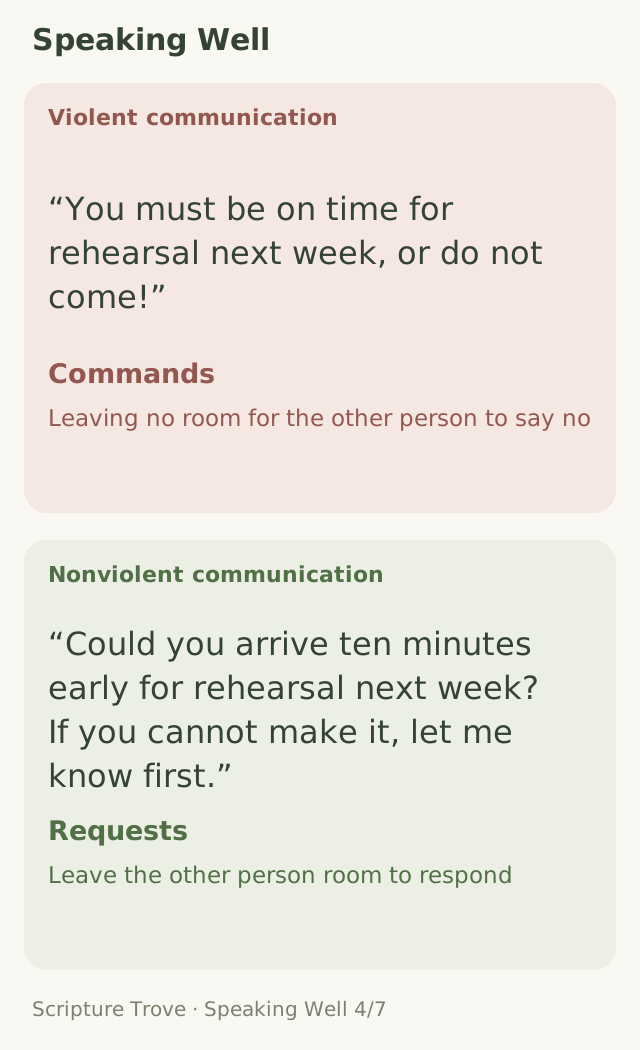
“You must be on time for rehearsal next week, or do not come!” leaves no room for refusal without expulsion.
A request allows space: “Could you arrive ten minutes early for rehearsal next week? If you cannot make it, let me know first.” Respect for agency, freedom and dignity often encourages willing cooperation.
Paul tells Philemon, “Therefore though I have all boldness in Christ to command you that which is appropriate, yet for love’s sake I rather appeal to you, being such a one as Paul, the aged, but also a prisoner of Jesus Christ” (Philemon 1:8–9). He chooses appeal despite authority to command.
Parents and leaders may establish rules. Scripture entrusts upbringing to parents while saying, “You fathers, don’t provoke your children to wrath” (Ephesians 6:4). Name a rule honestly instead of disguising it as negotiation: “From tonight, phones charge in the living room at half past ten. Let us discuss any difficulty doing that.” Clear rules need no humiliation.
2. Three Harmful Habits
Three habits can turn ordinary disagreement into injury.
Reviving Old Grievances
“You are always like this! Even the year we got married, you…” buries today's issue beneath years of accusations.
“He who covers an offense promotes love; but he who repeats a matter separates best friends” (Proverbs 17:9). Love “takes no account of evil” (1 Corinthians 13:5). Bring the conversation back: “Let us talk through what happened today first.”
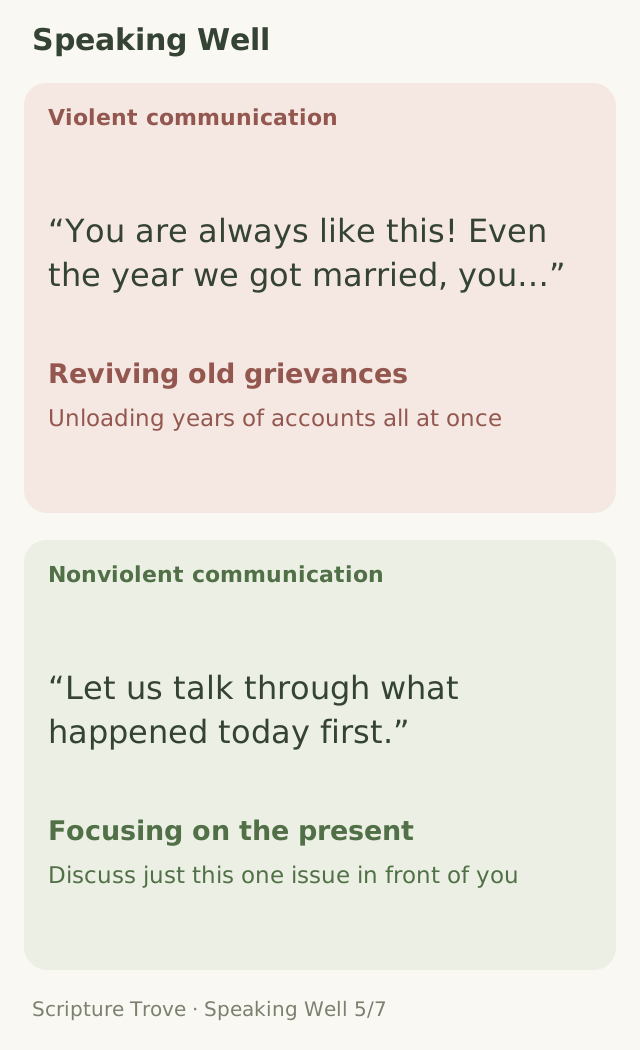
Focusing now does not erase history. Repeated harm needs separate, careful discussion, perhaps with trusted help. Avoid unloading years of accounts while angry.
Interrogation
“With marks this low, what on earth are you doing in class?” has a question mark but seeks admission of guilt rather than an answer.
A genuine question opens space: “Where did you get stuck this time? Tell me about it.” “Counsel in the heart of man is like deep water, but a man of understanding will draw it out” (Proverbs 20:5).
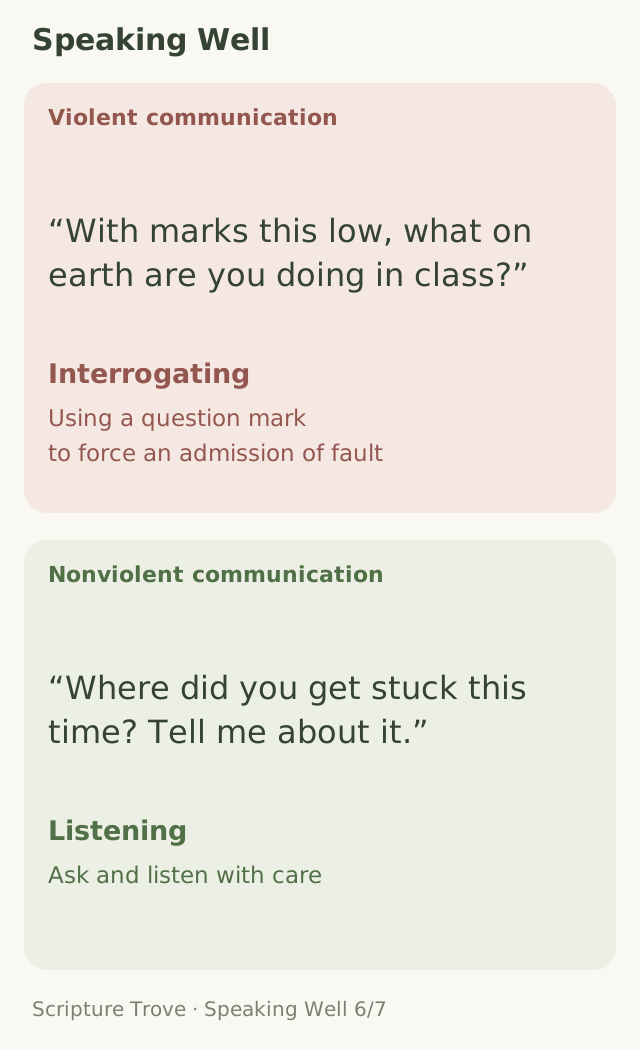
After human sin, God's first address is a question: “Where are you?” (Genesis 3:9). He knows the answer, yet calls the hiding person to face him. Our questions cannot equal that call, but we can learn to ask and listen before concluding.
The Silent Treatment
“Whatever,” followed by three days' silence, makes silence a punishment forcing surrender.
Cooling down is reasonable; returning afterwards matters. Say, “I am too angry right now. I want to go for a walk first. I will be back at nine, and we can talk it through properly.” Pausing prepares return.
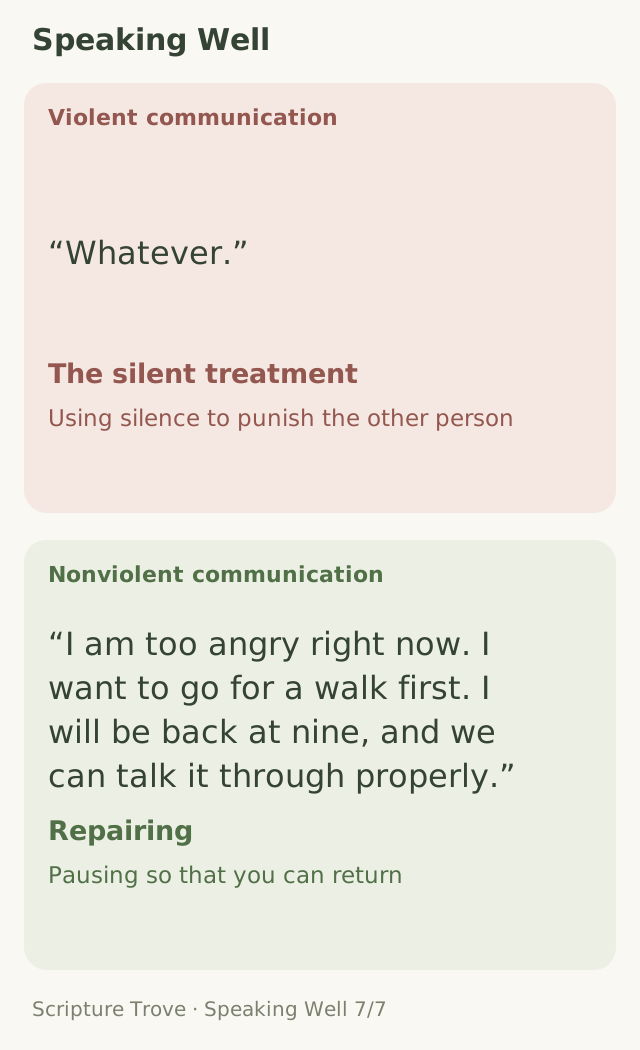
Paul says, “Don’t let the sun go down on your wrath, and don’t give place to the devil” (Ephesians 4:26–27). Avoid nurturing anger; every conflict need not be resolved before that day's end. Jesus even says that when we remember a brother’s grievance while offering a gift, “First be reconciled to your brother, and then come and offer your gift” (Matthew 5:23–24).
3. Why Knowing Does Not Guarantee Speaking Well
These four elements and three cautions can reduce needless defensiveness and misunderstanding. Yet under pressure, even informed people blurt out the most hurtful words.
Rosenberg sees unnoticed feelings and needs beneath harmful speech. James goes deeper: “Where do wars and fightings among you come from? Don’t they come from your pleasures that war in your members?” (James 4:1).
Respect, understanding and household peace are good desires. Once they become non-negotiable demands, however, we inwardly condemn anyone withholding them and punish through words.
Jesus says, “out of the abundance of the heart, his mouth speaks” (Luke 6:45). Speech grows from the heart. Communication techniques prune branches but cannot replace roots.
Keep Nonviolent Communication in its proper place. Some Christians reject psychology outright, yet God provides useful wisdom through human observation, and Proverbs already contains many such insights. Others make the method a universal solution or a manipulation technique: beautiful wording disguising a heart still calculating how to secure compliance. This dresses control in gentleness.
The approach works best where both parties willingly listen. One-sided use may reduce misunderstanding but cannot stop another's harm. Persistent verbal abuse, intimidation or physical violence requires protection and help from trusted relatives, reliable church colleagues or professional organisations, and police where necessary. You need not force yourself to speak more gently.
4. Christ Frees Us to Lay Down Verbal Weapons
Jesus was mocked and insulted during trial. Peter writes, “When he was cursed, he didn’t curse back. When he suffered, he didn’t threaten, but committed himself to him who judges righteously” (1 Peter 2:23). Justice rested in the Father's hands; he needed no harsh retort to reclaim it.
The gospel offers this freedom. Fully known and accepted in Christ, we need not win arguments to prove rightness or worth. The Lord judges, freeing us from revenge. Having received great forgiveness, we learn to forgive “just as God also in Christ forgave you” (Ephesians 4:32). Forgiveness relinquishes retaliation while preserving truth, boundaries and proper accountability.
The risen Jesus meets Peter by the sea after his three denials. Rather than rehearsing that night's accusations, he asks three times whether Peter loves him (John 21:15–17). Peter grieves at the third question: the failure is touched. Yet Jesus then entrusts his sheep to Peter. Truth is faced and relationship repaired.
5. Begin with One Sentence Today
- Pray first. Before speaking, say inwardly, “Set a watch, Yahweh, before my mouth. Keep the door of my lips” (Psalm 141:3).
- Rewrite one sentence. Rework a recent hurtful remark through observation, feeling, need and request. Where appropriate, apologise: “Calling you hopeless was wrong. I am sorry.”
- Ask before speaking. During the next disagreement, ask a real question and hear the answer: “be swift to hear, slow to speak, and slow to anger” (James 1:19).
Conclusion
Imagine the mother speaking differently the next day: “Four evenings this week, you used your phone after midnight. I worry about you falling asleep in class. Let us agree tonight when to put it away.” The child may still grumble or withdraw. Speaking well cannot decide his response, but her words need not close the door.
The same issue can be expressed as a sword or medicine. The difference often begins with where the heart goes before the mouth opens.
Let us pray: “Let the words of my mouth and the meditation of my heart be acceptable in your sight, Yahweh, my rock, and my redeemer” (Psalm 19:14).
Further Reading