In April 2025, the Bible Society published The Quiet Revival. One figure spread widely through Chinese church messaging groups: monthly church attendance among 18–24-year-olds had risen from 4% to 16%. Many shared it and felt encouraged.
The report was withdrawn on 26 March 2026. YouGov acknowledged a group of respondents it could now identify as fraudulent. The problem lay in an opt-in online panel: young people willing to repeatedly complete surveys for payment are already not a random group, with further distortion from people answering carelessly for rewards. Such samples are particularly unreliable for young people, and a surge in youthful religiosity is precisely the illusion they readily produce.
If you shared that figure, find an opportunity to correct it. Correction carries more authority than silence.
What is the actual picture? The following figures come from random probability sampling, selecting people randomly rather than inviting voluntary answers. I want to leave three points.
1. One in Twenty British Adults Attends Church Weekly
In 2024, only one in twenty British adults attended a church gathering each week: 5%.
Although 40% identify as Christian when asked, only 5% actually attend weekly Sunday church gatherings: one adult in twenty.
This is the British church's actual situation today.
2. An Apparently Stable Percentage Conceals a Changed Population
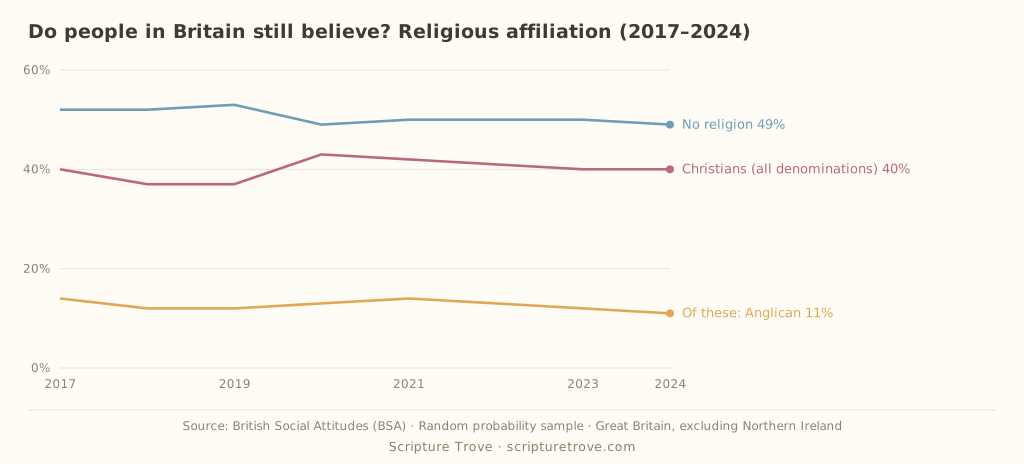
British Social Attitudes, 2017–2024. Data: the National Centre for Social Research, NatCen.
Christian identification totalled 40% in 2018 and still stood at 40% in 2024. Report author John Curtice says its long-term decline appears to have stalled.
Yet structural change is occurring beneath the stable surface.
In Greater London, White British people constitute only 39.9%, around two-fifths, of those identifying as Christian. Among the remaining three-fifths, nearly one-fifth of the total are Catholics from Poland, Romania and Lithuania, and 12% are African, alongside Caribbean and Irish groups. Birmingham's position is less pronounced: White British people constitute 62.4%.
Nationally, Christian identification among several migrant ethnic groups is higher than among White British people: Caribbean 69.1%, African 65.7%, Other White 60.0%, compared with White British 49.0%.
⚠️ This does not mean all migrants are more Christian than local people. Groups from Muslim or Hindu traditions have much lower Christian identification, including Pakistani 0.8% and Bangladeshi 0.3%.
Migrant communities therefore contribute substantially to the overall 40% being maintained. Cities with more migration consequently show higher religious affiliation, including Islam: Birmingham's no-religion proportion is only 24.14%, compared with 37.19% nationally.
3. Two Faiths: The Major Crisis behind Age Profiles
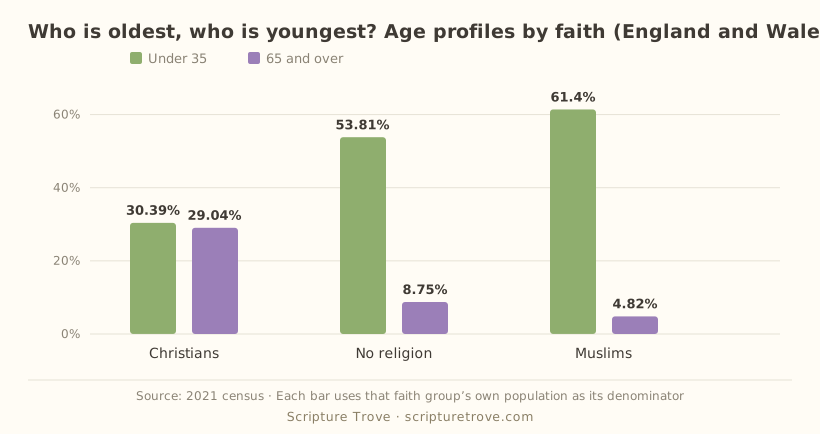
2021 census. Each cell's denominator is the population identifying with that faith.
Britain's Christians are the oldest group. People over 65 account for 29.04%, almost equal to the 30.39% under 35. Muslims show the reverse pattern: 61.4% are under 35, twice the Christian proportion, and only 4.82% over 65. Their overall population is very young.
Some respond that Christians still greatly outnumber Muslims. Identification totals are indeed 27.52 million Christians and 3.87 million Muslims, a ratio of 7.1 to one.
But these are nominal figures.
A rough attendance calculation gives Christians ×13% ≈ 3.58 million, and Muslims ×39%, using the overall non-Christian-faith attendance figure as a proxy, ≈ 1.51 million. The gap shrinks from 7.1 to around 2.4 times.
⚠️ This indicates only approximate scale. The 39% combines non-Christian religions; it is not a Muslim-specific rate. This module could not find a separately verifiable Muslim attendance rate in Britain's existing survey system. The broad direction, however, is clear.
The age gradient sharpens the picture. Christian-to-Muslim identification ratios are:
| Nominal Christians : Muslims | |
|---|---|
| Over 65 | 42.9 : 1 |
| All ages | 7.1 : 1 |
| Under 35 | 3.5 : 1 |
The extremes differ twelvefold.
What about Ten or Twenty Years Ahead? Today's Age Gradient Already Shows the Answer
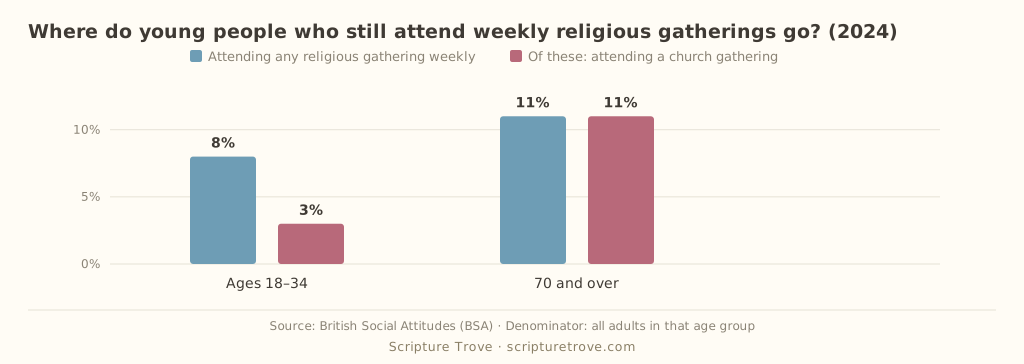
2024 British Social Attitudes. Denominator: all adults in each age group.
Among British adults aged 18–34, 8% attend any religious gathering weekly, while only 3% attend a Christian church. The other 5% attend other religions; one may infer that many probably attend mosques.
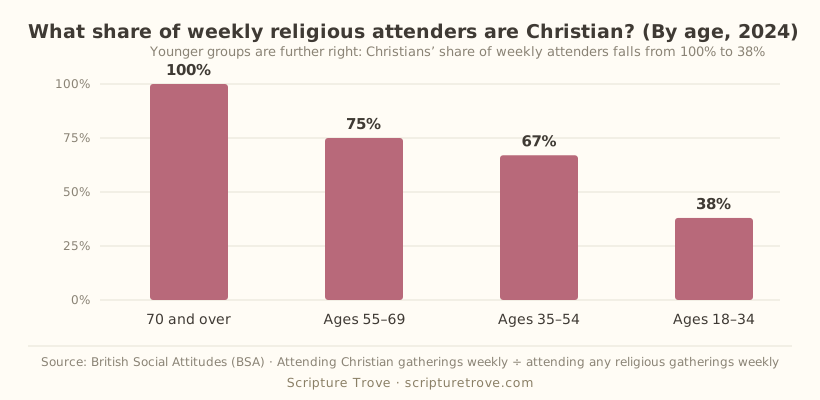
2024 British Social Attitudes. Weekly Christian attendance divided by weekly attendance at any religious gathering.
Dividing weekly attenders by age, the Christian share falls from 100% to 38%:
| Age group | Weekly attendance at any religious gathering | Christian attendance | Christian share |
|---|---|---|---|
| Over 70 | 11% | 11% | 100% |
| 55–69 | 8% | 6% | 75% |
| 35–54 | 9% | 6% | 67% |
| 18–34 | 8% | 3% | 38% |
These describe today's age groups, rather than a forecast. Generational replacement itself changes the composition of Britain's gathering population.
⚠️ Three limitations must accompany this table:
First, this is a trend rather than destiny. People change, and the future ultimately belongs to God.
Second, non-Christian does not mean Muslim. Hindu, Sikh, Jewish and Buddhist communities also belong to this category, though their shares are small.
Third, subgroup samples are small. Each BSA age group contains only a few hundred respondents. Look at gradients, rather than individual percentage points.
⚠️ Do not place the entire seriousness of the situation upon Muslims. Among British 18–34-year-olds, 92% attend no religious activities. Numerically, that is the real majority. A young person attending a mosque and one attending Sunday church both belong to a minority doing something their peers do not. Praying for them and treating them as a threat are entirely different paths.
What Should These Figures Lead Us to Do?
At Horeb, Elijah told God that only he remained.
God answered with correction rather than consolation: “Yet I reserved seven thousand in Israel, all the knees of which have not bowed to Baal…” (1 Kings 19:18).
Elijah's count was wrong. His position allowed him to see only himself; he was not lying.
Numbers change neither the gospel nor our calling. They change one thing: the clarity of our sight.
Clarity is grace: we need neither pretend all is well nor imagine we alone remain.
These figures have two sources with different geographical coverage and questions, so they cannot be added or subtracted against one another. Affiliation and attendance come from 2024 British Social Attitudes, a random probability survey covering Great Britain, excluding Northern Ireland, with 3,878 respondents. Ethnic and age composition come from the 2021 England and Wales census, Office for National Statistics. ⚠️ BSA subgroups are small, with only a few hundred respondents behind ages 18–34. Read trends, rather than decimal places.
⚠️ A wording clarification: BSA asks how often people attend meetings or activities connected with their religion, without restriction to Sunday. This article uses church gatherings or religious gatherings, avoiding wording that reduces gathering to a ritual, which particularly misleads new believers.
Every figure can be explored in Global Watch, including full definitions, common misreadings and cell-by-cell checks against independent sources. The data module presents facts; this article's judgments are the author's responsibility.