A Brief History of the Church — Study Guide
Pastor Bond · May 2026 · Compiled with the assistance of Claude · Scripture Trove Quest "Serving and Equipping Series," No. 10
Chapter 1 — The Early Church: Witness Through Fire and Blood
Learning Objectives: Understand the birth, growth, and trials of the church during the approximately three hundred years from Pentecost to the time of Constantine; learn how the Apostolic Fathers, apologists, and martyrs laid the church's foundations under persecution; and understand how the New Testament canon was formed.
1. Pentecost: The Birth of the Church
Acts chapter 2 records the moment the church was born: the Holy Spirit descended at Pentecost, the disciples were filled with the Spirit, Peter stood up and boldly proclaimed the gospel, and that day about three thousand people repented and were baptized. This small community of Galilean fishermen became a force that would change the course of human history.
Acts 2:42 paints a vivid portrait of the early church's life: "They continued steadfastly in the apostles' teaching and fellowship, in the breaking of bread, and prayer." These four things — the apostles' teaching (solid biblical instruction), fellowship (community life), the breaking of bread (the Lord's Supper), and prayer — remain the four pillars of a healthy church to this day. The early believers "had all things in common" (Acts 2:44–45), living in Jerusalem as a community of mutual love and willing generosity — the most authentic witness to the power of the gospel.
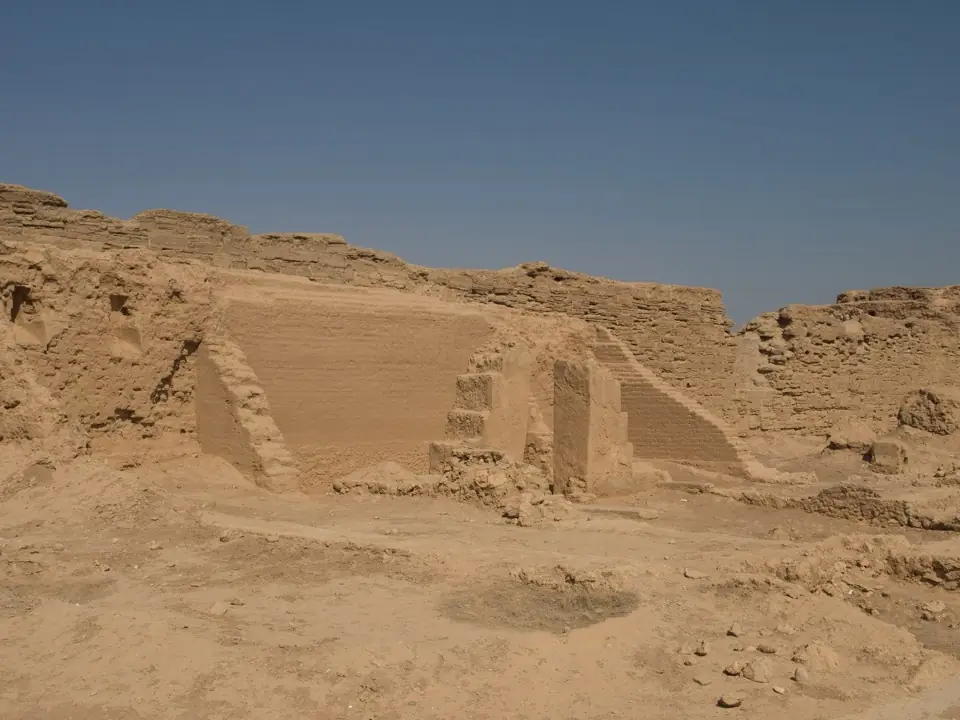
The house-church ruins at Dura-Europos in Syria, c. AD 232–256, are among the earliest surviving and most clearly identifiable Christian house-church buildings. Rooms in a private house were opened up to make a meeting hall, and another room was converted into a baptistery. Source: Doura Europos domus ecclesiae front from S.jpg, Marsyas, CC BY-SA 3.0. See this exhibit in the Bible Museum

2. The Church at Antioch: From the Jewish World to the Gentile World
The church at Antioch holds a landmark place in church history. Persecution became the very means by which the gospel spread — after Stephen's martyrdom, "those who were scattered abroad went around preaching the word" (Acts 8:4), and the gospel reached Antioch. There, the disciples were first called "Christians" (Acts 11:26), marking the moment this movement ceased to be a sect within Judaism and took on its own distinct identity.
More significantly, the church at Antioch, led by the Holy Spirit, sent out Barnabas and Paul on a mission (Acts 13:1–3), launching the first organized missionary sending in church history. Paul then undertook three missionary journeys, carrying the gospel from Asia into Europe. His strategic wisdom was far-reaching: he first entered Jewish synagogues to preach, then turned to the Gentiles (Acts 13:46); he planted churches in major cities as centers of influence (Acts 19:9–10); he raised up local leaders so that churches could become self-sustaining (Acts 14:21–23); and he maintained accountability with the sending church through regular reports (Acts 14:26–28).
3. The Historical Stage God Prepared
The apostle Paul wrote in Galatians 4:4: "But when the fullness of the time came, God sent out his Son." This was no accident. The Roman Empire provided three key conditions for the spread of the gospel: the network of Roman roads spanning the empire, enabling missionaries to travel quickly; Greek as the common language of the eastern empire, allowing the gospel to cross ethnic boundaries; and the Pax Romana (Roman Peace), which provided a relatively stable social environment. God reigns over human history and prepared the way for his plan of redemption.
4. Steadfast Under Persecution
Roman persecution of Christians ebbed and flowed over approximately three hundred years. From Nero's localized attacks (AD 64) to the empire-wide systematic persecutions under Decius (250) and Diocletian (303), the severity varied greatly across different periods. The primary reason Christians were persecuted was not that they refused to pay taxes or serve in the military, but that they refused to participate in the imperial cult — they would not burn incense to the Roman emperor or to pagan idols.
Yet persecution not only failed to destroy the church; it produced two unexpected positive effects. First, it purified and deepened the church's commitment — those who followed only casually fell away under pressure, leaving behind those who truly trusted in Christ. Second, the peace and courage martyrs displayed in the face of death deeply moved onlookers. The early Church Father Tertullian left us a timeless saying: "The blood of the martyrs is the seed of the church." Jesus had promised, "I will build my assembly, and the gates of Hades will not prevail against it" (Matthew 16:18), and the experience of the early church vividly confirmed those words.
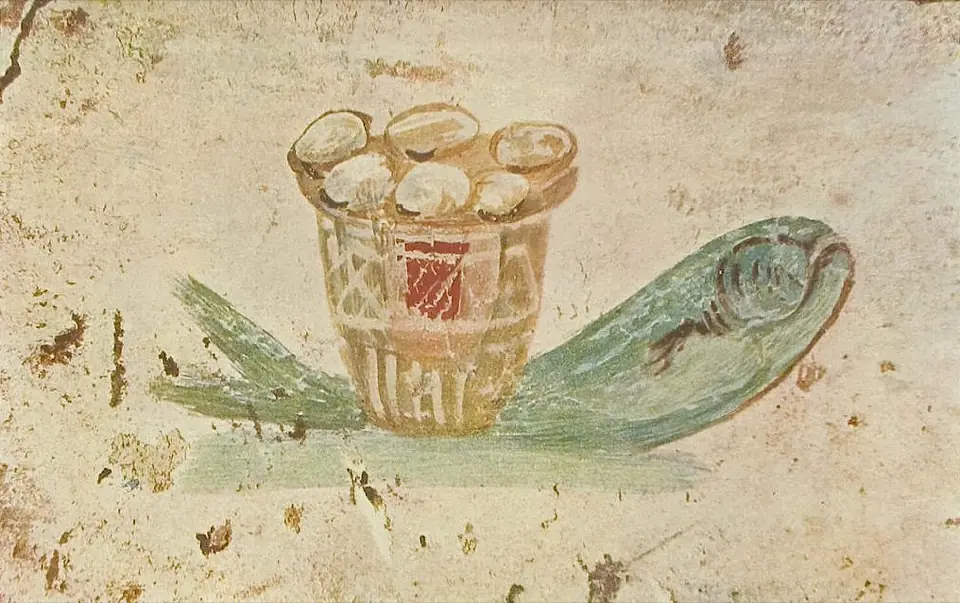
A fish-and-bread fresco in the Catacomb of Callistus in Rome, c. second century AD. Fish were a common early Christian symbol: the five Greek letters of “fish” (ΙΧΘΥΣ) could represent the initials of “Jesus Christ, God’s Son, Saviour”. The fish and bread also recall the feeding of the five thousand and the Lord’s Table. Source: Loaves and fish, Crypt of Lucina, Catacomb of Callistus, …, Joseph Wilpert catalogue (1903), public domain. See this exhibit in the Bible Museum

5. The Apostolic Fathers and the Apologists
The Apostolic Fathers were second-generation church leaders who had direct or indirect contact with the apostles — the first inheritors of the apostolic tradition:
Polycarp was a disciple of the apostle John and bishop of Smyrna. At approximately 86 years of age, he was martyred for refusing to deny Christ, leaving behind a deeply moving declaration: "Eighty-six years I have served him, and he has done me no wrong. How can I blaspheme my King who saved me?" The Martyrdom of Polycarp is one of the earliest surviving accounts of a Christian martyrdom and has inspired countless believers ever since.
Ignatius of Antioch was bishop of the church at Antioch. On his way to Rome to be martyred, he wrote seven letters. Two themes stand out: the unity of the church gathered around its bishop, and his own fervent longing for martyrdom — he wrote, "I am God's wheat, and I am ground by the teeth of wild beasts that I may be found pure bread of Christ."
Clement of Rome wrote to the church at Corinth around AD 96, urging them to restore order and unity — a beautiful expression of the mutual care and pastoral concern that characterized the early churches.
Among the apologists, Justin Martyr (c. 100–165) was the most important. A philosopher before his conversion, he used the Greek philosophical concept of the Logos to explain the reasonableness of the Christian faith to Roman intellectuals, demonstrating that Christianity was not superstition but the true "love of wisdom." He was later martyred for his faith. Justin's approach reminds us that communicating eternal truth in language that people of each era can understand is a lesson every generation of the church must learn.
Tertullian (c. 155–220), a church leader in Carthage in North Africa, is called the "Father of Latin Christianity." He was the first theologian to use the Latin term Trinitas (Trinity) and developed the formulation "one substance, three persons," laying crucial linguistic groundwork for the Trinitarian doctrine that would be affirmed at the Council of Nicaea.
6. The Formation of the New Testament Canon
The formation of the New Testament canon was a gradual and organic process, not a decision made from scratch at a single council. From the beginning, churches used the apostles' letters and Gospels in worship; later councils (such as the Council of Carthage in AD 397) confirmed the apostolic authority these books already possessed rather than conferring new authority upon them.
The process unfolded in three stages: use (widespread use in worship and teaching) → discernment (distinguishing apostolic writings from others) → confirmation (formally listing the authoritative books). One important catalyst was the challenge of heresy: the Marcionite heresy, which attempted to reduce the canon (retaining only a modified version of Luke and some of Paul's letters), actually prompted the church to define the canon's boundaries more clearly. A common misconception is that the Council of Nicaea (325) determined the canon — in fact, that council's agenda was Christology, not the canon.
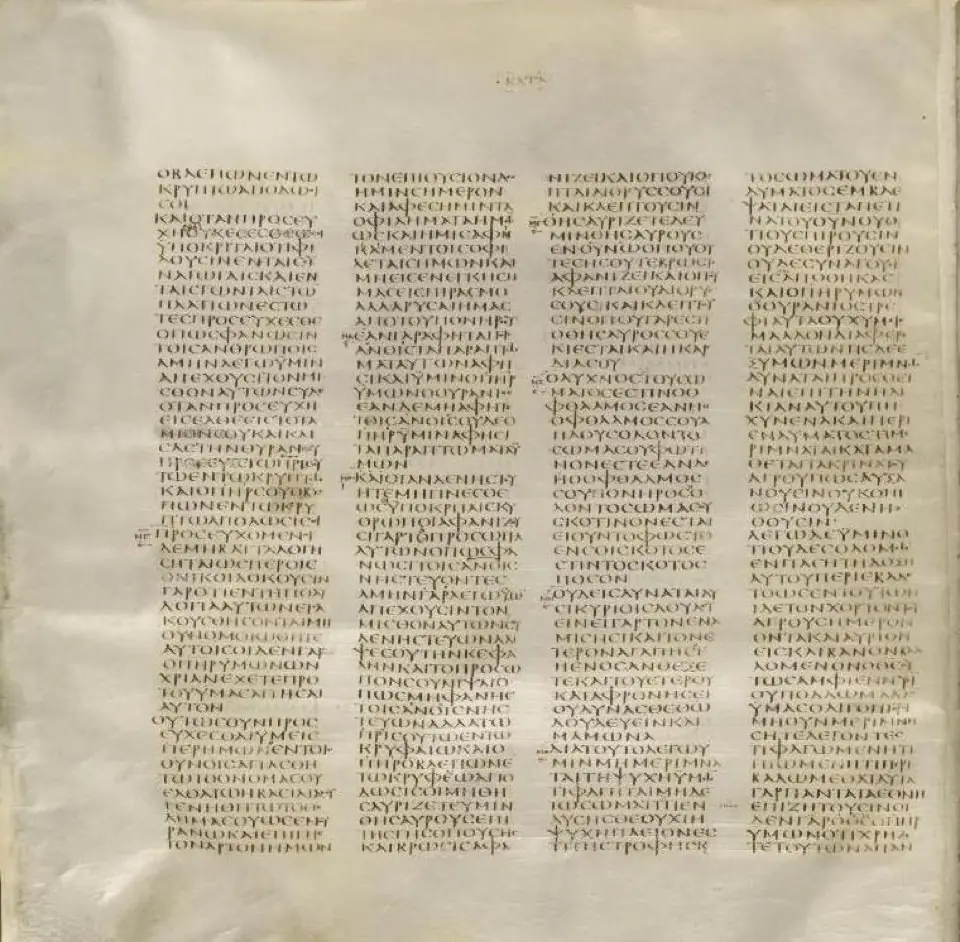
A page of Matthew 6 in Codex Sinaiticus. Dating to around the mid-fourth century AD, this manuscript is the oldest surviving complete New Testament; most of it is now in the British Library. Source: Codex Sinaiticus Matthew 6,4-32.JPG, public domain. See this exhibit in the Bible Museum

7. The Early Church's Response to Heresy
Facing challenges from Gnosticism and other heresies, the early church developed three key strategies: (1) Establishing apostolic succession — setting the publicly known apostolic teaching against the heretics' claims to "secret knowledge" (Irenaeus's Against Heresies is the landmark work here); (2) Formulating a rule of faith (regula fidei) — summarizing the core of apostolic teaching in concise confessional statements; (3) Progressively confirming the canon — giving the church a shared standard of authoritative Scripture. These strategies remind us that, in the face of false teaching, solid biblical instruction and clear confessions of faith remain the most effective defenses in every age.
Reflection and Discussion
- The early church grew and flourished in extraordinarily difficult circumstances. What encouragement does this offer us as we face challenges to our faith today?
- Tertullian said, "The blood of the martyrs is the seed of the church." How do you understand the relationship between persecution and the growth of the church?
- The Apostolic Fathers defended the faith with their lives. What challenge does their example of commitment present to our own faith today?
Chapter 2 — Creeds and Church Fathers: Establishing the Doctrinal Foundations
Learning Objectives: Understand the key historical events and ecumenical councils from Constantine to Chalcedon; learn how the Nicene Creed and the Chalcedonian Definition established the orthodox formulations of Trinitarian and Christological doctrine; and appreciate the lasting theological contributions of Augustine and other Church Fathers.
1. Constantine and the Edict of Milan
In AD 313, Constantine issued the Edict of Milan, declaring a policy of religious toleration and granting Christianity legal status, bringing to an end the intermittent persecutions of the previous era. This was a major turning point in church history — the church moved from being a persecuted minority to a legally recognized religion within the empire. It is worth noting that the Edict of Milan granted toleration, not establishment — it was Theodosius I who formally made Christianity the state religion in 380.
2. The Council of Nicaea and the Arian Controversy
The Council of Nicaea (325) was the first ecumenical council in Christian history, convened by Emperor Constantine. Its central task was to respond to the Arian challenge to the full divinity of Christ. Arius's core claim was that the Son was a created being, not eternal — "there was a time when the Son was not." He held that Christ, though the most exalted of creatures, was different in essence from the Father. This teaching appeared to honor Christ's greatness while in fact fundamentally denying his full divinity — if Christ is not truly God, the very foundation of salvation is undermined.
The council passed the Nicene Creed by an overwhelming majority, using several key phrases to counter Arius: Christ is "God of true God," "begotten, not made," "of one substance" (homoousios) with the Father. That single word, homoousios, became the dividing line between orthodox faith and the Arian heresy.
Athanasius was the most resolute defender of Nicene orthodoxy. Exiled five times throughout his life, he never compromised his insistence that the Son is of one substance with the Father. When the semi-Arians proposed the compromise term homoiousios ("of similar substance"), Athanasius firmly refused — he understood that a single letter's difference touched the very foundation of the faith. Posterity called him Athanasius contra mundum ("Athanasius against the world"), because at the most critical moments he stood almost alone against the pressure of the entire world.
3. The Deepening of Trinitarian Doctrine
The Cappadocian Fathers — Basil of Caesarea, Gregory of Nazianzus, and Gregory of Nyssa — made decisive contributions to Trinitarian theology. They carefully distinguished between the Greek terms ousia (essence, referring to the one shared divine nature) and hypostasis (person, referring to the distinct individuality of Father, Son, and Holy Spirit), thereby articulating clearly the orthodox formula of "one essence, three persons." Basil also wrote On the Holy Spirit, powerfully defending the full divinity of the Spirit.
Although the word "Trinity" does not appear directly in Scripture, the Trinitarian reality runs throughout the whole Bible — the Father sends the Son (John 3:16), the Son promises the Spirit (John 14:26), and the Trinitarian baptismal formula of Matthew 28:19 reads, "baptizing them in the name of the Father and of the Son and of the Holy Spirit." The work of the creeds was to summarize in precise language what Scripture had already revealed, not to invent new doctrine.
4. The Chalcedonian Definition: The Christological Standard
If Nicaea answered the question "Who is Christ?" (he is truly God), the Council of Chalcedon (451) answered the question "How do Christ's divine and human natures exist together in one person?" The Chalcedonian Definition declared that Christ is one person in two natures — fully divine and fully human — and used four famous negatives to define the relationship between the two natures:
- Without confusion — the two natures are not merged into a single new nature (responding to Eutychianism)
- Without change — each nature retains its own integrity
- Without division — the two natures cannot be split apart
- Without separation — the two natures are never separated within the one person (responding to Nestorianism)
The Chalcedonian Definition remains to this day the shared Christological standard of Protestantism, Roman Catholicism, and most of Eastern Orthodoxy — one of the most important doctrinal formulations in two thousand years of church history.
5. Augustine: The Shaper of Western Theology
Augustine of Hippo (354–430) is one of the most profoundly influential theologians in church history. His two core contributions deeply shaped subsequent Christian thought:
The doctrine of grace. In his controversy with Pelagius, Augustine insisted that because of the Fall and original sin, humanity is utterly incapable of saving itself; only God's sovereign grace can bring a person to repentance and faith in Christ (Romans 5:12). Pelagius, by contrast, argued that human beings have the capacity to choose good by free will and attain a perfect moral standard — a position the church condemned as heresy. Augustine's doctrine of grace profoundly influenced Luther and Calvin and became a vital theological foundation for the Protestant doctrine of "grace alone."
The City of God. After Rome was sacked by the Visigoths, pagans blamed Christianity for Rome's decline. Augustine responded with a sweeping vision, proposing the concept of "two cities": the "City of God," defined by love for God, and the "Earthly City," defined by love of self, intertwined throughout history until the final judgment separates them. This work became a foundational text for Western political theology and the philosophy of history.
6. Jerome and the Apostles' Creed
Jerome (c. 347–420) was fluent in Hebrew, Greek, and Latin. Over approximately twenty years, he translated the entire Bible from the original languages into Latin — the famous Vulgate. This translation became the standard Bible of the Western church for over a thousand years, until the Reformation era produced vernacular translations. Jerome's work reminds us how vital it is that every person be able to read God's Word in their own language.
The Apostles' Creed, though not written by the apostles themselves, developed gradually from the baptismal interrogations of the early church and reached its present form roughly between the 4th and 7th centuries. It faithfully summarizes the core of apostolic teaching, expressing in concise form the essentials of the Christian faith — the Triune God, the incarnation and resurrection of Christ, the work of the Holy Spirit, the nature of the church, and the hope of the age to come. The Apostles' Creed remains a shared confession across denominations to this day; both Luther and Calvin held it in high regard.
Reflection and Discussion
- Athanasius was exiled five times and never compromised. What does his steadfastness inspire in us when it comes to holding firm to truth today?
- The Chalcedonian Definition uses four negatives to define the relationship between Christ's two natures. How does this help us understand who Jesus is?
- Augustine emphasized that "only grace can save." How does this challenge the common human tendency to think we can manage on our own effort?
Chapter 3 — The Medieval Church: Light and Shadow Intertwined
Learning Objectives: Understand the many faces of the medieval church (c. 500–1500): how monasteries preserved civilization, how universities were born from the church, why the Eastern and Western churches divided, the complex historical legacy of the Crusades, and how forerunners of reform such as Wycliffe and Hus prepared the way for the Reformation.
1. Benedict and Monastic Civilization
Benedict of Nursia (c. 480–547) is honored as the "Father of Western Monasticism." The Rule of Saint Benedict he composed was built around the spirit of ora et labora — "pray and work" — emphasizing a disciplined and ordered spiritual life with a healthy rhythm of prayer, Scripture reading, and physical labor. Far from the extreme asceticism many might imagine, the Rule of Benedict is notable for its moderation and balance.
The contribution of medieval monasteries extended far beyond their religious function. Monks in the scriptorium painstakingly copied, word by word, vast quantities of ancient Greek and Roman texts and biblical manuscripts, preserving this precious knowledge through the chaos of the barbarian invasions. Monasteries also established Europe's earliest schools and hospitals, sheltered the poor and pilgrims, and pioneered many agricultural innovations — drainage, brewing, herbal cultivation, and more. Monasteries were the "beacons of civilization" in medieval Europe, preserving and transmitting knowledge and faith through what is sometimes called the "Dark Ages."
2. Irish Monks: Mission in Reverse
When the Western Roman Empire fell (476) and continental Europe descended into barbarian chaos, Ireland — remote and largely untouched — preserved Christian culture. Irish monks then launched a remarkable reverse mission: Columba established the famous monastery of Iona off the coast of Scotland, while Columbanus journeyed deep into Gaul and Italy, founding several monasteries. These monks carried hand-copied Bibles and scholarly texts, rebuilding faith and culture amid the ruins — a story later described as "how the Irish saved civilization."
3. Medieval Universities and Scholasticism
Almost all medieval European universities had close ties to the church — the University of Paris grew out of the cathedral school of Notre-Dame, while Oxford and Cambridge had deep roots in monasteries and bishoprics. Latin served as the common language of instruction, and theology held the highest place in the curriculum, called the "queen of the sciences" (regina scientiarum). These universities, born from the church, became the direct ancestors of the modern system of higher education.
Scholasticism was the defining intellectual tradition of the Middle Ages. Anselm proposed fides quaerens intellectum — "faith seeking understanding" — while Thomas Aquinas, in his Summa Theologica, systematically argued for the harmony of faith and reason: reason can discern certain evidence for God's existence, while revelation provides truths that reason alone cannot reach. Scholasticism demonstrated that faith and reason can work together, reminding us that loving God "with all your mind" (Matthew 22:37) includes the dimension of careful rational thought.
4. The Rise of Islam and the Shifting Map of Christianity
After Islam arose in the seventh century, it expanded with remarkable speed, conquering the entire Arabian Peninsula, Persia, and North Africa within a hundred years, and crossing into Spain. North Africa had been the homeland of Augustine, Cyprian, and other Church Fathers; the Middle East was the birthplace of the apostolic church — these oldest heartlands of Christianity gradually became Islamized after the conquests. In 732, Charles Martel halted the Muslim advance into Western Europe at the Battle of Tours; without that victory, the religious map of Europe might have looked entirely different. This history reminds us that the church's geographic boundaries can shift, but God's kingdom is not limited by geography.
5. The Great Schism of 1054: The Tearing Apart of East and West
In 1054, the Eastern and Western churches formally divided, giving rise to the two great traditions of Roman Catholicism in the West and Eastern Orthodoxy in the East. The causes of the split operated on several levels:
Theological dispute: The Western church inserted the Filioque clause into the Nicene Creed, declaring that the Holy Spirit proceeds from the Father "and the Son" (Filioque). The Eastern church objected not only to what might be a doctrinal deviation, but also to the act of altering the creed without the consent of an ecumenical council.
Dispute over governance: The Bishop of Rome increasingly claimed supreme authority over the universal church, while the Eastern sees of Constantinople, Alexandria, and others recognized him only as holding an honorary "first among equals" (primus inter pares) status, refusing to accept his absolute jurisdiction.
Cultural distance: The West used Latin; the East used Greek. The long political separation of the eastern and western halves of the Roman Empire, combined with independently developing liturgical and theological traditions, caused the two to drift ever further apart.
Eastern Orthodoxy has its own distinctive and rich spiritual character: an emphasis on theosis (the process by which a person, through union with God, progressively shares in God's holy nature), a deep veneration of icons, a rich liturgical tradition, and governance by a council of bishops. Understanding the Orthodox tradition helps us appreciate the breadth and richness of the Christian faith.
6. The Crusades: Facing the Complexity of History
The Crusades are among the most contested events of the Middle Ages and must be viewed with balance. On one hand, they had a context of self-defense — the Seljuk Turks had conquered the Christian holy lands, threatened the Byzantine Empire, and harassed pilgrims. On the other hand, the Crusades involved serious atrocities that betrayed their stated purposes (such as the Fourth Crusade's sack of Constantinople in 1204 — Christians attacking Christians) and were exploited by political ambition. The history of the Crusades reminds us that even when an undertaking has legitimate grounds, human sinfulness can still cause it to go badly wrong. We must face the light and shadow of church history with honesty.
7. Forerunners of Reform: Dawn Before the Sunrise
Before the Reformation formally broke out, several courageous voices had already challenged the church's deviations:
The Waldensians from the 12th century onward were committed to preaching Scripture in the language of ordinary people and called for a return to the simplicity of apostolic faith. They endured centuries of persistent persecution.
John Wycliffe (c. 1320–1384), called the "Morning Star of the Reformation," argued that Scripture holds supreme authority over church tradition and the papacy, and translated the Bible into English. Though he died a natural death, his bones were exhumed and burned 44 years later.
Jan Hus (c. 1372–1415) preached boldly in Prague on the basis of Scripture, challenging indulgences and church corruption. He was burned at the stake at the Council of Constance. Before he died, he reportedly said: "Today you burn a goose (Hus means 'goose' in Czech), but in a hundred years a swan will arise whom you will not be able to burn." A century later, Luther fulfilled that prophecy.
These forerunners shared a common characteristic: they all upheld the authority of Scripture and insisted that ordinary believers should be able to read and understand God's Word directly; and they all paid a heavy price for their faithfulness to the truth. Their blood and tears prepared the soil for the Reformation.
Reflection and Discussion
- The medieval church is often simply labeled the "Dark Ages," yet monasteries preserved civilization, universities were born, and the glory of Gothic cathedrals bears witness to the power of faith. How do we hold together the light and shadow of church history?
- Papal power gradually expanded from "first among equals" to absolute authority. What warning does this hold for church leadership and accountability today (Proverbs 11:14)?
- What moves you about the courage and sacrifice of the forerunners of reform?
Chapter 4 — The Reformation: Returning to the Gospel of Scripture
Learning Objectives: Understand the historical background and core theological convictions of the Reformation (the Five Solas); learn about the contributions and differences of reformers such as Luther, Calvin, and Zwingli; and understand how the major Protestant denominations came into being.
1. The Historical Preparation for Reform
The outbreak of the Reformation was not accidental; three important background factors converged:
The scholarly preparation of the Renaissance. Humanism emphasized ad fontes — "back to the sources," returning to the original classical texts. Erasmus's edition of the Greek New Testament (1516) allowed scholars to compare the original directly and discover translation errors in the standard Latin Vulgate. This spirit of returning to the sources provided the textual foundation for Luther's discovery of the biblical truth of justification by faith.
The technological revolution of the printing press. Gutenberg's printing press (invented c. 1440) made it possible to reproduce books rapidly and on a large scale. Luther's Ninety-Five Theses spread across the whole of Germany within a matter of weeks — something unimaginable in the age of hand-copying. The printing press was the key technological condition for the rapid spread of Reformation ideas.
Institutional corruption in the church. The sale of indulgences was rampant — the Dominican friar Tetzel publicly declared that a coin dropped in the collection box would release a soul from purgatory ("As soon as the coin in the coffer rings, the soul from purgatory springs"). Simony — the buying and selling of church offices — was widespread. Pope Leo X was living lavishly and selling indulgences on a large scale to fund the construction of St. Peter's Basilica. These corruptions directly distorted the gospel's core message — that salvation is God's free gift of grace, not something that can be purchased with money.
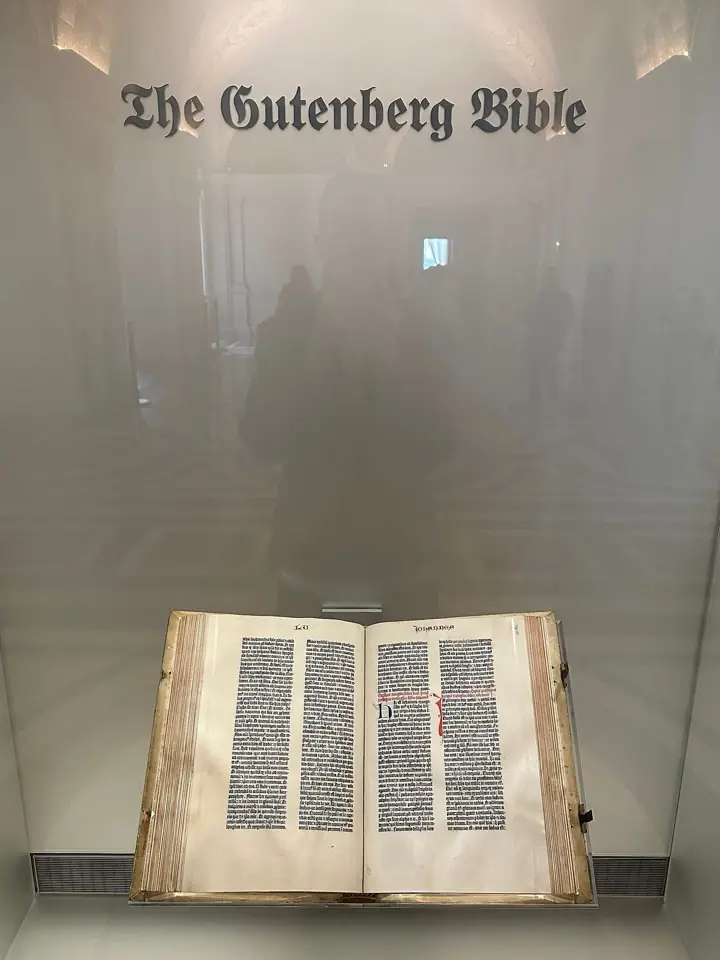
The Gutenberg Bible, printed with movable type in Mainz, Germany, around 1455, held in the Library of Congress. Source: Gutenberg Bible - Library of Congress.jpg, APK, CC BY 4.0. See this exhibit in the Bible Museum

2. Martin Luther and the Outbreak of the Reformation
On October 31, 1517, Martin Luther posted his Ninety-Five Theses on the door of the Castle Church in Wittenberg, initially intending only to invite academic debate about the abuse of indulgences. But as his conflict with Rome deepened, his theological convictions became ever clearer.
Luther's central discovery came from his study of Romans. Reading Romans 1:17 — "The righteous shall live by faith" (quoting Habakkuk 2:4) — he suddenly understood: the righteousness of God is not a standard that condemns us, but a gift God freely gives to those who trust in Christ. He later wrote: "I felt myself to be reborn, and to have gone through open doors into paradise."
At the Diet of Worms in 1521, facing the combined pressure of emperor and pope, Luther refused to recant: "Unless I am convinced by the testimony of the Scriptures or by clear reason — for I do not trust either in the pope or in councils alone — I am bound by the Scriptures I have quoted and my conscience is captive to the Word of God. I cannot and will not recant anything, since it is neither safe nor right to go against conscience. Here I stand. I can do no other. God help me."
Luther's contribution extended far beyond launching the Reformation itself: he translated the Bible into everyday German so that ordinary people could read God's Word directly (a translation that profoundly shaped the development of standard German); he composed congregational hymns (such as "A Mighty Fortress Is Our God"), establishing the Protestant tradition of the whole congregation singing together in worship; and he wrote the Large Catechism and Small Catechism, systematically teaching the core of the faith in question-and-answer form. Luther's example reminds us that reform is not only about rejecting error, but about constructively providing believers with sound resources for faith.
3. The Five Solas: The Theological Heart of the Reformation
The Reformation ultimately crystallized around five Solas (Latin for "alone" or "only"), which became the theological hallmarks of Protestantism:
Sola Scriptura (Scripture Alone) — Scripture is the supreme authority for faith and practice (2 Timothy 3:16). Church tradition has value but is not equal to Scripture; when tradition conflicts with Scripture, we return to Scripture.
Sola Gratia (Grace Alone) — Salvation comes entirely from God's grace; it cannot be earned by human effort (Ephesians 2:8–9).
Sola Fide (Faith Alone) — A person is declared righteous by God through faith in Christ, not through works (Romans 3:28; Galatians 2:16).
Solus Christus (Christ Alone) — Christ is the one mediator between God and humanity; salvation is found in Christ alone (Acts 4:12).
Soli Deo Gloria (To God Alone Be Glory) — All glory belongs to God; a person's salvation is entirely God's work.
These five Solas are not five isolated slogans but an organic whole: because God has revealed himself in Scripture, we know that salvation comes by grace alone, through faith alone, in Christ alone — and all glory belongs to God.
4. Calvin and the Reformation in Geneva
John Calvin (1509–1564) was the central figure of the second generation of the Reformation. His Institutes of the Christian Religion is one of the most systematic theological works in Protestantism, articulating the Reformed faith with clarity of logic and depth of insight. In Geneva, Calvin established a model of church governance grounded in Scripture, emphasizing the collective leadership of elders — pastors, teachers, elders, and deacons each fulfilling their distinct roles. His emphasis on God's sovereignty, his commitment to building church order, and his passion for education profoundly influenced Scotland, the Netherlands, France, the English Puritans, and ultimately the North American colonies — all through the Reformed tradition.
5. Zwingli and the Dispute over the Lord's Supper
Zwingli (1484–1531) carried out reform in Zurich independently of Luther. The two agreed on most doctrines, but a famous disagreement arose over the Lord's Supper: Luther insisted on the "real presence" of Christ in the Supper, while Zwingli held that the Supper is primarily a symbolic act of remembrance of Christ's sacrifice. At the Marburg Colloquy in 1529, the two men reached agreement on fourteen articles of doctrine but could not reach unity on this one point.
This history reminds us that brothers and sisters who agree on the core truths of the gospel may still hold different understandings on certain important doctrines. Unity does not mean complete agreement on every detail, but rather mutual respect for differences within a shared foundation of faith.
6. The English Reformation and Anglicanism
The English Reformation took a distinctive path. Henry VIII (1534) broke with Rome because the pope refused to annul his marriage — his personal motives were far from pure, but the subsequent reform of the English church did involve genuine changes in doctrine and governance, including Tyndale's translation of the Bible into English and Cranmer's composition of the Thirty-Nine Articles. The true establishment of the Anglican identity came through Elizabeth I's "via media" — seeking a middle way between Protestant doctrine and Catholic liturgical tradition. The Book of Common Prayer became the central text of Anglican worship.
7. The Diversity of Protestant Denominations
The Reformation gave rise to multiple Protestant denominations, each with its own emphases but sharing the core faith: Lutheranism emphasizes justification by faith; the Reformed tradition (Presbyterianism) emphasizes God's sovereignty and covenant theology; Baptists emphasize believer's baptism and congregational governance; Methodism emphasizes holy living and social concern; Anglicanism maintains a balance between Protestant and Catholic traditions.
These denominations are united in their core convictions — the Triune God, Christ's redemption, justification by faith, and the authority of Scripture. Differences lie mainly in governance and emphasis. Like a great tree with many branches sharing one root, diversity does not equal division, but reflects the rich variety of faith expressed across different cultures and historical contexts.
Reflection and Discussion
- Luther discovered the truth of "the righteous shall live by faith" in Romans, and it completely transformed his life. Have you ever had an experience of being "illuminated by Scripture"?
- Which of the Five Solas presents the greatest challenge and renewal to your own faith?
- Faced with the diversity of Protestant denominations, how do we find the balance between unity and holding firm to truth?
Chapter 5 — Pietism and the Great Spiritual Awakenings
Learning Objectives: Understand the background, key figures, and core spirit of the Pietist movement and the Great Awakenings of the 17th–19th centuries; understand how these movements responded to spiritual coldness and formalism in the church; and appreciate how they profoundly shaped the modern missionary movement and evangelical faith.
1. Pietism: When Orthodox Doctrine Meets a Cold Heart
The Reformation successfully restored sound doctrine, but by the 17th century many Lutheran churches had fallen into a new crisis — doctrinally orthodox but spiritually lifeless. Faith had become a system of propositions in the mind; church worship had become a matter of going through the motions; and believers' daily lives were disconnected from their faith. This "cold orthodoxy" urgently needed spiritual renewal.
Philipp Jakob Spener (1635–1705) is honored as the "Father of Pietism." In his 1675 work Pia Desideria ("Pious Desires"), he put forward six proposals for reform, with the central conviction that faith cannot remain at the level of intellectual knowledge — it must penetrate the heart and be lived out in daily life. He promoted small Bible study and prayer groups (collegia pietatis), encouraging lay believers to practice godliness in one another's company.
August Hermann Francke (1663–1727) established a network of social ministries in Halle — an orphanage, schools, and a publishing house — translating devout faith into practical care for society. The University of Halle he helped build became a center for training godly ministers and missionaries.
2. The Moravian Brethren: A Century of Unceasing Prayer
Count Nikolaus von Zinzendorf (1700–1760) welcomed onto his estate at Herrnhut a group of refugees descended from the Hussite tradition in Moravia (present-day Czech Republic). In 1727, this small community experienced a powerful outpouring of the Holy Spirit — brothers and sisters came together in repentance, forgave one another, and renewed their commitment. They then began a prayer relay that continued unbroken for over a hundred years, with members taking turns interceding around the clock for the world.
Even more remarkable, this community of only a few hundred people sent out more than 300 missionaries to the world within 25 years — from enslaved communities in the Caribbean to the Inuit of Greenland, from South Africa to South America. The Moravian Brethren became pioneers of the modern missionary movement. Their motto was: "To win for the Lamb."
3. The Wesley Brothers and the Methodist Movement
The 18th-century Church of England had fallen into serious spiritual coldness and formalism. John Wesley (1703–1791) and his brother Charles Wesley led a spiritual revival that swept across Britain. John Wesley's experience on May 24, 1738, became the turning point of his life — he later recalled: "I felt my heart strangely warmed. I felt I did trust in Christ, Christ alone, for salvation."
Wesley rode on horseback across Britain, preaching in the open air, delivering more than 40,000 sermons in his lifetime and traveling over 250,000 miles. He established the "class meeting" system — small groups for Bible study, mutual accountability, and the practice of holy living. Charles Wesley composed more than 6,000 hymns, making him one of the most prolific hymn writers in the history of church music.
The Methodist movement brought not only spiritual revival but also far-reaching social transformation — including the campaign to abolish the slave trade (William Wilberforce was deeply influenced by Wesley), prison reform, and education for the poor. This reminds us that genuine spiritual revival will inevitably bear fruit in social justice.
4. The Great Awakenings
The North American colonies experienced two "Great Awakenings" in the 18th century. The First Great Awakening (c. 1730s–1740s) was led by figures including Jonathan Edwards and George Whitefield; tens of thousands repented and came to faith, and the churches experienced unprecedented growth.
The Second Great Awakening (c. 1790s–1840s) swept across America, with particularly deep impact through outdoor camp meetings on the frontier. This movement brought not only spiritual renewal but also gave birth to numerous social reform movements, including abolitionism, the temperance movement, and the spread of public education.
The Great Awakenings also gave rise to the modern overseas missionary movement. William Carey (1761–1834), called the "Father of Modern Missions," took as his motto "Expect great things from God; attempt great things for God," and went to India in 1793, opening a new era of Protestant overseas mission. The Student Volunteer Movement of the 19th century inspired a whole generation of young people to commit to overseas mission, with the watchword: "The evangelization of the world in this generation."
5. Bonhoeffer and "Costly Grace"
The 20th-century German theologian Dietrich Bonhoeffer (1906–1945) drew a distinction in The Cost of Discipleship that continues to ring out with prophetic force:
"Cheap grace" is grace without cost — verbal acknowledgment without genuine repentance or changed life. Cheap grace turns grace into a license to sin.
"Costly grace" is the grace Christ purchased at the price of his own life — it is freely given to us, but it calls us to live out a new life of repentance and obedience in grateful response.
The "grace alone" of the Reformation was never a license to live carelessly; it was always the motivation for a life of gratitude and holiness. Bonhoeffer himself was martyred shortly before the end of World War II for his involvement in resistance against the Nazi regime, living out with his own life the "costly grace" he had proclaimed.
Reflection and Discussion
- "Doctrinally orthodox but spiritually lifeless" — do you think this danger exists in the church today? How do we move faith from the mind into the heart and into daily life?
- The Moravian community of a few hundred people sent out hundreds of missionaries. What does this inspire in your church or small group?
- What does the distinction between "cheap grace" and "costly grace" call you to reflect on?
Chapter 6 — Global Christianity and the Chinese Church
Learning Objectives: Understand the distribution and development trends of contemporary Christianity around the world; learn about the four waves of Christianity's entry into China and the distinctive history of the Chinese church; and understand the mission and challenges of the overseas Chinese church.
1. The Global Face of Christianity
The 20th century witnessed a dramatic shift in the center of gravity of Christianity. If in 1900 that center still lay in Europe and North America, by the early 21st century the Global South (Asia, Africa, and Latin America) had become the fastest-growing region for Christianity:
Africa is the most striking region of Christian growth. In 1900 Africa had approximately ten million Christians; by the early 21st century that number had surpassed 600 million, making it one of the continents with the largest Christian populations in the world. African churches are full of vitality, but also face challenges of poverty, ethnic conflict, and underdeveloped theological education.
South Korea's church growth has been remarkable — from the arrival of the gospel in the late 19th century to today, South Korea has become one of the world's leading missionary-sending nations. Yoido Full Gospel Church in Seoul was once the largest single congregation in the world. The Korean church's tradition of early morning prayer and its missionary zeal have influenced Chinese churches around the world.
Europe faces a serious tide of secularization, with many historic cathedrals seeing ever-dwindling congregations. Yet even in Europe, immigrant churches — including Chinese churches — are breathing new life into this ancient Christian land.
The Middle East is the birthplace of Christianity, but today Christians are a minority in this region, facing particular pressures and challenges. The steadfast witness of Middle Eastern Christians deserves the prayers and attention of the global church.
Southeast Asia presents a diverse picture — Singapore's Chinese churches are at the forefront of urban mission and theological education; Indonesia is the world's most populous Muslim-majority nation but also has a large Christian community; Japan's Christian population has long remained below 2% of the total, earning it the description "hard soil for the gospel" — mission to Japan requires long-term commitment and deeply contextualized strategies.
The ultimate vision of Revelation 7:9 — "a great multitude, which no man could number, out of every nation and of all tribes, peoples, and languages, standing before the throne and before the Lamb" — is unfolding before our eyes in the diverse growth of the global church today.
2. The Four Waves of Christianity's Entry into China
Christianity's spread in China has passed through four main phases, each with its own distinctive historical context:
The first wave: Tang Dynasty Nestorianism (c. 635). The Syrian missionary Alopen brought the faith of the Eastern Church (the Church of the East, often called Nestorian) to Chang'an; Emperor Taizong permitted the building of a church and the preaching of the faith. The Nestorian Stele (Stele of the Propagation in China of the Luminous Religion of Daqin) records this history. Nestorianism flourished for a time in the Tang Dynasty, but because it was overly dependent on imperial patronage and never took deep root among ordinary people, it gradually disappeared after the Huichang Suppression of Buddhism.
The second wave: Yuan Dynasty Christianity (13th–14th centuries). The openness of the Mongol Empire allowed Christianity to enter China again; the Yuan Dynasty called Christians Yelikewen. But again, because the faith was attached to the ruling power rather than rooted among the people, it vanished when the Yuan Dynasty fell.
The third wave: Catholic missions in the late Ming and early Qing dynasties (16th–18th centuries). The Jesuits, represented by Matteo Ricci, adopted a strategy of cultural accommodation, using scientific knowledge as a bridge to enter Chinese elite society. Ricci mastered Chinese, dressed as a Confucian scholar, and befriended literati, pioneering a highly contextualized model of mission. However, the later "Chinese Rites Controversy" (over whether ancestor veneration and the veneration of Heaven were compatible with Christian faith) led to a papal prohibition and the Kangxi Emperor's ban on Christianity, severely damaging the spread of Catholicism.
The fourth wave: Protestant missions from the 19th century onward. Robert Morrison arrived in China in 1807 as the first Protestant missionary. He translated the first complete Chinese Bible, laying the foundation for subsequent gospel work. Hudson Taylor then founded the China Inland Mission, taking the gospel deep into China's interior. His strategy of cultural identification — wearing Chinese clothing, learning the Chinese language, eating Chinese food — became a model for cross-cultural mission.
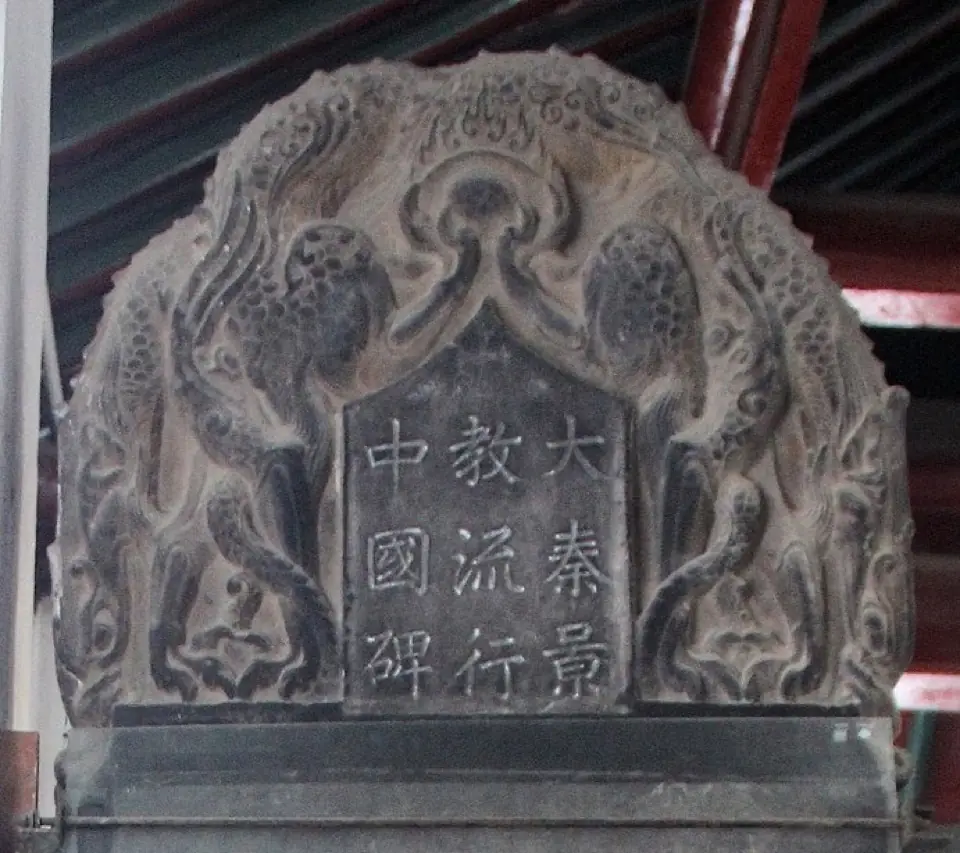
The heading of the “Stele Commemorating the Propagation in China of the Luminous Religion from Daqin”, in Xi’an’s Stele Forest. Erected in AD 781, the second year of the Tang Jianzhong era, it records the arrival of the Church of the East in Chang’an in 635, the ninth year of Zhenguan. It was unearthed in Xi’an in the late Ming period. Source: Xian Stele (detail).jpg, Gary Todd, CC0.

3. The Chinese Church: Suffering and Revival
The Chinese church in the 20th century endured extraordinarily severe trials and also witnessed God's astonishing faithfulness.
The Republican era produced several outstanding Chinese church leaders: Wang Mingdao (1900–1991) was known for his unwavering commitment to biblical truth and his refusal to compromise; he maintained his stand of "we are for the faith" under intense pressure and was imprisoned for more than 20 years. Watchman Nee (Ni Tuosheng, 1903–1972) established the Local Church movement (the "Little Flock"), and his book The Normal Christian Life has influenced Chinese Christians around the world. John Sung (Song Shangjie, 1901–1944) was one of the most powerful Chinese evangelists of the 20th century; his itinerant preaching brought tens of thousands to faith.
After 1949, the Chinese church entered its most severe period of trial. All foreign missionaries were expelled; churches were required to join the "Three-Self Patriotic Movement" (self-governance, self-support, self-propagation); and many church leaders were imprisoned. During the Cultural Revolution (1966–1976), all church activities were banned, Bibles were burned, and believers suffered brutal persecution.
Yet God never abandoned his church. The house churches that continued to meet underground became the lifeline of Chinese Christianity. After the Reform and Opening Up, the Chinese church experienced the most astonishing growth in its history — from an estimated one million Christians before the Cultural Revolution to an estimated tens of millions, or even over a hundred million today (exact figures vary depending on how they are counted). This is one of the most breathtaking testimonies in 20th-century global church history: persecution cannot destroy the church; in suffering, God's grace is displayed all the more abundantly.
4. The Mission of the Overseas Chinese Church
Chinese people are scattered across the world — from Southeast Asia to North America, from Europe to Oceania — and Chinese churches have taken root and grown in their places of sojourn. The overseas Chinese church has a distinctive mission and distinctive challenges:
In pastoral ministry, there is a need to serve Chinese communities of very different backgrounds — older immigrants, international students, professionals, and second-generation members (ABCs, BBCs) growing up in the tension between Chinese and Western cultures. Language transition (Chinese → English → bilingual) and cultural adaptation are ongoing challenges.
In mission, the overseas Chinese church occupies a uniquely strategic position — it can evangelize the Chinese communities in its host country, serve as a bridge to witness to the broader local society and other ethnic groups, and support and participate in mission work back to mainland China and around the world.
Acts 1:8 — "in Jerusalem, in all Judea and Samaria, and to the uttermost parts of the earth" — provides every church, including the overseas Chinese church, with a concentric vision for mission: beginning with the local Chinese community, expanding to the city and nation, and ultimately participating in global mission.
Reflection and Discussion
- Of the four waves of Christianity's entry into China, the first two both declined because they were attached to political power rather than rooted among the people. What does this teach us about the relationship between the church and political authority?
- The resilience of the Chinese church through the suffering of the Cultural Revolution, and its explosive growth afterward, — what encouragement does this give to your faith?
- Whether your church is in China or part of a Chinese-speaking community elsewhere in the world, what do you think its greatest mission and challenge are today?
Chapter 7 — Creeds, Discerning Heresy, and the Unity of the Church
Learning Objectives: Understand the continuing value of the ecumenical creeds (the Apostles' Creed and the Nicene Creed) in the life of the church; develop a basic framework for discerning heresy; and reflect on what church history teaches us about the unity of the church and the transmission of faith in our own time.
1. The Continuing Value of the Creeds
The ecumenical creeds — the Apostles' Creed and the Nicene Creed — are not meant to replace Scripture, but are the church's faithful summary of Scripture's core teaching. The Protestant position is that the authority of the creeds is not equal to Scripture, but the creeds help believers confess their faith together in worship, transmit orthodox doctrine in teaching, and stand firm when facing heresy.
Some ask: "Isn't Scripture enough? Why do we need creeds written by human beings?" This question deserves a serious answer. The principle of Sola Scriptura is correct — Scripture is the supreme authority. But the reformers themselves held the creeds in high regard and used them extensively. Luther wrote catechetical explanations of the creed; Calvin quoted the creeds frequently in the Institutes. The creeds are the distilled essence of faith that the church, guided by the Holy Spirit, drew from Scripture over centuries of discernment and confirmation — they help every generation of believers avoid repeating errors that are as old as the church itself.
2. Discerning Ancient and Modern Heresies
Heresies throughout church history typically deviate from orthodoxy in one or more of the following core areas:
Denying the full divinity of Christ: Arianism held that Christ is a created being, not truly God. Today's Jehovah's Witnesses carry on this position, viewing Christ as a created archangel.
Denying the Trinity: Modalism held that God has only one person, appearing in different modes. Similar teaching occasionally surfaces in some extreme charismatic groups today.
Adding "new revelation" beyond Scripture: Gnosticism claimed to possess secret knowledge surpassing the apostolic tradition. Today, Mormonism claims the Book of Mormon is God's "new revelation"; Shincheonji (the Shincheonji Church of Jesus, the Temple of the Tabernacle of the Testimony) claims its founder Lee Man-hee is the returned Christ.
Denying grace and insisting on salvation by works: Pelagianism held that human beings can attain moral perfection through their own effort. Some modern religious groups tie salvation to strict observance of particular rules.
The most fundamental principle for discerning heresy comes from the apostle John: "Beloved, don't believe every spirit, but test the spirits, whether they are of God" (1 John 4:1). The standard for discernment is always the clear teaching of Scripture — any "revelation" that contradicts Scripture cannot come from God. The church's response across the centuries has been consistent: Sola Scriptura as the supreme authority.
3. Similarities and Differences Among the Three Great Traditions
Through the course of history, Christianity has developed into three great traditions: Roman Catholicism, Eastern Orthodoxy, and Protestantism. Their shared foundation includes: the Triune God, the incarnation and redemption of Christ, and the Apostles' and Nicene Creeds.
Two key historical moments separated them: (1) The Great Schism of 1054, over the Filioque clause and papal authority, which produced Roman Catholicism and Eastern Orthodoxy; (2) The Reformation of 1517, in which Luther and others articulated the Five Solas, giving rise to Protestantism.
The denominational diversity within Protestantism also deserves a proper understanding — Lutheranism, the Reformed tradition, Baptists, Methodists, Anglicans, and others are united in their core convictions, with differences mainly in governance and emphasis. Most Protestant theologians also acknowledge that there are genuine Christians within the Catholic and Orthodox traditions — we do not need to deny others in order to affirm ourselves.
4. The Spiritual Legacy of Church History
Looking back over two thousand years of church history, several recurring spiritual patterns are worth holding in our hearts:
Crisis is often the prelude to revival. The darkest period of the medieval church gave birth to the Reformation; the Chinese church experienced explosive growth after the suffering of the Cultural Revolution. God never abandons his church — "the gates of Hades will not prevail against it" (Matthew 16:18). When the church faces its lowest points, we can draw confidence and hope from history.
Power without accountability inevitably leads to corruption. The medieval papacy gradually expanded from "first among equals" to absolute authority, ultimately producing serious corruption. Healthy church governance requires collective leadership, transparent decision-making, and mutual accountability.
Faithful transmission of faith requires three elements. The most successful examples of faith transmission in church history all include: solid biblical teaching (as the reformers prioritized catechetical education), authentic living examples (the witness of spiritual forebears), and space and opportunity for the next generation to encounter God personally.
5. The Call to Church Unity
The Lord Jesus prayed for the church in John 17:21: "that they may all be one." The unity of the church is not organizational uniformity, but union in truth and love.
Jude 1:3 urges us to "contend earnestly for the faith which was once for all delivered to the saints." This reminds us that holding to truth is the prerequisite for church unity — unity without a foundation in truth is only a false peace. At the same time, the call to unity also invites us to treat with humility and love those brothers and sisters who differ from us on secondary matters.
Perhaps the most precious lesson church history leaves us is this: God's faithfulness is greater than human failure. Over two thousand years, the church has endured persecution, division, corruption, and the erosion of heresy — yet God has always watched over his church, causing her to stand through storms and shine in the darkness. We, too, stand in this long chain of faith transmission — from the apostles to the Church Fathers, from the reformers to the missionaries, from the martyrs to you and me. Let us faithfully take up the baton and live out the witness of Christ in our generation.
Reflection and Discussion
- Faced with the many heresies and false teachings of our day, in what area do you think the church most needs to be better equipped?
- The pattern in church history of "crisis becoming the prelude to revival" — what encouragement does this give you in facing present difficulties?
- "God's faithfulness is greater than human failure" — looking back over two thousand years of church history, which period moves you most deeply?
Conclusion
Two thousand years of church history is a story of God's faithful care for his people. From the fire of the Holy Spirit's descent at Pentecost, to the blood of martyrs in the Roman arenas; from the monks quietly preserving ancient manuscripts in the scriptorium, to the world-changing Ninety-Five Theses on the Wittenberg church door; from Wesley's open-air preaching across the English countryside, to the resilience and explosive growth of China's house churches through suffering — every page is filled with God's faithfulness.
The church is not perfect — she is made up of sinners and has made many mistakes throughout history. But the Head of the church, Christ, is perfect; and he has promised to be with his church to the very end of the age.
We study church history not to satisfy curiosity, but to draw strength from the faith witness of those who came before us, to learn from their failures, and to know more deeply the God who reigns over history. May our generation, like "a cloud of witnesses surrounding us" (Hebrews 12:1), run faithfully the race God has set before us.
"Jesus Christ is the same yesterday, today, and forever." (Hebrews 13:8)
📝 This guide accompanies the relevant section of Scripture Trove Quiz Challenge, Level 3: Ministry Equipping. After reading, try the questions to reinforce what you have learned.