Jesus—Did He Really Exist in History?
"Seeing that many have undertaken to set in order a narrative concerning those matters which have been fulfilled among us, even as they delivered them to us, who from the beginning were eyewitnesses and servants of the word, it seemed good to me also, having traced the course of all things accurately from the first, to write to you in order, most excellent Theophilus." (Luke 1:1-3)
I. "Did Jesus Really Exist?"
This is a genuine question in some people's hearts. Some think Jesus is like Zeus in Greece or Pangu in Chinese legend: a figure invented within a religious culture, with no historical basis.
If that is what you think, this article may surprise you.
The fact is this: among serious historians, "Did Jesus exist?" is hardly a matter of debate. The great majority of scholars of the ancient world (including those who are not Christians) acknowledge that in first-century Palestine there really was a Jew named Jesus, who taught, gathered a band of disciples, and was crucified during the time Pontius Pilate governed.
Of course, "He existed" and "He is the Son of God" are two different questions, and the latter is a matter of faith. But the former (His historical existence) rests on very solid evidence. Let us look at it.
II. Ancient Evidence from Outside Christianity
One of the most persuasive kinds of evidence is the testimony of non-Christian sources about Jesus, because these writers had no motive to "speak well of Christianity."
1. Tacitus: one of the most important historians of the Roman Empire. In his Annals, written around AD 116, he records Emperor Nero's persecution of Christians in AD 64 and explains where the name "Christians" came from:
"They take their name from 'Christ' (Christus), who was executed in the reign of Tiberius by the provincial governor Pontius Pilate."
A Roman historian with no sympathy for Christianity independently confirms that a man called "Christ" was put to death under Pilate.
2. Josephus: a Jewish historian. In his Antiquities of the Jews, written around AD 93, he mentions Jesus in two places. The most famous passage (known as the Testimonium Flavianum) may have been touched up by later Christian copyists, but scholars generally agree that the original version did mention Jesus as a wise man who did remarkable deeds, who was condemned to the cross by Pilate, and whose disciples continued to follow Him after His death. The other passage refers to "James, the brother of Jesus who was called Christ," and this one is almost uncontested.
3. Pliny the Younger: a Roman governor. In a letter to Emperor Trajan around AD 112, he reported how he had dealt with Christians: these people "met on a fixed day before dawn and sang hymns to Christ as to a god." Although this does not directly describe Jesus, it independently confirms that less than a hundred years after Jesus' death, large numbers of people were already worshipping Him as God, and such a phenomenon needs a historical starting point.
There are other sources as well: the Roman historian Suetonius, the Syrian philosopher Mara bar Serapion, and the Jewish tradition recorded in the Talmud all refer, from different angles, to Jesus or the early Christian movement. There is no possibility that they colluded, yet they point to the same fact: this man really lived.
III. The Historical Value of the New Testament Itself
Some may say, "You can't use the Bible to prove the Bible." That sounds reasonable, but it confuses one thing.
The New Testament is not "one book." It is 27 separate documents, written by different authors, in different places and at different times, including letters, biographies, and historical narrative. Gathering them into "one book" was something the church did later. In historical study, these 27 documents should be evaluated one by one, while also taking into account the connections in their material, such as the material shared by the three Synoptic Gospels of Matthew, Mark, and Luke.
And the historical quality of these documents is quite high.
When Luke wrote his Gospel, he stated his method right at the start: he had "traced the course of all things accurately from the first" and wrote them down in order (Luke 1:3). In Luke 3:1-2 he anchors the beginning of Jesus' ministry precisely to a series of verifiable historical markers: the fifteenth year of Tiberius, Pontius Pilate governor of Judea, Herod tetrarch of Galilee... This is not how myth is written, but how historical narrative is written.
Paul's letters were written only 20 to 30 years after Jesus' death. In 1 Corinthians 15:3-8, he lists the eyewitnesses of the resurrection (including "above five hundred brothers at once") and says "of whom the greater part remain until now," which is as good as saying to his readers, "If you don't believe me, you can go and ask them." Someone making up a story would not invite readers to check it out like this.
IV. Corroboration from Archaeology
Beyond the written sources, archaeology also provides physical evidence, bringing the people and settings of the Gospels off the page and back into the real world:
The Pilate Inscription. In 1961, archaeologists found a limestone inscription in the ruins of a theater at Caesarea, bearing the name "Pontius Pilatus, Prefect of Judea." It was the first physical evidence outside the Bible, independently confirming the existence of the Roman governor who sentenced Jesus to death.
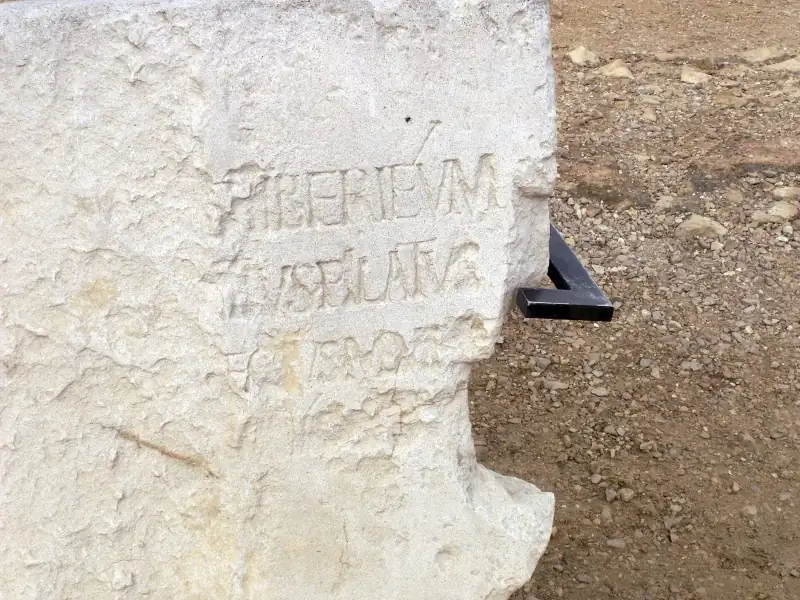
A replica of the Pilate Stone displayed at the Caesarea site. The original was unearthed there in 1961 and is now kept in the Israel Museum; its Latin inscription includes the words "Pontius Pilatus" and "Prefect of Judea." Source: Pilate Inscription.JPG, Marion Doss, CC BY-SA 2.0. See this exhibit in the Bible Museum

The Caiaphas Ossuary. In 1990, a finely carved limestone ossuary (bone box) was unearthed in southern Jerusalem, inscribed "Joseph, son of Caiaphas." It very probably belonged to the family of the high priest Caiaphas; John's Gospel records that Annas sent the bound Jesus to Caiaphas (John 18:24).
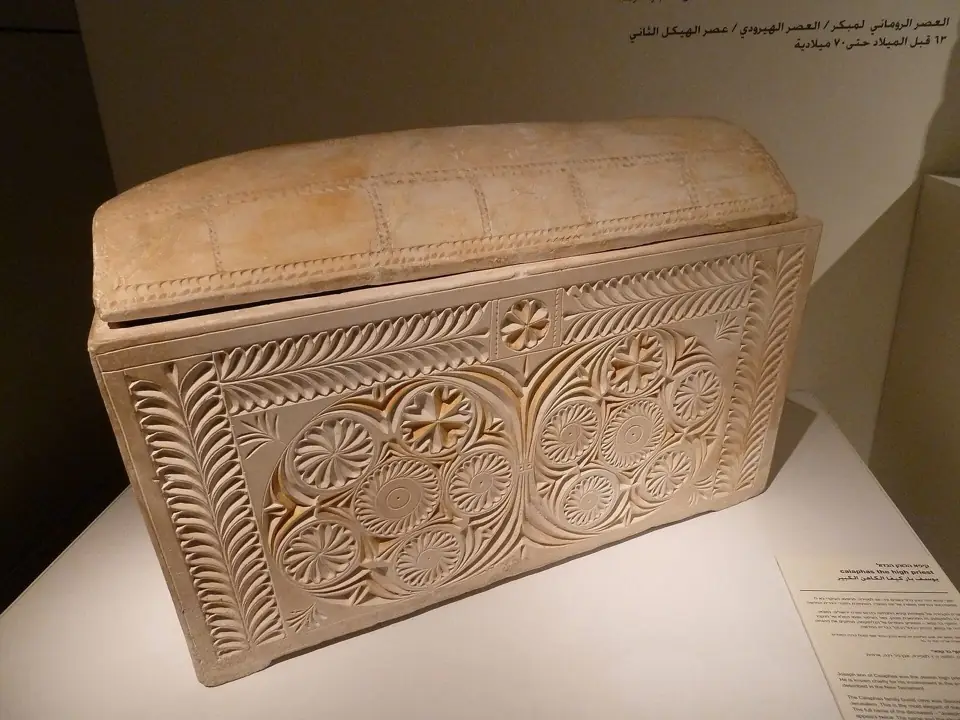
An ossuary unearthed in 1990 in the southern part of Jerusalem, with the inscription "Joseph son of Caiaphas" on its side; held by the Israel Museum. Source: Ossuary of the high priest Joseph Caiaphas P1180839.JPG, deror_avi, CC BY-SA 3.0. See this exhibit in the Bible Museum

Nail marks. Archaeologists have found the remains of a first-century man put to death by being nailed to a cross, confirming the method of execution described in the Gospels (John 20:25).
Cities and buildings. The Pool of Bethesda mentioned in John 5:2, the Pool of Siloam in John 9:7, and the synagogue at Capernaum (Mark 1:21) have all been excavated and confirmed. The official titles Luke uses for various places in Acts (proconsul, Asiarch, city magistrate) have also been confirmed one by one by inscriptions unearthed. (For more detail, see How the Bible Reached Us.)
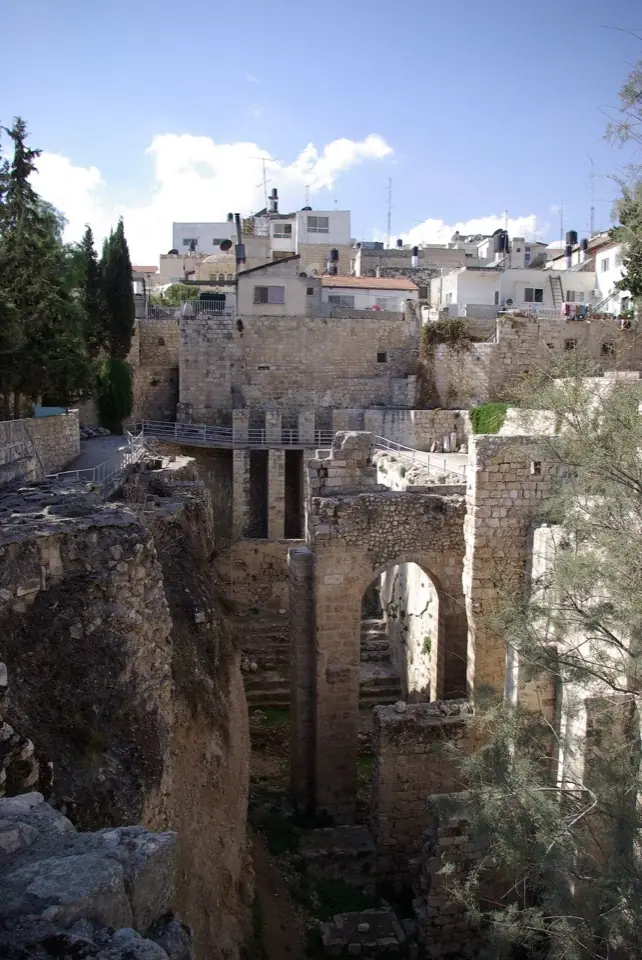
The site of the Pool of Bethesda in Jerusalem. The excavated twin pools and colonnade remains match John 5:2: "having five porches." Source: Jerusalem Bethesda BW 1.JPG, Berthold Werner, public domain. See this exhibit in the Bible Museum

These are not "evidences of faith"; they are evidences of history. They cannot prove that Jesus is the Son of God, but they do show that the Gospels were not made up out of thin air: their authors were describing a real time, real places, and real people.
V. No One Denied That He Existed
Perhaps the most persuasive point of all is this: in the ancient world, no one (including the people most hostile to Christianity) ever said, "Jesus did not exist."
The Jews denied that Jesus was the Messiah, but never that the man existed. The Romans mocked the Christian faith, yet never questioned the existence of Christ himself. The early church's critics attacked Christian teaching on every front, but not one of them put forward the simplest and deadliest rebuttal: "There never was a Jesus."
If Jesus had never existed, this would have been the easiest and strongest argument against Christianity. Yet in those years closest to the events, when people were best placed to check, no one said it. That in itself is very strong indirect evidence.
VI. The Real Question Is Not "Did He?" but "Who Is He?"
So the evidence for Jesus' historical existence is quite sufficient. Bart Ehrman, a contemporary historian who is not a Christian and is known for his critical stance, also writes plainly: "Jesus certainly existed, whether we like it or not... Nearly every scholar of antiquity, Christian or non-Christian, agrees on this."
So the real question has never been "Did this man exist?" but "Who exactly is this man?" Only a good teacher? A revolutionary? A prophet? Or (as He Himself claimed) the Son of God and the Savior of the world?
History can tell you that He existed, that He was crucified, and that His disciples, after His death, proclaimed that He had risen, and were willing to die for that claim. But the question "Who is He, really?" is one you must face for yourself: read the Gospels, learn what He said and did, and think about what His death and resurrection mean.
That Jesus of Nazareth, who really lived, is still waiting today for you to face Him seriously.
Conclusion
Dear friend, if you once thought Jesus was only a religious legend, the evidence today may lead you to think again. He is not a mythical figure but a man who truly walked the dusty roads of Palestine in the first century AD, a historical figure recorded in Roman writings, corroborated by Jewish sources, and handed down in a great number of manuscripts.
History provides evidence for His existence, but history cannot make a decision for you: who is this Jesus who really lived? What does He mean for your life?
I invite you to carry this question with you and keep going. In the articles that follow, we will look more deeply at His life and ministry.
Let us pray together:
God, thank you for letting me know that Jesus is not a fictional figure but a real person who lived in history. Help me not to stop at "knowing He existed," but to ask earnestly the deeper question: who is He, really? If He truly is your Son and the Savior of the world, then what does this have to do with me? Give me courage and honesty to face this question seriously. In the name of the Lord Jesus I pray, amen.
📖 "The Gospel" Series · 12 Articles
- The Gospel Is the Power of God
- The Gospel Saves Everyone Who Believes
- The Gospel Is the Good News About Jesus Christ
- Jesus—The Messiah Promised in the Old Testament
- Jesus—Did He Really Exist in History? (This Article)
- Jesus—Born of a Virgin: Is It Believable?
- Jesus—Three and a Half Years That Changed the World
- Jesus—Died on the Cross for Our Sins
- Jesus—Declared the Son of God with Power by His Resurrection from the Dead
- Jesus—Is the Resurrection Believable?
- Jesus—Gave Us the Holy Spirit to Be with Us
- Jesus—The King Who Will Come Again to Judge the Earth
This article may be freely reproduced, printed, and used as material for sermons or training, without asking the author's permission; for commercial publication, please contact the author first.